
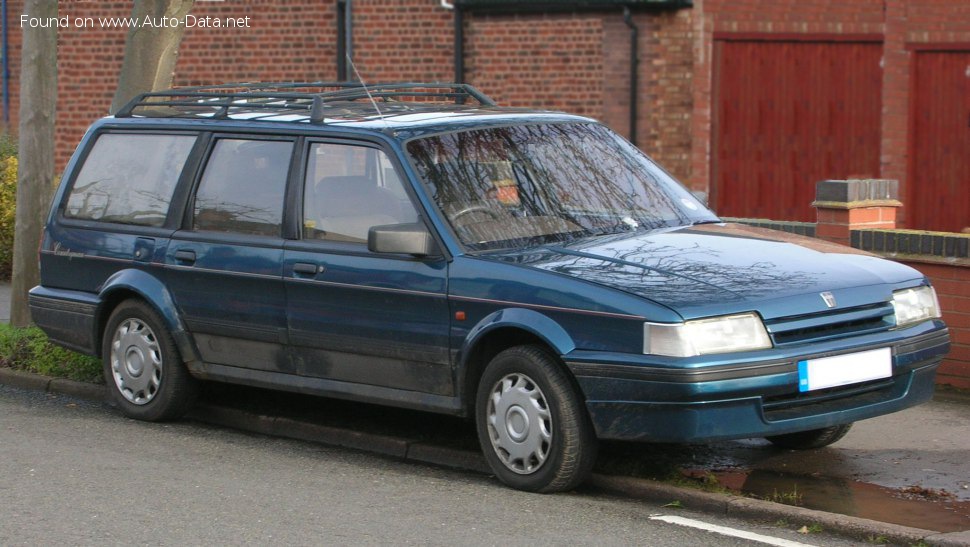
The Rover Montego Estate (XE) 2.0 GTI/LXI (102 Hp), produced between 1990 and 1993, represents a significant chapter in the history of the British automotive manufacturer, Rover. Positioned as a mid-size family station wagon, or “estate” as it was known in its primary European market, this particular iteration of the Montego aimed to offer a blend of practicality, comfort, and a touch of upscale refinement. While never officially sold in the United States, the Montego Estate played a crucial role in the European D-segment, competing against established rivals by offering a spacious interior and a dependable powertrain for families and business users alike.
The Rover Montego Estate (XE) 2.0 GTI/LXI: A British Family Workhorse
Genesis and Market Position
The Rover Montego’s lineage traces back to the Austin Rover Group, a conglomerate formed from the remnants of British Leyland. Launched initially in 1984 as a saloon (sedan) and shortly after as an estate, the Montego was designed to replace the aging Austin Ambassador and Morris Ital. By 1990, when the XE generation’s 2.0 GTI/LXI variant commenced production, Rover had begun to shed some of its troubled past, aiming for improved quality and a more premium image under the Rover brand. The Montego Estate (XE) 2.0 GTI/LXI was specifically tailored for the European family market, where station wagons were, and remain, immensely popular. It provided a practical, five-door, five-seat configuration, making it an ideal choice for transporting families, luggage, and even small businesses requiring ample cargo space. The “GTI/LXI” designation, while perhaps suggesting a sportier intent with “GTI,” also pointed to higher trim levels, indicating a focus on features and comfort for the discerning buyer.
Engine and Performance Overview
At the heart of the Rover Montego Estate (XE) 2.0 GTI/LXI was a naturally aspirated 2.0-liter gasoline (petrol) engine, delivering a respectable 102 horsepower. This powertrain architecture, relying on internal combustion, was a conventional choice for its era, prioritizing reliability and smooth power delivery over outright speed. For a family station wagon weighing in at a practical, rather than performance-oriented, class, 102 HP was considered adequate, providing sufficient grunt for highway cruising and comfortable city driving. The engine was designed for efficiency and longevity, consuming standard gasoline and featuring an engine oil capacity of 4.9 liters (approximately 5.18 US quarts). The cooling system, with a capacity of 8.5 liters (around 8.98 US quarts), was robust enough to handle varying driving conditions, ensuring engine stability. While the “GTI” moniker might have evoked images of hot hatches, in the Montego Estate, it more likely denoted a higher-specification engine within the range, perhaps with fuel injection (though not explicitly stated, common for GTI variants of the era) and a focus on refined power for its segment rather than raw acceleration.
Design and Features
The Rover Montego Estate (XE) was a quintessential station wagon of its time, designed with practicality at its core. Its five-door body type offered excellent accessibility to both the passenger compartment and the substantial cargo area. With seating for five occupants, the Montego Estate provided comfortable accommodation for a family, while the rear load space was a key selling point, offering versatility for everything from grocery runs to holiday luggage. The design language, while perhaps conservative by today’s standards, was functional and aimed for a sense of understated elegance that Rover was keen to cultivate. The exterior featured clean lines and a relatively upright stance, maximizing interior volume. For the LXI trim, features would likely have included more luxurious interior materials, possibly electric windows, central locking, and improved audio systems, all contributing to a more refined driving and passenger experience. Safety features of the era would have been basic compared to modern vehicles but would have included standard seatbelts and potentially improved braking systems for higher trims. The Montego Estate’s strength lay in its ability to blend everyday usability with a touch of British comfort, making it a popular choice among those who valued space and practicality.
Technical Specifications of the Rover Montego Estate (XE) 2.0 GTI/LXI (102 Hp)
| Category | Specification |
|---|---|
| Brand | Rover |
| Model | Montego |
| Generation | Montego Estate (XE) |
| Type (Engine) | 2.0 GTI/LXI (102 Hp) |
| Start of Production | 1990 year |
| End of Production | 1993 year |
| Powertrain Architecture | Internal Combustion engine |
| Body Type | Station wagon (estate) |
| Seats | 5 |
| Doors | 5 |
| Fuel Type | Petrol (Gasoline) |
| Power | 102 Hp |
| Engine Aspiration | Naturally aspirated engine |
| Engine Oil Capacity | 4.9 l (5.18 US qt | 4.31 UK qt) |
| Coolant Capacity | 8.5 l (8.98 US qt | 7.48 UK qt) |
| Fuel Tank Capacity | 50 l (13.21 US gal | 11 UK gal) |
Legacy and Market Impact
The Rover Montego Estate (XE) 2.0 GTI/LXI, along with its stablemates, holds a unique place in automotive history, particularly within the context of the British car industry. In its primary European market, especially the United Kingdom, it was a common sight on roads throughout the late 1980s and early 1990s. It competed fiercely in the D-segment against formidable rivals such as the Ford Sierra Estate, Vauxhall Cavalier Estate (Opel Ascona/Vectra in continental Europe), and the Peugeot 405 Estate. While it might not have achieved the same sales volumes or critical acclaim as some of its competitors, the Montego Estate offered a compelling package for those seeking a practical, spacious, and relatively affordable family car with a British badge.
Its reputation was somewhat mixed. On one hand, it was praised for its comfortable ride, spacious interior, and decent luggage capacity. The 2.0-liter engine, while not exhilarating, provided reliable and economical performance suitable for its intended purpose. On the other hand, the Montego, like many Austin Rover products of its era, sometimes struggled with perceptions of build quality and reliability issues, a lingering shadow from British Leyland’s past. However, by the XE generation, many of these issues had been addressed, leading to a more robust and dependable vehicle.
The Montego Estate’s historical significance lies in its representation of Rover’s efforts to modernize and compete in a highly competitive market. It was one of the last truly mass-produced, mainstream family cars designed and built primarily in Britain before the industry underwent significant restructuring and foreign ownership. Today, the Rover Montego Estate is remembered by enthusiasts and former owners as a practical, unpretentious workhorse that served countless families across Europe. While it never achieved iconic status, its legacy is that of a dependable, if sometimes understated, vehicle that played a vital role in everyday life, embodying the practicality and functionality that defined the station wagon segment of its era. For an automotive expert, it provides a fascinating case study of a brand navigating a challenging economic and competitive landscape, striving to deliver a competent product against formidable international rivals.

