
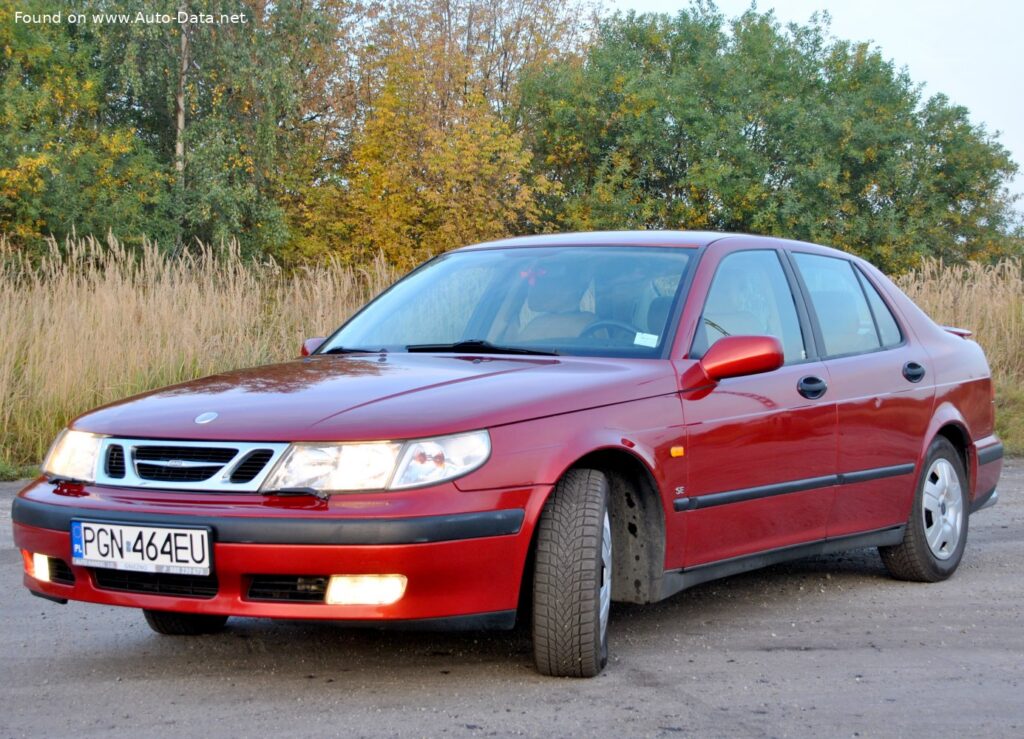
The Saab 9-5, a quintessential executive car from the Swedish automaker, represented a significant evolution in the brand’s commitment to safety, innovation, and distinctive design. Introduced in 1997 as a replacement for the long-running Saab 9000, the first-generation 9-5 quickly established itself in the competitive European premium segment, offering a unique, intellectually driven alternative to its more conventional German rivals. This particular variant, the Saab 9-5 2.3i T (170 Hp) Automatic, produced between 1998 and 2001, showcased Saab’s characteristic blend of turbocharged performance, ergonomic design, and advanced safety features, all wrapped in a practical and stylish sedan body. While its primary market was Europe, its design philosophy and mechanical underpinnings were indicative of Saab’s global aspirations, sharing much with models available in North America. The 9-5 aimed to provide a sophisticated driving experience with a strong focus on real-world usability, passenger comfort, and a unique Scandinavian flair, embodying the brand’s “born from jets” philosophy through its emphasis on aerodynamics and driver-centric controls. Its appeal lay in its thoughtful engineering and a distinct personality that set it apart in a crowded market.
The Saab 9-5 2.3i T (170 Hp) Automatic: Engineering and Performance
At the heart of the Saab 9-5 2.3i T (170 Hp) Automatic lies a robust and characterful 2.3-liter (2290 cm3 or 139.74 cu. in.) inline-four engine, designated as the B235E. This powerplant is a prime example of Saab’s long-standing expertise in forced induction, utilizing a precisely calibrated turbocharger to extract impressive performance from a relatively modest displacement. The engine delivers a respectable 170 horsepower at 5500 rpm, a figure that provides ample motivation for the executive sedan, allowing for confident overtaking and effortless highway cruising. More significantly, it produces a stout 206.52 lb.-ft. of torque at a remarkably low 1800 rpm. This broad, accessible torque band is a hallmark of Saab’s turbocharged engines, ensuring strong, immediate acceleration from low engine speeds, minimizing the need to rev the engine excessively and contributing to a relaxed yet responsive driving experience.
The B235E engine features a DOHC (Double Overhead Camshaft) valvetrain with four valves per cylinder, contributing to efficient breathing and optimized power delivery across the rev range. Fuel is supplied via a multi-port manifold injection system, precisely managed to optimize combustion, fuel economy, and emissions. With a compression ratio of 9.3:1, the engine is designed to balance performance with long-term durability, a key consideration for a premium vehicle. Power is channeled to the front wheels through a smooth-shifting 4-speed automatic transmission, a common choice for premium vehicles of its era, prioritizing comfort and ease of driving in varying conditions. This powertrain architecture, with its front-transverse engine layout, underpins the vehicle’s front-wheel-drive configuration, offering predictable handling characteristics and reliable traction, especially important in diverse European climates.
In terms of outright performance, the Saab 9-5 2.3i T (170 Hp) Automatic delivers a commendable showing for a car of its size and segment. It accelerates from 0 to 60 mph in an estimated 9.4 seconds, with the 0-100 km/h sprint achieved in 9.9 seconds. The maximum speed is rated at 136.7 mph (220 km/h), demonstrating its capability for sustained high-speed highway cruising, a common requirement in its European market. Despite its performance capabilities, Saab also aimed for a reasonable balance of fuel efficiency. The urban fuel consumption is rated at 15.6 US mpg, while extra-urban driving yields a more impressive 30.2 US mpg. These figures, while perhaps not outstanding by today’s hybrid standards, were competitive for a turbocharged premium sedan in the late 1990s, especially considering the vehicle’s substantial curb weight of 3328.98 lbs. (1510 kg). The weight-to-power ratio stands at 8.9 kg/Hp, or 112.6 Hp/tonne, while the weight-to-torque ratio is 5.4 kg/Nm, or 185.4 Nm/tonne, highlighting a strong emphasis on torque delivery relative to its mass, crucial for its executive car role.
Design and Features of the Saab 9-5 Sedan
The Saab 9-5 sedan, with its distinctive body type, embodies the brand’s unique design language, characterized by clean lines, a purposeful stance, and an aerodynamic profile that was meticulously honed for efficiency and stability. Measuring 189.17 inches (4805 mm) in length, 70.55 inches (1792 mm
