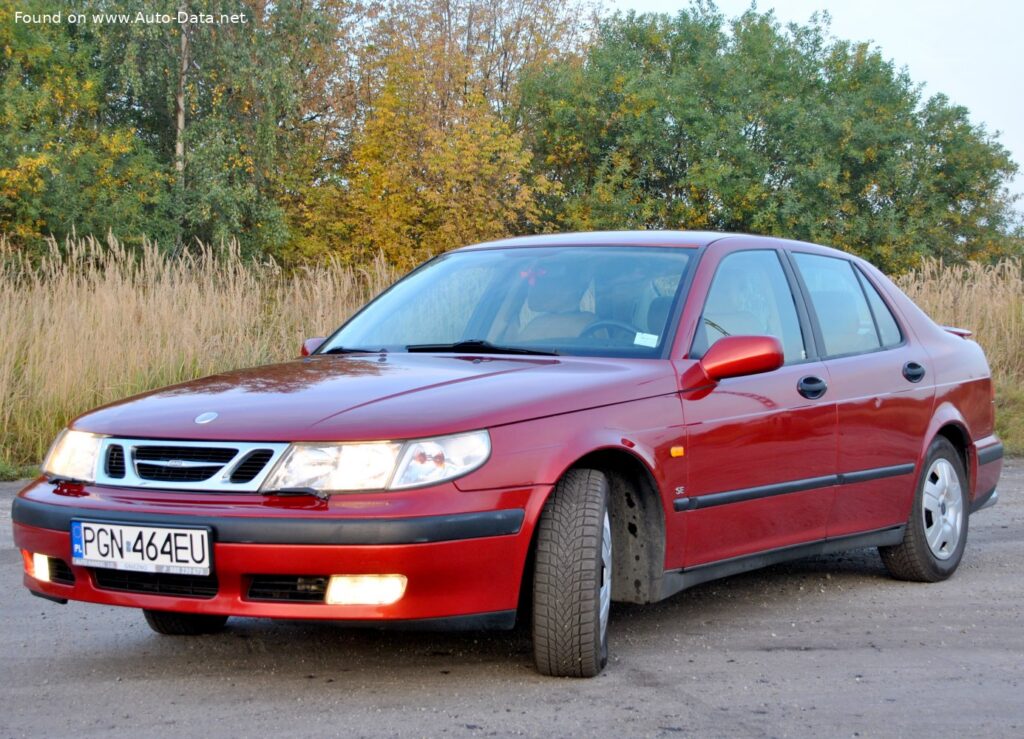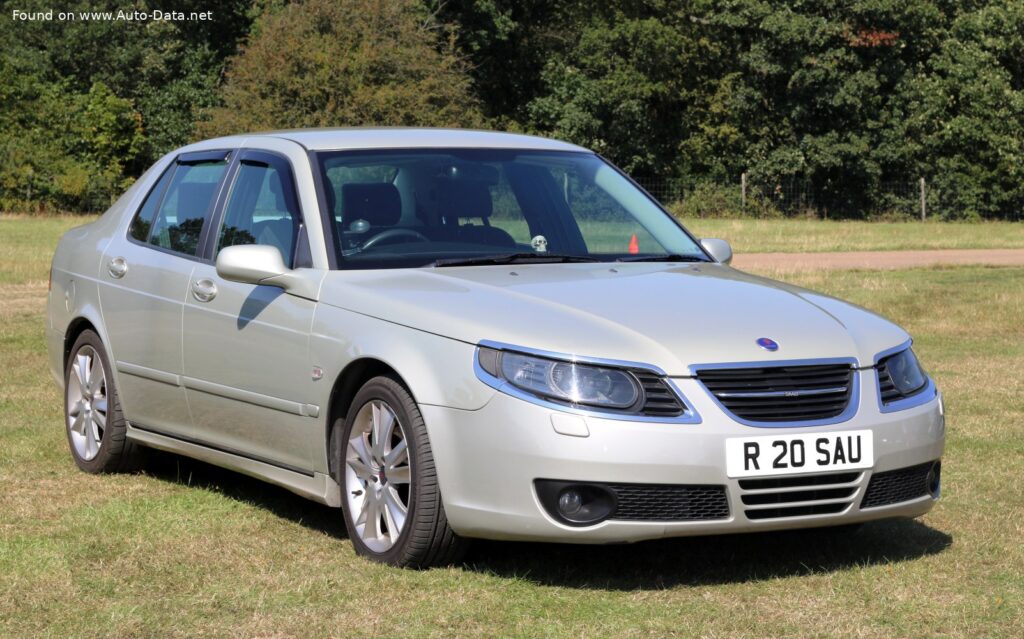
The 2005 facelift of the Saab 9-5 marked a significant evolution for the Swedish automaker’s executive sedan, a model renowned for its unique blend of Scandinavian design, aviation-inspired ergonomics, and a steadfast commitment to safety. Positioned in the competitive premium mid-size segment, the Saab 9-5 (facelift 2005) aimed to refresh its appeal while retaining the core values that distinguished the brand. This particular iteration, featuring the 1.9 TiD (150 Hp) Automatic powertrain, was a crucial offering primarily for the European market, where diesel engines held a substantial share due to their efficiency and torque characteristics. While Saab’s presence in the United States often centered on its turbocharged gasoline engines, the 1.9 TiD variant underscored the brand’s adaptability to diverse global market demands, offering a compelling blend of performance and economy for its time. The facelift, often colloquially referred to as the “Dame Edna” due to its distinctive headlamp design, sought to modernize the vehicle’s aesthetic while building upon the robust engineering of its predecessor, produced from 2005 until 2009.
Engine and Performance of the Saab 9-5 (facelift 2005)
At the heart of this particular Saab 9-5 (facelift 2005) variant lies the 1.9-liter TiD (Turbocharged Intercooled Diesel) engine, a robust and efficient four-cylinder unit designed to deliver a balanced driving experience. Designated with the engine code Z19DTH, this powerplant features an inline configuration with a displacement of 1910 cubic centimeters (116.56 cubic inches). It employs a Double Overhead Camshaft (DOHC) valvetrain with four valves per cylinder, a setup that enhances breathing efficiency and power delivery across the rev range. The engine’s aspiration system is a sophisticated combination of a turbocharger and an intercooler, crucial for maximizing power output and fuel efficiency by compressing and cooling the intake air. Fuel is delivered via a common rail diesel injection system, a technology that allows for precise control over fuel atomization and injection timing, contributing to smoother operation, reduced emissions, and improved economy.
The 1.9 TiD engine generates a commendable 150 horsepower at 4000 revolutions per minute, translating to a specific output of 78.5 horsepower per liter. More impressively for a diesel, it produces a substantial 320 Newton-meters (236.02 lb-ft) of torque, available across a broad and usable band from 2000 to 2750 rpm. This ample torque, characteristic of modern diesel engines, provides strong acceleration from low speeds and effortless cruising capabilities. Mated to a 5-speed automatic transmission, the powertrain architecture drives the front wheels, offering a smooth and predictable driving dynamic. Performance figures for this model include an acceleration from 0 to 60 miles per hour in a respectable 10.5 seconds, with a top speed reaching 127.38 miles per hour (205 km/h). These figures position the 9-5 1.9 TiD as a capable performer in its class, adept at both urban commuting and long-distance highway travel.
Fuel efficiency was a key selling point for this diesel variant, particularly in markets where fuel costs were a significant consideration. The combined fuel consumption, measured under the NEDC (New European Driving Cycle) standard, stands at 7.4 liters per 100 kilometers, which translates to an impressive 31.8 US miles per gallon (38.2 UK mpg). Urban driving yields 10.2 l/100 km (23.1 US mpg), while extra-urban cruising significantly improves to 5.7 l/100 km (41.3 US mpg). In terms of environmental responsibility for its era, the vehicle met the Euro 4 emission standard and produced CO2 emissions of 199 grams per kilometer. Furthermore, the inclusion of a particulate filter was an advanced feature for the time, helping to reduce harmful emissions and align with evolving environmental regulations.
Design and Features of the Saab 9-5 Sedan
The 2005 facelift brought a refreshed aesthetic to the Saab 9-5, updating its visual identity while maintaining the brand’s distinctive design philosophy. The car retained its classic sedan body type, featuring four doors and seating for five occupants, emphasizing practicality and passenger comfort. The most noticeable changes were concentrated at the front, with a redesigned front fascia, more aggressive headlights, and a revised grille that gave the car a more contemporary and assertive stance. The rear also received subtle updates to the taillights, ensuring a cohesive and modernized look.
Dimensionally, the Saab 9-5 facelift measured 190.39 inches (4836 mm) in length, 70.55 inches (1792 mm) in width (81.5 inches or 2070 mm including mirrors), and 57.01 inches (1448 mm) in height. Its wheelbase of 106.42 inches (2703 mm) contributed to a stable ride and generous interior space. The minimum turning circle of 35.43 feet (10.8 meters) provided reasonable maneuverability in urban environments. Inside, Saab’s aviation heritage was evident in the driver-focused cockpit, featuring an ergonomic layout and the signature “Night Panel” function, which allowed the driver to dim all non-essential instrument lighting for reduced distraction during night driving. The trunk offered a substantial 17.66 cubic feet (500 liters) of cargo space, making the 9-5 a practical choice for families and business travelers alike. The fuel tank capacity was a generous 19.81 US gallons (75 liters), providing an excellent cruising range, especially with the efficient diesel engine.
Safety remained a paramount consideration for Saab, and the 9-5 was engineered with a robust chassis and comprehensive safety systems. Standard assisting systems included ABS (Anti-lock Braking System), enhancing braking control under challenging conditions. The car featured an independent McPherson strut front suspension with a transverse stabilizer, paired with an independent multi-link rear suspension, also with a transverse stabilizer. This setup provided a comfortable ride quality and predictable handling characteristics. Braking duties were handled by 308 mm ventilated discs at the front and 286 mm solid discs at the rear, ensuring strong stopping power. The steering system was a hydraulic rack and pinion setup, offering direct feedback to the driver. The vehicle was equipped with 215/55 R16 or 225/45 R17 tires, mounted on 6.5J x 16 or 7J x 17 wheel rims respectively, providing a balance of grip and ride comfort. The Saab 9-5 (facelift 2005) 1.9 TiD Automatic, therefore, represented a complete package, blending distinctive design, solid performance, excellent fuel economy for its time, and Saab’s legendary commitment to safety and driver engagement.
Technical Specifications for the Saab 9-5 (facelift 2005) 1.9 TiD Automatic
| Brand | Saab |
| Model | 9-5 |
| Generation | 9-5 (facelift 2005) |
| Type (Engine) | 1.9 TiD (150 Hp) Automatic |
| Start of production | 2005 year |
| End of production | 2009 year |
| Powertrain Architecture | Internal Combustion engine |
| Body type | Sedan |
| Seats | 5 |
| Doors | 4 |
| Fuel consumption (economy) – urban (NEDC) | 10.2 l/100 km (23.1 US mpg) |
| Fuel consumption (economy) – extra urban (NEDC) | 5.7 l/100 km (41.3 US mpg) |
| Fuel consumption (economy) – combined (NEDC) | 7.4 l/100 km (31.8 US mpg) |
| CO2 emissions (NEDC) | 199 g/km |
| Fuel Type | Diesel |
| Acceleration 0 – 100 km/h | 11 sec |
| Acceleration 0 – 62 mph | 11 sec |
| Acceleration 0 – 60 mph (Calculated by Auto-Data.net) | 10.5 sec |
| Maximum speed | 205 km/h (127.38 mph) |
| Emission standard | Euro 4 |
| Power | 150 Hp @ 4000 rpm. |
| Power per liter | 78.5 Hp/l |
| Torque | 320 Nm @ 2000-2750 rpm. (236.02 lb.-ft. @ 2000-2750 rpm.) |
| Engine layout | Front, Transverse |
| Engine Model/Code | Z19DTH |
| Engine displacement | 1910 cm3 (116.56 cu. in.) |
| Number of cylinders | 4 |
| Engine configuration | Inline |
| Cylinder Bore | 82 mm (3.23 in.) |
| Piston Stroke | 90.4 mm (3.56 in.) |
| Number of valves per cylinder | 4 |
| Fuel injection system | Diesel Commonrail |
| Engine aspiration | Turbocharger, Intercooler |
| Valvetrain | DOHC |
| Engine oil capacity | 4.3 l (4.54 US qt | 3.78 UK qt) |
| Coolant | 7.4 l (7.82 US qt | 6.51 UK qt) |
| Engine systems | Particulate filter |
| Trunk (boot) space – minimum | 500 l (17.66 cu. ft.) |
| Fuel tank capacity | 75 l (19.81 US gal | 16.5 UK gal) |
| Max. roof load | 100 kg (220.46 lbs.) |
| Permitted trailer load with brakes (12%) | 1800 kg (3968.32 lbs.) |
| Permitted trailer load without brakes | 750 kg (1653.47 lbs.) |
| Length | 4836 mm (190.39 in.) |
| Width | 1792 mm (70.55 in.) |
| Width including mirrors | 2070 mm (81.5 in.) |
| Height | 1448 mm (57.01 in.) |
| Wheelbase | 2703 mm (106.42 in.) |
| Front track | 1522 mm (59.92 in.) |
| Rear (Back) track | 1528 mm (60.16 in.) |
| Front overhang | 1031 mm (40.59 in.) |
| Rear overhang | 1102 mm (43.39 in.) |
| Minimum turning circle (turning diameter) | 10.8 m (35.43 ft.) |
| Drivetrain Architecture | The Internal combustion engine (ICE) drives the front wheels of the vehicle. |
| Drive wheel | Front wheel drive |
| Number of gears and type of gearbox | 5 gears, automatic transmission |
| Front suspension | Independent type McPherson, Transverse stabilizer |
| Rear suspension | Independent multi-link suspension, Transverse stabilizer |
| Front brakes | Ventilated discs, 308 mm |
| Rear brakes | Disc, 286 mm |
| Assisting systems | ABS (Anti-lock braking system) |
| Steering type | Steering rack and pinion |
| Power steering | Hydraulic Steering |
| Tires size | 215/55 R16; 225/45 R17 |
| Wheel rims size | 6.5J x 16; 7J x 17 |