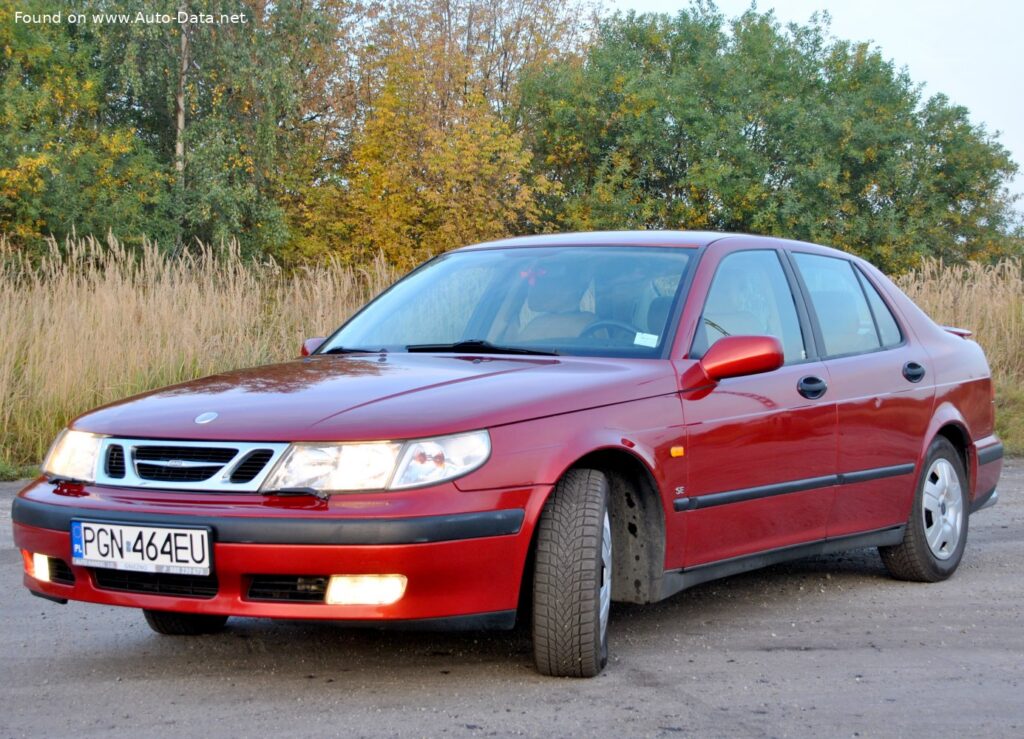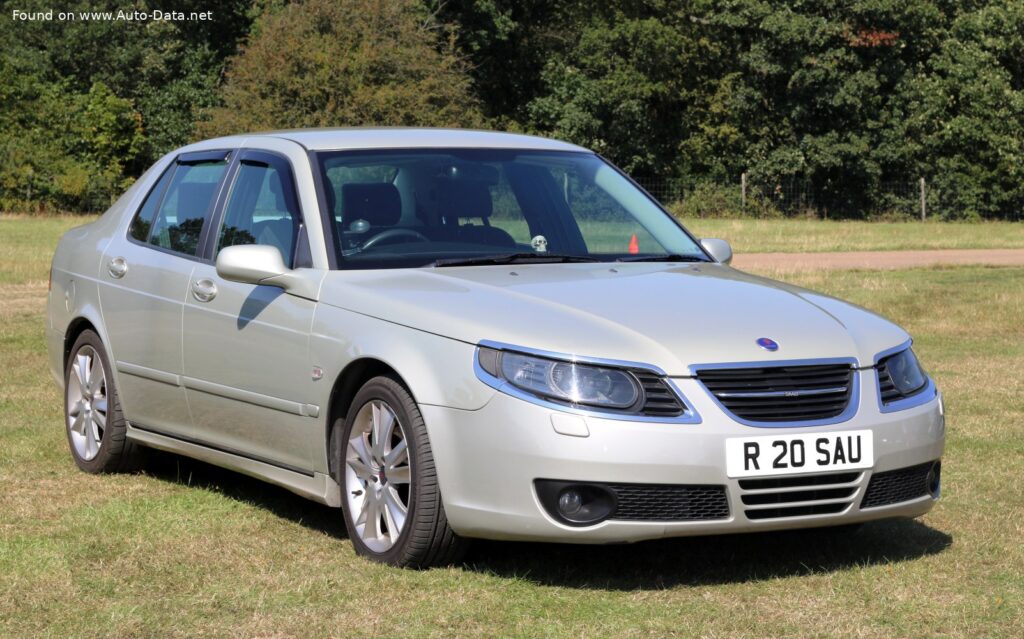
The Saab 9-5 (facelift 2005) 2.0t (150 Hp) represents a significant iteration of Saab’s flagship executive sedan, embodying the brand’s distinctive approach to automotive engineering, safety, and design. Introduced in 2005, this facelifted model was part of the first-generation 9-5 series, which had originally debuted in 1997. The 2005 update brought subtle yet impactful refinements, aimed at modernizing its aesthetic and enhancing its appeal in a competitive global market segment, including North America where Saab had a dedicated following. Produced until 2009, this particular variant, powered by a turbocharged 2.0-liter engine delivering 150 horsepower, offered a compelling blend of performance, fuel efficiency, and the idiosyncratic charm that defined the Swedish marque. Positioned as a practical yet sophisticated four-door, five-seat sedan, it continued Saab’s legacy of pioneering turbocharging technology and prioritizing driver-centric design.
Engineering and Performance of the Saab 9-5 (facelift 2005) 2.0t (150 Hp)
At the heart of the Saab 9-5 (facelift 2005) 2.0t (150 Hp) lies a robust and characterful 2.0-liter turbocharged inline-four engine, designated B205E. This powertrain architecture, a hallmark of Saab engineering, features a front, transverse layout driving the front wheels. The 1985 cubic centimeter (121.13 cu. in.) engine is equipped with a Double Overhead Camshaft (DOHC) valvetrain and four valves per cylinder, optimizing airflow for both power and efficiency. A multi-port manifold injection system ensures precise fuel delivery, while the combination of a turbocharger and an intercooler significantly boosts the engine’s output and responsiveness, especially at lower RPMs.
The engine generates 150 horsepower at 5500 revolutions per minute (rpm), translating to a respectable power-per-liter figure of 75.6 horsepower per liter. More impressively, it produces a substantial 240 Newton meters (177.01 lb.-ft.) of torque, available across a broad and usable band from 1800 to 3500 rpm. This wide torque plateau is a direct benefit of Saab’s sophisticated turbocharging, providing strong, immediate acceleration without the need to constantly wind the engine to high RPMs. This characteristic makes the 9-5 feel effortless in daily driving and provides confident overtaking capability on highways.
Mated to a 5-speed manual transmission, the 2.0t (150 Hp) variant offered an engaging driving experience. The power delivery, combined with the manual gearbox, allowed the sedan to accelerate from 0 to 60 miles per hour in a brisk 9.3 seconds (0-100 km/h in 9.8 seconds), and achieve a maximum speed of 133.59 miles per hour (215 km/h). These figures placed it competitively within its segment, offering a balance of performance and practicality.
Fuel efficiency for the 9-5 2.0t (150 Hp) was commendable for a turbocharged executive sedan of its era. According to NEDC (New European Driving Cycle) standards, it achieved a combined fuel economy of 9 liters per 100 kilometers, which translates to approximately 26.1 US miles per gallon. Urban consumption was rated at 12.6 l/100 km (18.7 US mpg), while extra-urban driving saw figures as low as 6.9 l/100 km (34.1 US mpg). This efficiency, coupled with a generous 19.81 US gallon (75 liter) fuel tank capacity, ensured a substantial cruising range. Furthermore, the vehicle met the Euro 4 emission standard, with CO2 emissions of 214 grams per kilometer, reflecting Saab’s commitment to environmental responsibility even in the mid-2000s.
Design, Features, and Ergonomics
The Saab 9-5 (facelift 2005) retained the distinctive visual identity of its predecessors while introducing a refreshed aesthetic. As a four-door, five-seat sedan, its dimensions—190.39 inches (4836 mm) in length, 70.55 inches (1792 mm) in width (81.5 inches / 2070 mm including mirrors), and 57.01 inches (1448 mm) in height—provided a commanding road presence without being overly cumbersome. The facelift brought updated front and rear fascias, including new headlights and taillights, giving the car a more contemporary and aggressive look while maintaining Saab’s signature clean lines and aerodynamic profile, often inspired by its aviation heritage. The wheelbase measured 106.42 inches (2703 mm), contributing to a stable ride and ample interior space.
Inside, the Saab 9-5 continued its tradition of ergonomic excellence and unique features. The cabin was designed with the driver in mind, featuring intuitive controls and a “Night Panel” function that allowed drivers to dim all non-essential instrument lighting for reduced distraction during night driving—a direct carryover from aircraft cockpits. Seating was comfortable and supportive, designed for long journeys. The trunk offered a substantial 17.66 cubic feet (500 liters) of cargo space, making the 9-5 a practical choice for families or those needing ample luggage capacity.
Safety was a paramount concern for Saab, and the 9-5 (facelift 2005) reflected this commitment. Beyond the standard Anti-lock Braking System (ABS) mentioned in the specifications, Saab vehicles of this era were renowned for their robust passive safety structures, including advanced crumple zones, side-impact protection, and a comprehensive array of airbags. The braking system itself was robust, featuring 308 mm ventilated discs at the front and 286 mm discs at the rear, ensuring strong and consistent stopping power.
The driving dynamics of the 9-5 were further enhanced by its well-engineered suspension system. The front utilized an independent McPherson strut setup with a transverse stabilizer, while the rear featured an independent multi-link suspension, also with a transverse stabilizer. This configuration provided a comfortable ride quality, effectively absorbing road imperfections, while maintaining composed handling. Steering was managed by a hydraulic rack and pinion system, offering tactile feedback and a precise feel, further contributing to the Saab’s engaging driving experience. The minimum turning circle of 35.43 feet (10.8 meters) made it surprisingly maneuverable for its size. The vehicle offered tire size options of 215/55 R16 or 225/45 R17, paired with wheel rims sized 6.5J x 16 or 7J x 17 respectively, allowing for a balance between ride comfort and road grip.
Technical Specifications: Saab 9-5 (facelift 2005) 2.0t (150 Hp)
| Brand | Saab |
| Model | 9-5 |
| Generation | 9-5 (facelift 2005) |
| Type (Engine) | 2.0t (150 Hp) |
| Start of Production | 2005 year |
| End of Production | 2009 year |
| Powertrain Architecture | Internal Combustion Engine (ICE) |
| Body Type | Sedan |
| Seats | 5 |
| Doors | 4 |
| Fuel Consumption (Urban, NEDC) | 12.6 l/100 km (18.7 US mpg) |
| Fuel Consumption (Extra Urban, NEDC) | 6.9 l/100 km (34.1 US mpg) |
| Fuel Consumption (Combined, NEDC) | 9 l/100 km (26.1 US mpg) |
| CO2 Emissions (NEDC) | 214 g/km |
| Fuel Type | Petrol (Gasoline) |
| Acceleration 0-60 mph | 9.3 sec |
| Acceleration 0-100 km/h | 9.8 sec |
| Maximum Speed | 215 km/h (133.59 mph) |
| Emission Standard | Euro 4 |
| Power | 150 Hp @ 5500 rpm |
| Power per Liter | 75.6 Hp/l |
| Torque | 240 Nm @ 1800-3500 rpm (177.01 lb.-ft.) |
| Engine Layout | Front, Transverse |
| Engine Model/Code | B205E |
| Engine Displacement | 1985 cm3 (121.13 cu. in.) |
| Number of Cylinders | 4 |
| Engine Configuration | Inline |
| Cylinder Bore | 90 mm (3.54 in.) |
| Piston Stroke | 78 mm (3.07 in.) |
| Number of Valves per Cylinder | 4 |
| Fuel Injection System | Multi-port manifold injection |
| Engine Aspiration | Turbocharger, Intercooler |
| Valvetrain | DOHC |
| Engine Oil Capacity | 4 l (4.23 US qt) |
| Engine Oil Specification | Not specified |
| Coolant Capacity | 7.4 l (7.82 US qt) |
| Trunk (Boot) Space – Minimum | 500 l (17.66 cu. ft.) |
| Fuel Tank Capacity | 75 l (19.81 US gal) |
| Max. Roof Load | 100 kg (220.46 lbs.) |
| Permitted Trailer Load with Brakes (12%) | 1800 kg (3968.32 lbs.) |
| Permitted Trailer Load without Brakes | 750 kg (1653.47 lbs.) |
| Length | 4836 mm (190.39 in.) |
| Width | 1792 mm (70.55 in.) |
| Width including Mirrors | 2070 mm (81.5 in.) |
| Height | 1448 mm (57.01 in.) |
| Wheelbase | 2703 mm (106.42 in.) |
| Front Track | 1522 mm (59.92 in.) |
| Rear (Back) Track | 1528 mm (60.16 in.) |
| Front Overhang | 1031 mm (40.59 in.) |
| Rear Overhang | 1102 mm (43.39 in.) |
| Minimum Turning Circle (Turning Diameter) | 10.8 m (35.43 ft.) |
| Drivetrain Architecture | Internal combustion engine drives the front wheels |
| Drive Wheel | Front wheel drive |
| Number of Gears and Type of Gearbox | 5 gears, manual transmission |
| Front Suspension | Independent type McPherson, Transverse stabilizer |
| Rear Suspension | Independent multi-link suspension, Transverse stabilizer |
| Front Brakes | Ventilated discs, 308 mm |
| Rear Brakes | Disc, 286 mm |
| Assisting Systems | ABS (Anti-lock braking system) |
| Steering Type | Steering rack and pinion |
| Power Steering | Hydraulic Steering |
| Tires Size | 215/55 R16; 225/45 R17 |
| Wheel Rims Size | 6.5J x 16; 7J x 17 |