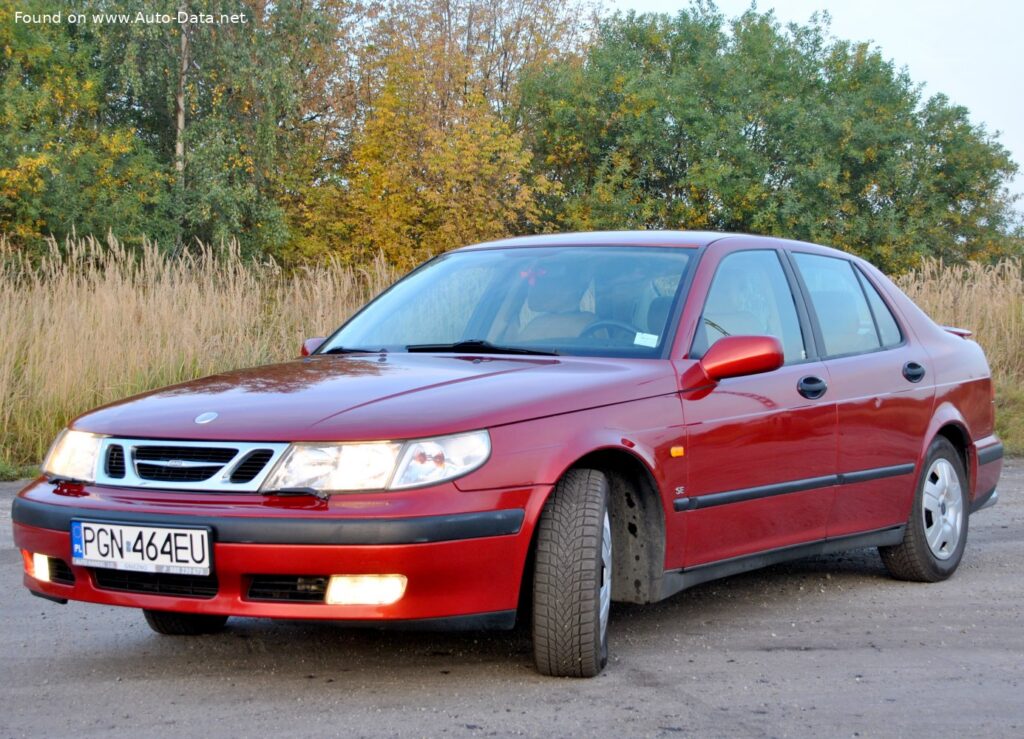
The Saab 9-5, specifically the facelifted 2001 generation, represented a significant iteration of the Swedish automaker’s executive sedan offering. While Saab had a niche but loyal following in North America, the Saab 9-5 (facelift 2001) 2.2 TDi (120 Hp) variant, produced from 2002 to 2005, was primarily targeted at European markets where diesel powertrains were a cornerstone of the premium mid-size segment. This particular model combined Saab’s distinctive design philosophy and commitment to safety with an emphasis on fuel efficiency, catering to a sophisticated clientele seeking a blend of performance, comfort, and economy. The 9-5, first introduced in 1997 as a replacement for the long-running 9000, underwent a notable refresh for the 2001 model year (with production beginning in 2002), bringing updated styling cues and technological enhancements to maintain its competitive edge against established German rivals.
Engine and Performance: The 2.2 TDi (120 Hp) Powertrain in the Saab 9-5 (facelift 2001)
At the heart of this particular Saab 9-5 model was a robust 2.2-liter TDi (Turbocharged Direct Injection) inline-four diesel engine, designated with the internal code D223L. This powerplant was engineered to deliver a balance of usable torque, efficiency, and refined operation, characteristic of European market preferences. With an engine displacement of 2172 cubic centimeters (approximately 2.2 liters or 132.54 cubic inches), it generated a respectable 120 horsepower at 4300 revolutions per minute. More critically for a diesel, it produced a strong 206.52 pound-feet (280 Nm) of torque, available from a low 1500 rpm. This broad torque band ensured responsive acceleration and effortless cruising, particularly beneficial for highway driving and navigating urban environments.
The engine’s technical sophistication included a common rail fuel injection system, which precisely controlled fuel delivery for optimal combustion, contributing to both power and economy. Further enhancing its performance and efficiency was a turbocharger coupled with an intercooler, effectively boosting air intake density and thus power output, while managing thermal loads. The OHC (Overhead Camshaft) valvetrain with four valves per cylinder ensured efficient gas flow, and a high compression ratio of 19.5:1 was typical for a direct-injection diesel of its era. With a bore of 84 mm (3.31 inches) and a piston stroke of 98 mm (3.86 inches), the engine was designed for durability and smooth operation.
Performance figures for the 2.2 TDi variant were competitive for its segment. The sedan could accelerate from 0 to 60 mph in a calculated 10.5 seconds (0-100 km/h in 11 seconds), and reach a maximum speed of 124.27 mph (200 km/h). These figures, while not sports-car territory, provided ample capability for daily driving and long-distance travel. Power was delivered to the front wheels through a precise 5-speed manual transmission, offering engaging control for the driver. The vehicle’s weight-to-power ratio stood at 13.3 kg/Hp (75 Hp/tonne), and its weight-to-torque ratio was 5.7 kg/Nm (175 Nm/tonne), indicating a well-matched powertrain for its intended purpose.
Fuel economy was a standout feature, particularly when compared to gasoline-powered counterparts. The 9-5 2.2 TDi achieved an impressive combined fuel consumption of 35.1 US mpg (6.7 l/100 km). In extra-urban driving, this figure soared to 45.2 US mpg (5.2 l/100 km), showcasing its efficiency on longer journeys. Even in urban conditions, it delivered a respectable 26.1 US mpg (9 l/100 km). With a generous 18.49 US gallon (70-liter) fuel tank capacity, the 9-5 offered an extended cruising range, a highly desirable trait for European motorists.
Design and Features
The Saab 9-5 (facelift 2001) maintained its distinctive identity while incorporating subtle yet effective updates. As a four-door, five-seat sedan, it embodied Saab’s characteristic blend of Scandinavian practicality and unique design flair. The facelift introduced minor revisions to the front fascia, including redesigned headlights and grille, along with updated taillights and bumpers, giving the car a fresher and more contemporary appearance without straying from its established aesthetic. Its overall length measured 189.37 inches (4810 mm), with a width of 70.47 inches (1790 mm) and a height of 57.09 inches (1450 mm), providing a substantial road presence and a spacious cabin.
Inside, the 9-5 continued Saab’s tradition of an aircraft-inspired cockpit, emphasizing ergonomics and driver focus. The instrument panel was logically laid out, with controls intuitively placed. A notable feature was the “Black Panel” function, allowing the driver to extinguish all instrument lighting except for critical information, reducing distraction during night driving – a direct nod to aviation principles. Comfort was paramount, with supportive seating designed for long-distance travel. The vehicle offered a generous trunk space of 17.66 cubic feet (500 liters), making it highly practical for families and business users alike.
Safety remained a core tenet of Saab’s engineering philosophy. The 9-5 featured a robust chassis and an advanced array of passive safety systems for its time, designed to protect occupants in various collision scenarios. Active safety was bolstered by the inclusion of ABS (Anti-lock Braking System), providing enhanced control during emergency braking. The braking system itself consisted of ventilated discs at the front and solid discs at the rear, ensuring effective stopping power. Steering was managed by a rack and pinion system with hydraulic power steering, offering precise feedback and ease of maneuverability. The suspension setup utilized a Spring Strut design at both the front and rear, tuned to provide a comfortable yet composed ride characteristic of an executive sedan. The car rode on 205/65 R15 tires, providing a good balance of grip and ride comfort.
With a kerb weight of 3527.4 lbs (1600 kg) and a maximum permissible weight of 4607.66 lbs (2090 kg), the 9-5 demonstrated a solid build quality. Its maximum payload capacity of 1080.27 lbs (490 kg) further underscored its utility. The Saab 9-5 (facelift 2001) 2.2 TDi (120 Hp) ultimately represented a compelling package for the European market, combining distinctive Scandinavian design, a focus on safety, and the economic benefits of a modern diesel powertrain.
Technical Specifications: Saab 9-5 (facelift 2001) 2.2 TDi (120 Hp)
| Brand | Saab |
| Model | 9-5 |
| Generation | 9-5 (facelift 2001) |
| Type (Engine) | 2.2 TDi (120 Hp) |
| Start of production | 2002 year |
| End of production | 2005 year |
| Powertrain Architecture | Internal Combustion engine |
| Body type | Sedan |
| Seats | 5 |
| Doors | 4 |
| Fuel consumption (economy) – urban | 26.1 US mpg (9 l/100 km) |
| Fuel consumption (economy) – extra urban | 45.2 US mpg (5.2 l/100 km) |
| Fuel consumption (economy) – combined | 35.1 US mpg (6.7 l/100 km) |
| Fuel Type | Diesel |
| Acceleration 0 – 60 mph | 10.5 sec |
| Maximum speed | 124.27 mph (200 km/h) |
| Weight-to-power ratio | 13.3 kg/Hp (75 Hp/tonne) |
| Weight-to-torque ratio | 5.7 kg/Nm (175 Nm/tonne) |
| Power | 120 Hp @ 4300 rpm |
| Power per liter | 55.2 Hp/l |
| Torque | 206.52 lb.-ft. (280 Nm) @ 1500 rpm |
| Engine layout | Front, Transverse |
| Engine Model/Code | D223L |
| Engine displacement | 2.2 liters (2172 cm3, 132.54 cu. in.) |
| Number of cylinders | 4 |
| Engine configuration | Inline |
| Cylinder Bore | 3.31 in. (84 mm) |
| Piston Stroke | 3.86 in. (98 mm) |
| Compression ratio | 19.5:1 |
| Number of valves per cylinder | 4 |
| Fuel injection system | Diesel Commonrail |
| Engine aspiration | Turbocharger, Intercooler |
| Valvetrain | OHC |
| Engine oil capacity | 5.81 US qt (5.5 l) |
| Coolant | 7.61 US qt (7.2 l) |
| Kerb Weight | 3527.4 lbs (1600 kg) |
| Max. weight | 4607.66 lbs (2090 kg) |
| Max load | 1080.27 lbs (490 kg) |
| Trunk (boot) space – minimum | 17.66 cu. ft. (500 l) |
| Fuel tank capacity | 18.49 US gal (70 l) |
| Length | 189.37 in. (4810 mm) |
| Width | 70.47 in. (1790 mm) |
| Height | 57.09 in. (1450 mm) |
| Wheelbase | 106.5 in. (2705 mm) |
| Front track | 59.84 in. (1520 mm) |
| Rear (Back) track | 59.84 in. (1520 mm) |
| Drivetrain Architecture | Internal Combustion engine drives the front wheels |
| Drive wheel | Front wheel drive |
| Number of gears and type of gearbox | 5 gears, manual transmission |
| Front suspension | Spring Strut |
| Rear suspension | Spring Strut |
| Front brakes | Ventilated discs |
| Rear brakes | Disc |
| Assisting systems | ABS (Anti-lock braking system) |
| Steering type | Steering rack and pinion |
| Power steering | Hydraulic Steering |
| Tires size | 205/65 R15 |