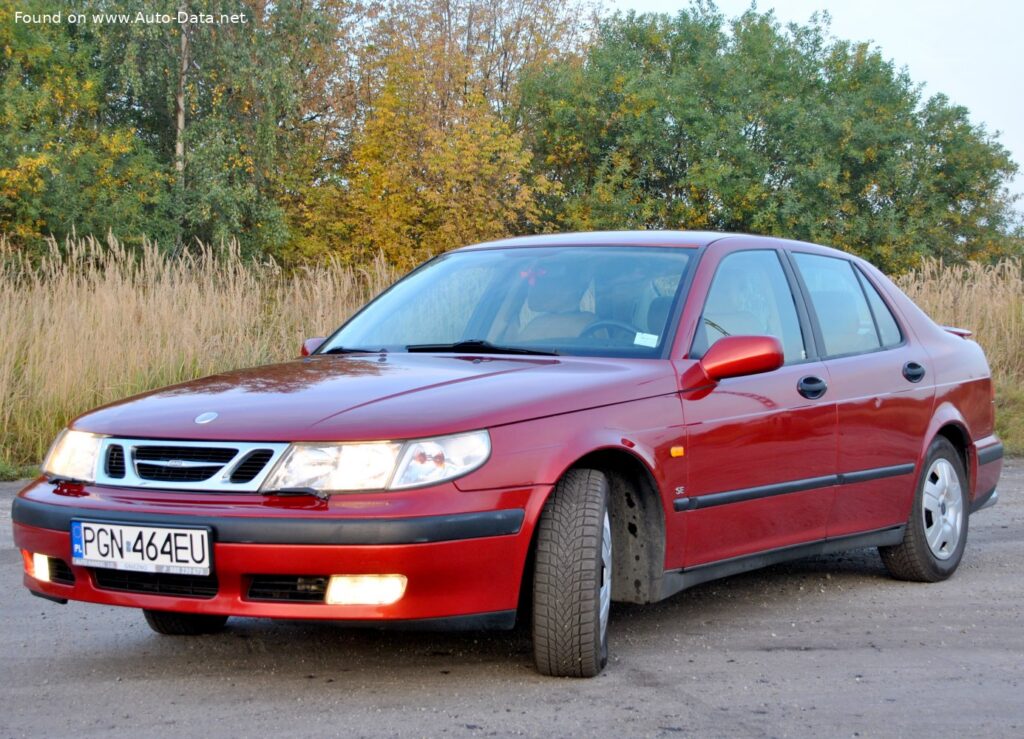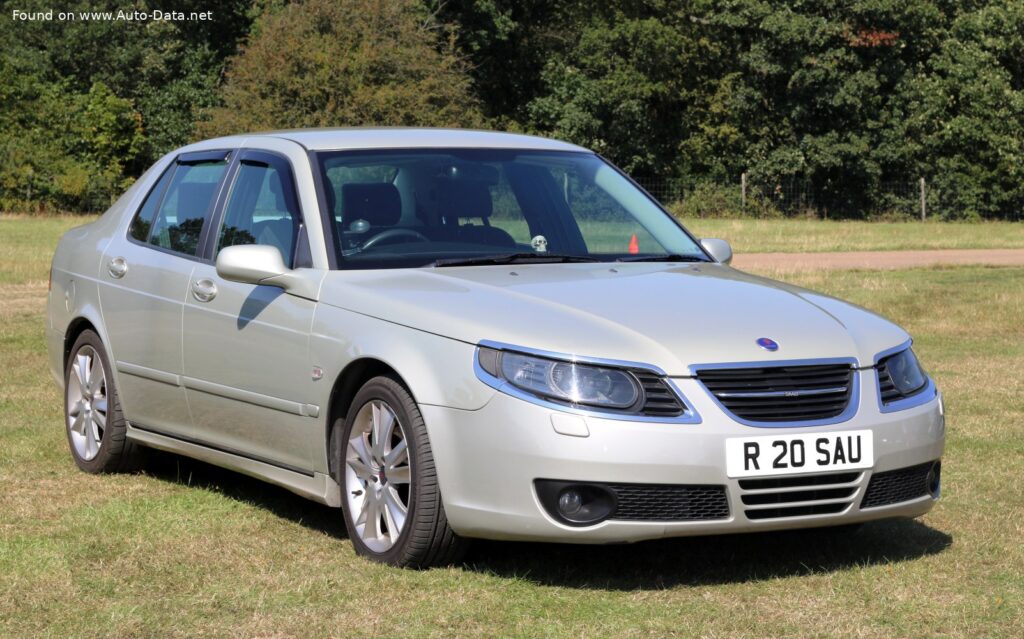
The Saab 9-5, a distinctive offering from the Swedish automaker, represented Saab’s flagship model in the executive car segment. First introduced in 1997 as a replacement for the Saab 9000, the 9-5 carried the torch of Saab’s unique blend of Scandinavian design, aviation-inspired ergonomics, and turbocharged performance. The variant under scrutiny, the Saab 9-5 (facelift 2005) 2.3 Turbo (260 Hp) Sentronic, represents a crucial mid-cycle refresh that aimed to modernize its aesthetics and enhance its powertrain, keeping it competitive in a challenging market dominated by German luxury brands. While Saab, as a brand, held a niche but loyal following in the United States, its primary sales strongholds were often found in Europe and other international markets where its quirkiness and safety reputation resonated more profoundly. This particular model, produced from 2005 to 2009, embodies the brand’s commitment to turbocharging and front-wheel-drive performance, packaged in a four-door sedan body style designed for five occupants.
The Saab 9-5 (facelift 2005) 2.3 Turbo (260 Hp) Sentronic – A Blend of Performance and Scandinavian Design
Powertrain and Driving Dynamics
At the heart of the Saab 9-5 (facelift 2005) 2.3 Turbo (260 Hp) Sentronic lies a potent 2.3-liter turbocharged inline-four engine, designated with the B235R code. This engine, a hallmark of Saab’s engineering prowess, delivers a robust 260 horsepower at 5200 rpm, showcasing an impressive power output of 113.5 horsepower per liter. More significantly for real-world driving, it generates a substantial 258.15 lb.-ft. of torque, available across a broad rev range from 1900 to 4500 rpm. This wide torque band, characteristic of Saab’s turbocharged engines, ensured responsive acceleration and strong passing power without constant downshifting. The engine’s architecture features a front, transverse layout, and a DOHC valvetrain with four valves per cylinder, fed by a multi-port manifold injection system and boosted by a turbocharger with an intercooler to maximize efficiency and performance. With a compression ratio of 9.3:1, it was optimized for premium gasoline.
Power is channeled to the front wheels through a 5-speed Sentronic automatic transmission. This gearbox offered the convenience of an automatic with the option for manual gear selection, allowing drivers a degree of control over the engine’s considerable output. Performance figures for this configuration were competitive for its era: the sedan could accelerate from 0 to 60 mph in approximately 7.8 seconds, with a top speed electronically limited to 155.34 mph (250 km/h). Despite its performance aspirations, the 9-5 aimed for a balance with everyday usability. Fuel economy, measured under the NEDC standard, translated to a combined cycle of 23.1 US mpg (10.2 l/100 km), with urban consumption at 15.3 US mpg and extra-urban at 33.1 US mpg. CO2 emissions were rated at 244 g/km, adhering to the Euro 4 emission standard.
The driving dynamics of the Saab 9-5 (facelift 2005) 2.3 Turbo (260 Hp) Sentronic were characterized by a focus on stable and comfortable cruising, typical of a European executive sedan. The front suspension utilized an independent McPherson strut setup with a transverse stabilizer, while the rear featured an independent multi-link suspension, also equipped with a transverse stabilizer. This combination provided a refined ride quality while maintaining competent handling. Braking power was supplied by ventilated discs measuring 308 mm at the front and solid discs of 286 mm at the rear, augmented by an Anti-lock Braking System (ABS) for enhanced safety and control. The hydraulic power steering system, employing a rack and pinion design, offered precise feedback, contributing to a confident driving experience. The car rode on 235/45 R17 tires mounted on 7.5J x 17 wheel rims, providing a good balance of grip and ride comfort.
Design, Ergonomics, and Features
The 2005 facelift brought a refreshed aesthetic to the Saab 9-5, most notably with a redesigned front fascia featuring a more aggressive grille and new headlights, aligning it with Saab’s evolving design language seen in the 9-3. The sedan’s overall silhouette remained distinctive, characterized by its smooth lines and subtle nods to Saab’s aviation heritage, such as the ‘black panel’ function in the interior that could dim most dashboard lights at night. Measuring 190.39 inches (4836 mm) in length, 70.55 inches (1792 mm) in width (81.5 inches including mirrors), and 57.01 inches (1448 mm) in height, the 9-5 offered a substantial road presence. Its wheelbase of 106.42 inches (2703 mm) contributed to a spacious cabin and stable ride.
Inside, the Saab 9-5 (facelift 2005) 2.3 Turbo (260 Hp) Sentronic maintained Saab’s reputation for ergonomic excellence and thoughtful design. The five-seat cabin was designed with occupant comfort and safety as priorities. The trunk space was generous for the segment, offering 17.66 cubic feet (500 liters) of cargo capacity, making it practical for long journeys or family use. The fuel tank capacity of 19.81 US gallons (75 liters) further supported its touring capabilities. Beyond the standard ABS, Saab vehicles were known for their robust safety structures and attention to passive safety, although specific airbag counts are not detailed in the provided data. Practical features included a maximum roof load of 220.46 lbs (100 kg) and significant towing capabilities, with a permitted trailer load of 3968.32 lbs (1800 kg) with brakes and 1653.47 lbs (750 kg) without brakes, highlighting its versatility.
Market Context and Legacy
During its production run from 2005 to 2009, the Saab 9-5 (facelift 2005) 2.3 Turbo (260 Hp) Sentronic faced intense competition from established luxury brands. Saab’s unique appeal often attracted buyers who valued individuality, safety, and a distinct driving experience over mainstream luxury badges. The 9-5, particularly in its higher-performance turbocharged variants, offered a compelling alternative for those seeking a sophisticated sedan with a spirited engine and a strong sense of character. While never a high-volume seller in the US market, it carved out a niche among enthusiasts and professionals who appreciated its thoughtful engineering and distinctive Scandinavian design ethos. The 2005 facelift helped extend the model’s relevance, but it ultimately represented one of the final iterations of Saab’s original design and engineering philosophy before the company’s later financial struggles and eventual dissolution. Today, the 9-5 facelift model is remembered as a testament to Saab’s innovative spirit and its enduring commitment to turbocharging, safety, and driver-focused design.
Technical Specifications: Saab 9-5 (facelift 2005) 2.3 Turbo (260 Hp) Sentronic
| Brand | Saab |
| Model | 9-5 |
| Generation | 9-5 (facelift 2005) |
| Type (Engine) | 2.3 Turbo (260 Hp) Sentronic |
| Start of production | 2005 year |
| End of production | 2009 year |
| Powertrain Architecture | Internal Combustion engine |
| Body type | Sedan |
| Seats | 5 |
| Doors | 4 |
| Fuel consumption (economy) – urban (NEDC) | 15.4 l/100 km (15.3 US mpg) |
| Fuel consumption (economy) – extra urban (NEDC) | 7.1 l/100 km (33.1 US mpg) |
| Fuel consumption (economy) – combined (NEDC) | 10.2 l/100 km (23.1 US mpg) |
| CO2 emissions (NEDC) | 244 g/km |
| Fuel Type | Petrol (Gasoline) |
| Acceleration 0 – 100 km/h | 8.2 sec |
| Acceleration 0 – 62 mph | 8.2 sec |
| Acceleration 0 – 60 mph (Calculated by Auto-Data.net) | 7.8 sec |
| Maximum speed | 250 km/h (155.34 mph) |
| Emission standard | Euro 4 |
| Power | 260 Hp @ 5200 rpm. |
| Power per litre | 113.5 Hp/l |
| Torque | 350 Nm @ 1900-4500 rpm. (258.15 lb.-ft.) |
| Engine layout | Front, Transverse |
| Engine Model/Code | B235R |
| Engine displacement | 2290 cm3 (139.74 cu. in.) |
| Number of cylinders | 4 |
| Engine configuration | Inline |
| Cylinder Bore | 90 mm (3.54 in.) |
| Piston Stroke | 90 mm (3.54 in.) |
| Compression ratio | 9.3:1 |
| Number of valves per cylinder | 4 |
| Fuel injection system | Multi-port manifold injection |
| Engine aspiration | Turbocharger, Intercooler |
| Valvetrain | DOHC |
| Engine oil capacity | 4 l (4.23 US qt) |
| Coolant | 7.4 l (7.82 US qt) |
| Trunk (boot) space – minimum | 500 l (17.66 cu. ft.) |
| Fuel tank capacity | 75 l (19.81 US gal) |
| Max. roof load | 100 kg (220.46 lbs.) |
| Permitted trailer load with brakes (12%) | 1800 kg (3968.32 lbs.) |
| Permitted trailer load without brakes | 750 kg (1653.47 lbs.) |
| Length | 4836 mm (190.39 in.) |
| Width | 1792 mm (70.55 in.) |
| Width including mirrors | 2070 mm (81.5 in.) |
| Height | 1448 mm (57.01 in.) |
| Wheelbase | 2703 mm (106.42 in.) |
| Front track | 1522 mm (59.92 in.) |
| Rear (Back) track | 1528 mm (60.16 in.) |
| Front overhang | 1031 mm (40.59 in.) |
| Rear overhang | 1102 mm (43.39 in.) |
| Minimum turning circle (turning diameter) | 10.8 m (35.43 ft.) |
| Drivetrain Architecture | The Internal combustion engine (ICE) drives the front wheels of the vehicle. |
| Drive wheel | Front wheel drive |
| Number of gears and type of gearbox | 5 gears, automatic transmission Sentronic |
| Front suspension | Independent type McPherson, Transverse stabilizer |
| Rear suspension | Independent multi-link suspension, Transverse stabilizer |
| Front brakes | Ventilated discs, 308 mm |
| Rear brakes | Disc, 286 mm |
| Assisting systems | ABS (Anti-lock braking system) |
| Steering type | Steering rack and pinion |
| Power steering | Hydraulic Steering |
| Tires size | 235/45 R17 |
| Wheel rims size | 7.5J x 17 |