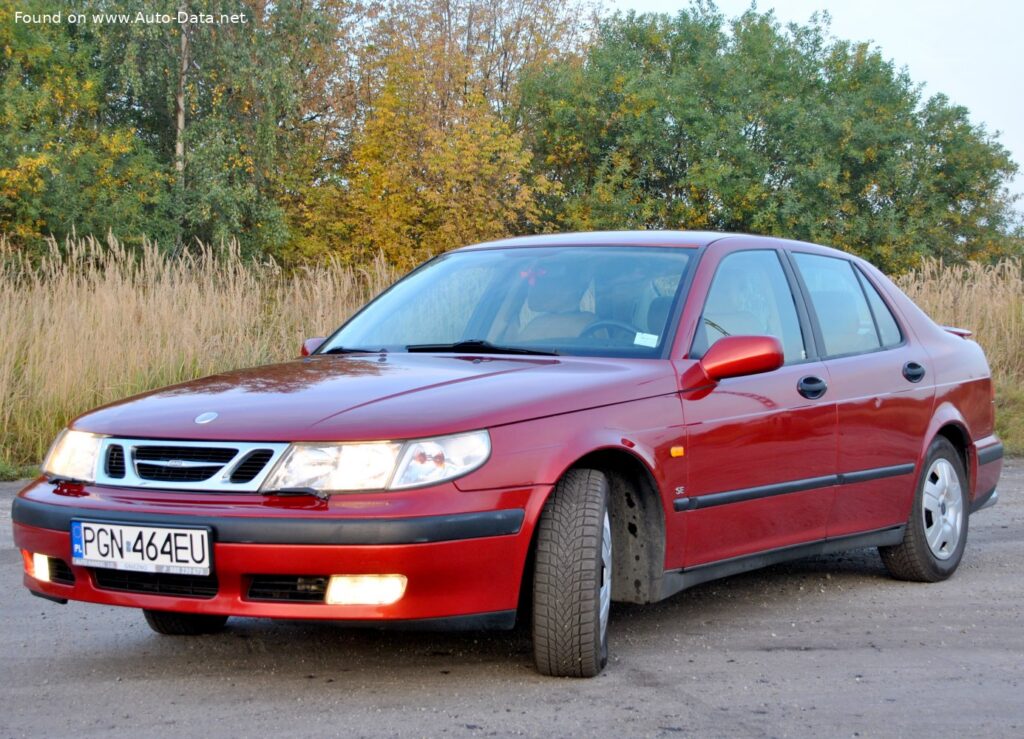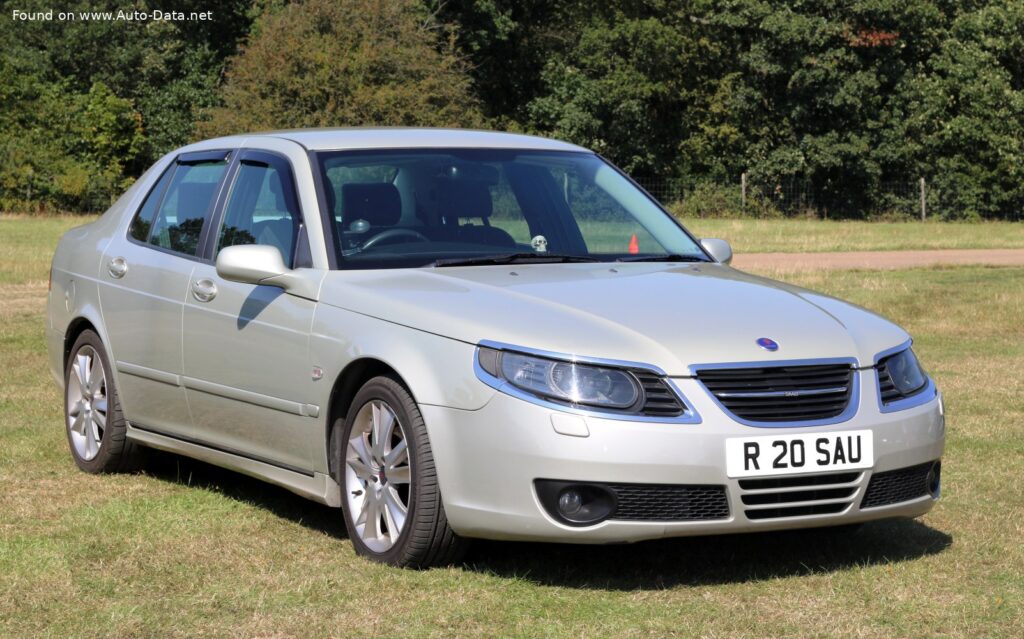
The Saab 9-5 (facelift 2005) represents a significant chapter in the history of the distinctive Swedish automaker, embodying a blend of quirky individualism, advanced engineering, and robust safety that was characteristic of the brand. Positioned as a premium executive sedan, the 9-5 carved out a niche in the European and North American markets for buyers seeking an alternative to the more conventional German luxury offerings. This particular iteration, featuring the 2.3t engine with 185 horsepower and the Sentronic automatic transmission, arrived as a refreshed model in 2005 and continued its production run until 2009. While Saab’s presence in the United States was always more boutique than mainstream, the 9-5 cultivated a loyal following drawn to its unique Scandinavian design ethos and its pioneering use of turbocharging technology in passenger cars. The facelift introduced subtle yet effective updates, ensuring the car remained competitive in its segment, emphasizing its core strengths of performance, comfort, and uncompromising safety.
The Saab 9-5 (facelift 2005): A Legacy of Innovation
The Saab 9-5 (facelift 2005) continued the legacy of a model line first introduced in 1997, serving as the flagship sedan for the brand. This mid-cycle refresh brought a sharper, more modern aesthetic that aimed to align the vehicle with contemporary design trends while retaining its distinct Saab identity. The 9-5 was more than just a car; it was a statement of intellectual and engineering prowess. Its front-wheel-drive architecture, unusual for a car in its executive class, underscored Saab’s commitment to packaging efficiency and superior adverse-weather traction. The brand’s reputation for innovation was deeply embedded in the 9-5, from its “Black Panel” night vision dashboard feature to its advanced active head restraints, which were groundbreaking for their time. The 2005 facelift specifically targeted an enhanced visual presence and refined driving dynamics, extending the appeal of a model already celebrated for its comfort and long-distance cruising capability.
Powertrain and Driving Dynamics
At the heart of the Saab 9-5 (facelift 2005) 2.3t Sentronic lies a meticulously engineered 2.3-liter (2290 cm3 or 139.74 cu. in.) inline four-cylinder engine, designated B235E. This powerplant is a testament to Saab’s long-standing expertise in turbocharging, delivering a robust 185 horsepower at 5500 rpm. What truly sets this engine apart is its impressive torque output: a substantial 206.52 lb.-ft. available across a broad rev range, specifically from 1800 to 3500 rpm. This wide torque band is a hallmark of Saab’s turbocharged engines, providing excellent low-end grunt and a smooth, effortless surge of acceleration that makes for confident overtaking and relaxed highway cruising. The engine features a DOHC (Double Overhead Camshaft) valvetrain with four valves per cylinder and utilizes a multi-port manifold injection system, all working in concert with a turbocharger and intercooler to optimize combustion and power delivery.
Paired with this potent engine is a 5-speed Sentronic automatic transmission. This system not only offers the convenience of an automatic but also provides a manual shift mode, allowing the driver to select gears for a more engaging experience. The combination results in respectable performance for a sedan of its size and class, with the 9-5 2.3t Sentronic capable of accelerating from 0 to 60 mph in a brisk 7.9 seconds and reaching a maximum speed of 142.92 mph. Despite its performance capabilities, Saab also paid attention to efficiency for its era. The vehicle achieves a combined fuel economy of 23.5 US mpg (10 l/100 km), with extra-urban figures reaching 32.7 US mpg (7.2 l/100 km). Emitting 238 g/km of CO2, the 9-5 met the Euro 4 emission standard, demonstrating Saab’s commitment to balancing performance with environmental responsibility in the mid-2000s.
Design Philosophy and Interior Comfort
The design of the Saab 9-5 (facelift 2005) is a masterclass in functional elegance, reflecting its Scandinavian origins. As a four-door sedan with seating for five, its exterior dimensions—190.39 inches in length, 70.55 inches in width (81.5 inches including mirrors), and 57.01 inches in height—contribute to a substantial road presence. The facelift introduced a more assertive front fascia, with revised headlights and grille, and subtly tweaked rear styling, giving the car a fresher, more contemporary look. Yet, it retained the distinctive Saab design cues, such as the wraparound windshield and the subtle aircraft-inspired lines, paying homage to the brand’s aviation heritage. The aerodynamic profile not only contributed to its visual appeal but also to its stability and efficiency at higher speeds.
Inside, the 9-5 prioritizes driver focus and passenger comfort. The cockpit is ergonomically designed, with controls intuitively placed and a driver-centric layout. Saab’s commitment to safety is evident in the robust construction and thoughtful interior features, even if specific modern electronic safety aids are not detailed in the raw data. The independent McPherson front suspension and independent multi-link rear suspension, both with transverse stabilizers, provide a composed and comfortable ride, effectively absorbing road imperfections while maintaining stable handling. The hydraulic rack and pinion steering offers precise control and good feedback, enhancing the driving experience. Braking is handled by 308 mm ventilated discs at the front and 286 mm discs at the rear, complemented by an Anti-lock Braking System (ABS) for enhanced stopping power and control. The vehicle rides on either 215/55 R16 or 225/45 R17 tires, mounted on 6.5J x 16 or 7J x 17 wheel rims, respectively. Practicality is also a strong suit, with a generous trunk capacity of 17.66 cu. ft. (500 liters), making the 9-5 well-suited for family use and long journeys.
Safety and Environmental Considerations
Saab has always been synonymous with safety, and the 9-5 (facelift 2005) is no exception. While the provided data only explicitly mentions ABS (Anti-lock Braking System) as an assisting system, Saab vehicles of this era were renowned for their robust passive safety structures, advanced seatbelt systems, and pioneering active head restraints designed to mitigate whiplash injuries. The focus on occupant protection was a core tenet of Saab’s engineering philosophy, aiming to provide a secure environment for all five passengers. Environmentally, the 2.3t Sentronic model complies with the Euro 4 emission standard, which was a stringent benchmark for vehicle emissions in Europe during its production period. Its CO2 emissions of 238 g/km reflect the technology available at the time, offering a balance between turbocharged performance and environmental impact.
Technical Specifications of the Saab 9-5 (facelift 2005) 2.3t Sentronic
| Brand | Saab |
| Model | 9-5 |
| Generation | 9-5 (facelift 2005) |
| Type (Engine) | 2.3t (185 Hp) Sentronic |
| Start of production | 2005 year |
| End of production | 2009 year |
| Powertrain Architecture | Internal Combustion engine |
| Body type | Sedan |
| Seats | 5 |
| Doors | 4 |
| Fuel consumption (economy) – urban (NEDC) | 14.8 l/100 km (15.9 US mpg) |
| Fuel consumption (economy) – extra urban (NEDC) | 7.2 l/100 km (32.7 US mpg) |
| Fuel consumption (economy) – combined (NEDC) | 10 l/100 km (23.5 US mpg) |
| CO2 emissions (NEDC) | 238 g/km |
| Fuel Type | Petrol (Gasoline) |
| Acceleration 0 – 100 km/h | 8.3 sec |
| Acceleration 0 – 62 mph | 8.3 sec |
| Acceleration 0 – 60 mph (Calculated) | 7.9 sec |
| Maximum speed | 230 km/h (142.92 mph) |
| Emission standard | Euro 4 |
| Power | 185 Hp @ 5500 rpm. |
| Power per litre | 80.8 Hp/l |
| Torque | 280 Nm @ 1800-3500 rpm. (206.52 lb.-ft.) |
| Engine layout | Front, Transverse |
| Engine Model/Code | B235E |
| Engine displacement | 2290 cm3 (139.74 cu. in.) |
| Number of cylinders | 4 |
| Engine configuration | Inline |
| Cylinder Bore | 90 mm (3.54 in.) |
| Piston Stroke | 90 mm (3.54 in.) |
| Number of valves per cylinder | 4 |
| Fuel injection system | Multi-port manifold injection |
| Engine aspiration | Turbocharger, Intercooler |
| Valvetrain | DOHC |
| Engine oil capacity | 4 l (4.23 US qt) |
| Coolant | 7.4 l (7.82 US qt) |
| Trunk (boot) space – minimum | 500 l (17.66 cu. ft.) |
| Fuel tank capacity | 75 l (19.81 US gal) |
| Max. roof load | 100 kg (220.46 lbs.) |
| Permitted trailer load with brakes (12%) | 1800 kg (3968.32 lbs.) |
| Permitted trailer load without brakes | 750 kg (1653.47 lbs.) |
| Length | 4836 mm (190.39 in.) |
| Width | 1792 mm (70.55 in.) |
| Width including mirrors | 2070 mm (81.5 in.) |
| Height | 1448 mm (57.01 in.) |
| Wheelbase | 2703 mm (106.42 in.) |
| Front track | 1522 mm (59.92 in.) |
| Rear (Back) track | 1528 mm (60.16 in.) |
| Front overhang | 1031 mm (40.59 in.) |
| Rear overhang | 1102 mm (43.39 in.) |
| Minimum turning circle (turning diameter) | 10.8 m (35.43 ft.) |
| Drivetrain Architecture | The Internal combustion engine (ICE) drives the front wheels of the vehicle. |
| Drive wheel | Front wheel drive |
| Number of gears and type of gearbox | 5 gears, automatic transmission Sentronic |
| Front suspension | Independent type McPherson, Transverse stabilizer |
| Rear suspension | Independent multi-link suspension, Transverse stabilizer |
| Front brakes | Ventilated discs, 308 mm |
| Rear brakes | Disc, 286 mm |
| Assisting systems | ABS (Anti-lock braking system) |
| Steering type | Steering rack and pinion |
| Power steering | Hydraulic Steering |
| Tires size | 215/55 R16; 225/45 R17 |
| Wheel rims size | 6.5J x 16; 7J x 17 |