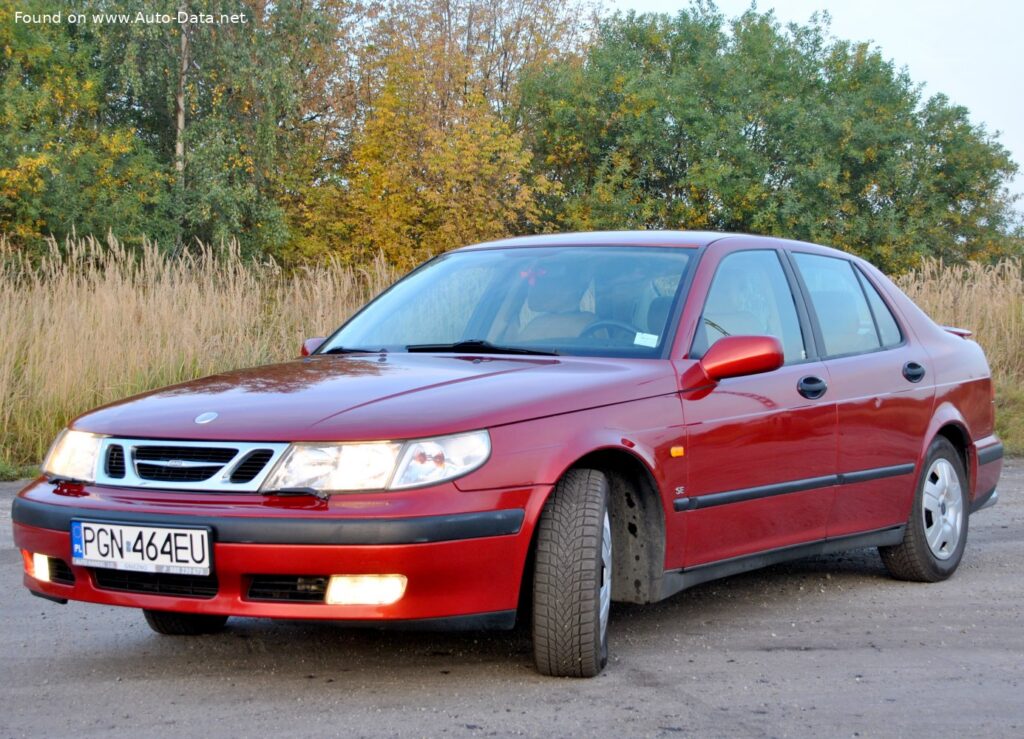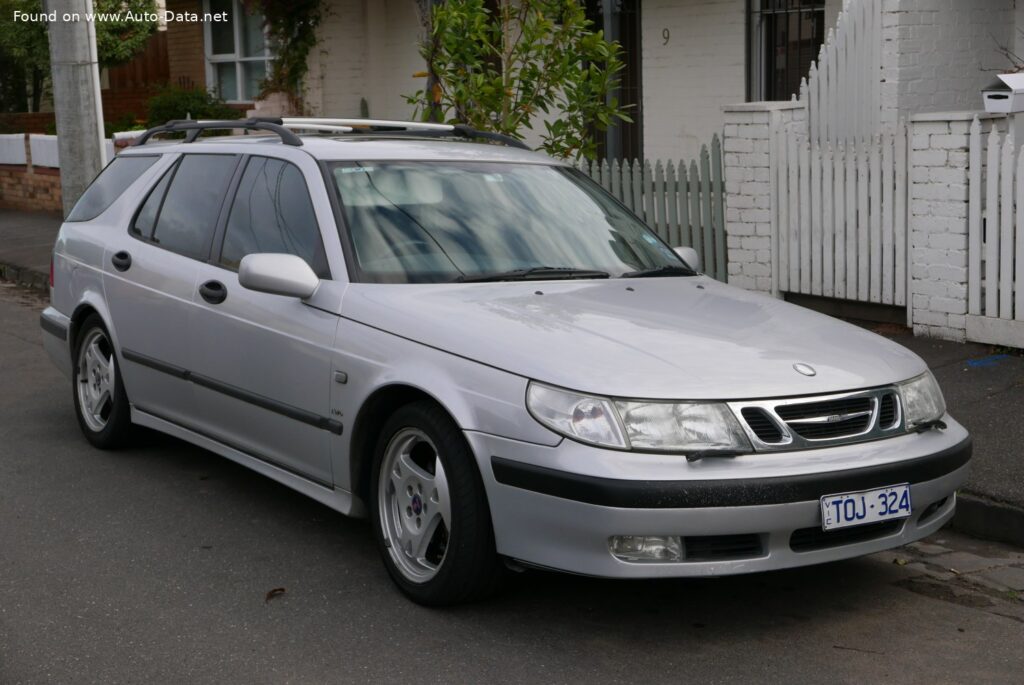
The Saab 9-5 Sport Combi 2.3 T (230 Hp) Automatic represents a distinctive chapter in the history of the Swedish automaker, embodying Saab’s unique blend of Scandinavian design, advanced turbocharging technology, and a steadfast commitment to safety and practicality. Introduced in 1999 as part of the first-generation 9-5 lineup, the Sport Combi variant quickly established itself in the executive mid-size wagon segment, particularly in its primary European markets. This model, produced until 2001, appealed to a discerning clientele seeking a vehicle that offered both spirited performance and versatile utility, without sacrificing individuality. At a time when many manufacturers were gravitating towards more conventional designs, the Saab 9-5 Sport Combi stood out with its aeronautically inspired aesthetics and engineering prowess, making it a compelling choice for drivers who valued innovation and a unique driving experience.
The Saab 9-5 Sport Combi: A Blend of Practicality and Performance
The Saab 9-5 Sport Combi, in its 2.3 T (230 Hp) Automatic guise, was more than just a family hauler; it was a testament to Saab’s engineering philosophy that prioritized intelligent design and robust performance. This particular model, spanning production years from 1999 to 2001, showcased the brand’s expertise in leveraging turbocharging to deliver impressive power and torque from a relatively modest displacement engine. The “Sport Combi” designation itself underscored its dual nature, promising both the versatility of a station wagon and the dynamic capabilities typically associated with sport sedans. For the North American market, where station wagons faced stiff competition from SUVs, the 9-5 Sport Combi carved out a niche for those who appreciated its sophisticated ride, ample cargo space, and distinctive character. In Europe, it competed against established German rivals, offering a compelling alternative with its unique blend of attributes.
Engineering and Powertrain
At the heart of the 1999-2001 Saab 9-5 Sport Combi 2.3 T (230 Hp) Automatic lay a meticulously engineered B235R engine, a 2.3-liter (2290 cm3 or 139.74 cu. in.) inline-four cylinder unit designed for optimal performance and efficiency. This powerplant featured a DOHC (Dual Overhead Camshaft) valvetrain with four valves per cylinder, ensuring precise control over intake and exhaust cycles. The engine’s aspiration was handled by a sophisticated turbocharger, a hallmark of Saab’s automotive identity, which contributed significantly to its impressive output. It generated a robust 230 horsepower at 5500 rpm, a substantial figure for its class at the time. More critically, the engine delivered a formidable 258.15 lb.-ft. (350 Nm) of torque, available from a remarkably low 1900 rpm. This broad torque band ensured strong, flexible acceleration across the rev range, making the car feel responsive and powerful in various driving conditions, from city commutes to highway cruising.
The power was channeled to the front wheels via a 4-speed automatic transmission, a common configuration for executive vehicles of its era. While modern automatics boast more gears, the Saab’s transmission was tuned to complement the engine’s torque characteristics, providing smooth shifts and adequate performance. The 9-5 Sport Combi 2.3 T was capable of accelerating from 0 to 60 mph in a respectable 8.1 seconds (0-100 km/h in 8.5 seconds) and could achieve a maximum speed of 149.13 mph (240 km/h). These figures underscored its “Sport” designation, proving it was more than capable of keeping pace with its performance-oriented competitors. Fuel economy, while not its primary focus, was competitive for a turbocharged wagon of its size and performance. It achieved an estimated 15.6 US mpg in urban driving and an impressive 29.4 US mpg on the highway, reflecting the efficiency benefits of turbocharging when driven conservatively. With a 70-liter (18.49 US gal) fuel tank, the vehicle offered a commendable cruising range. The weight-to-power ratio of 6.8 kg/Hp (147 Hp/tonne) further highlighted the car’s dynamic capabilities for its segment.
Design, Ergonomics, and Safety Features
The design of the Saab 9-5 Sport Combi was quintessentially Saab, characterized by clean lines, aerodynamic efficiency, and a purposeful stance. As a 5-door station wagon (often referred to as an “estate” in European markets), it offered exceptional practicality without sacrificing its distinctive aesthetic. With a length of 189.29 inches (4808 mm), a width of 70.55 inches (1792 mm), and a height of 58.94 inches (1497 mm), the 9-5 Sport Combi commanded a significant presence. Its 106.42-inch (2703 mm) wheelbase contributed to a stable ride and a spacious cabin, comfortably accommodating five occupants. The interior was a testament to Saab’s commitment to ergonomics and driver focus, featuring a “Night Panel” function that allowed drivers to extinguish non-essential dashboard lighting for reduced distraction during nighttime driving, a feature inspired by aircraft cockpits.
Cargo capacity was a strong suit for the Sport Combi. It offered a minimum trunk space of 14.66 cubic feet (415 liters), which could expand to an impressive 52.62 cubic feet (1490 liters) with the rear seats folded down, making it highly versatile for family trips, hauling gear, or even transporting larger items. Saab’s legendary focus on safety was evident throughout the 9-5. While specific active safety features were more limited than in modern vehicles, the 9-5 came standard with ABS (Anti-lock Braking System), enhancing braking control in emergency situations. The vehicle’s robust chassis, advanced crumple zones, and comprehensive airbag system (standard for its time, though not detailed in the provided data) were part of Saab’s holistic approach to passenger protection. The suspension system, featuring Spring Struts at both the front and rear, provided a balanced ride that combined comfort with capable handling. Braking power was supplied by ventilated discs at the front and solid discs at the rear, ensuring confident stopping performance. The hydraulic rack and pinion steering system offered precise feedback and effortless maneuverability, complemented by 215/55 R16 tires mounted on 6.5J x 16-inch wheel rims.
Technical Specifications of the Saab 9-5 Sport Combi 2.3 T (230 Hp) Automatic
| Brand | Saab |
| Model | 9-5 |
| Generation | 9-5 Sport Combi |
| Type (Engine) | 2.3 T (230 Hp) Automatic |
| Start of production | 1999 year |
| End of production | 2001 year |
| Powertrain Architecture | Internal Combustion engine |
| Body type | Station wagon (estate) |
| Seats | 5 |
| Doors | 5 |
| Fuel consumption (economy) – urban | 15.1 l/100 km (15.6 US mpg) |
| Fuel consumption (economy) – extra urban | 8 l/100 km (29.4 US mpg) |
| Fuel Type | Petrol (Gasoline) |
| Acceleration 0 – 60 mph | 8.1 sec |
| Acceleration 0 – 62 mph (0-100 km/h) | 8.5 sec |
| Maximum speed | 149.13 mph (240 km/h) |
| Weight-to-power ratio | 6.8 kg/Hp (147 Hp/tonne) |
| Weight-to-torque ratio | 4.5 kg/Nm (223.6 Nm/tonne) |
| Power | 230 Hp @ 5500 rpm |
| Power per litre | 100.4 Hp/l |
| Torque | 258.15 lb.-ft. (350 Nm) @ 1900 rpm |
| Engine layout | Front, Transverse |
| Engine Model/Code | B235R |
| Engine displacement | 2290 cm3 (139.74 cu. in.) |
| Number of cylinders | 4 |
| Engine configuration | Inline |
| Cylinder Bore | 3.54 in. (90 mm) |
| Piston Stroke | 3.54 in. (90 mm) |
| Compression ratio | 9.3:1 |
| Number of valves per cylinder | 4 |
| Fuel injection system | Multi-port manifold injection |
| Engine aspiration | Turbocharger |
| Valvetrain | DOHC |
| Engine oil capacity | 4 l (4.23 US qt) |
| Coolant | 7.4 l (7.82 US qt) |
| Kerb Weight | 3450.23 lbs. (1565 kg) |
| Max. weight | 4806.08 lbs. (2180 kg) |
| Max load | 1355.84 lbs. (615 kg) |
| Trunk (boot) space – minimum | 14.66 cu. ft. (415 l) |
| Trunk (boot) space – maximum | 52.62 cu. ft. (1490 l) |
| Fuel tank capacity | 18.49 US gal (70 l) |
| Length | 189.29 in. (4808 mm) |
| Width | 70.55 in. (1792 mm) |
| Height | 58.94 in. (1497 mm) |
| Wheelbase | 106.42 in. (2703 mm) |
| Front track | 59.92 in. (1522 mm) |
| Rear (Back) track | 59.92 in. (1522 mm) |
| Drivetrain Architecture | Internal Combustion engine drives the front wheels |
| Drive wheel | Front wheel drive |
| Number of gears and type of gearbox | 4 gears, automatic transmission |
| Front suspension | Spring Strut |
| Rear suspension | Spring Strut |
| Front brakes | Ventilated discs |
| Rear brakes | Disc |
| Assisting systems | ABS (Anti-lock braking system) |
| Steering type | Steering rack and pinion |
| Power steering | Hydraulic Steering |
| Tires size | 215/55 R16 |
| Wheel rims size | 6.5J x 16 |