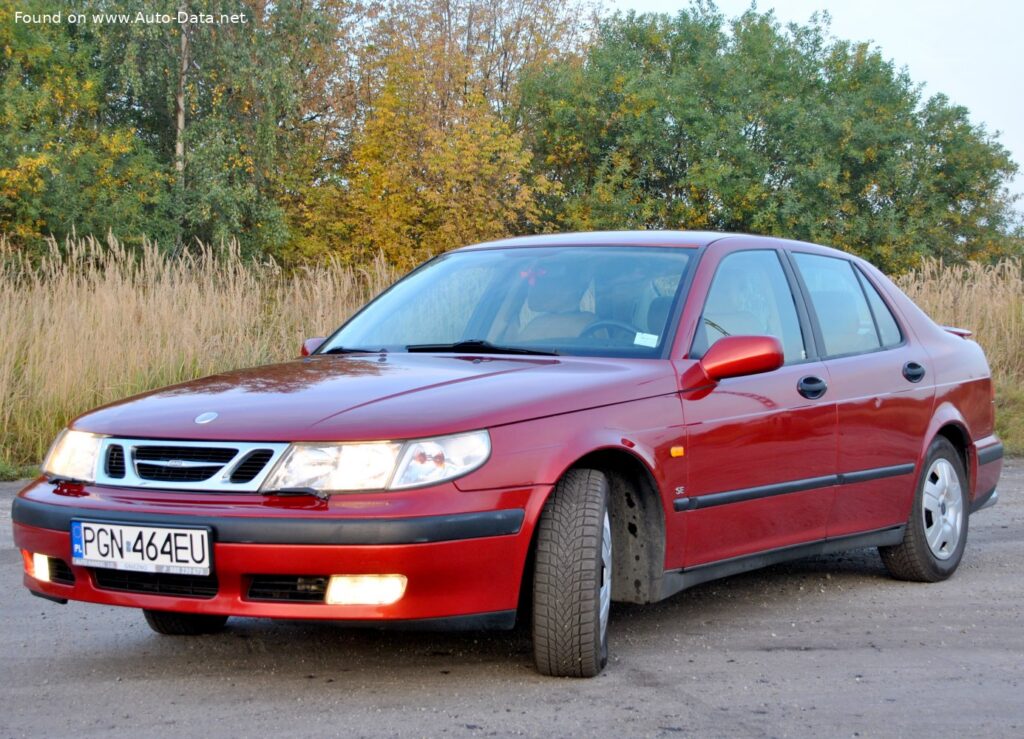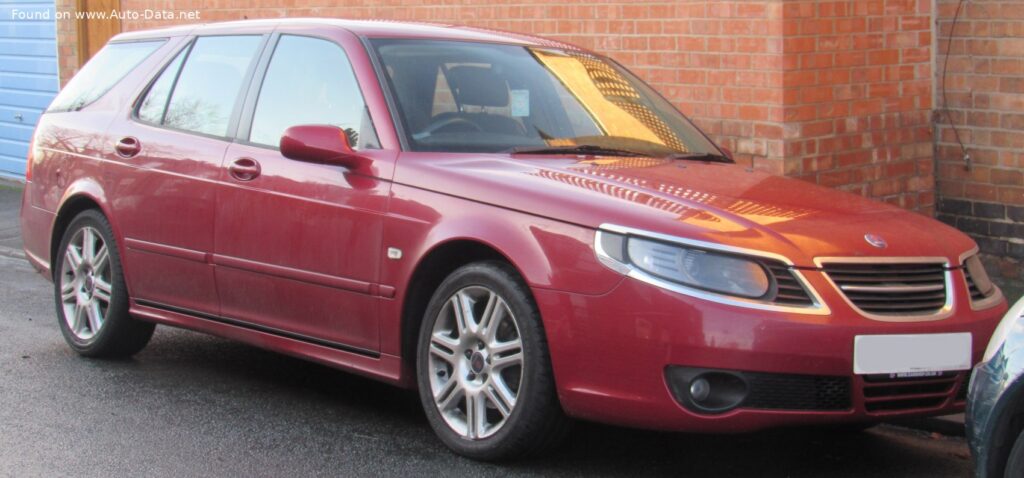
The Saab 9-5 Sport Combi (facelift 2005) 2.0t (150 Hp) Sentronic represents a significant chapter in the history of the Swedish automaker, embodying Saab’s distinctive blend of avant-garde design, practical utility, and turbocharged performance. Launched as part of the refreshed first-generation 9-5 lineup, which spanned from 2005 to 2010, this model continued Saab’s tradition of offering a compelling alternative in the executive and premium mid-size segment. While Saab vehicles, including the 9-5, found a dedicated following in the United States for their unique character and safety-first philosophy, the Sport Combi, or wagon variant, was particularly appreciated in European markets for its versatility. This particular iteration, equipped with the 2.0-liter turbocharged engine and Sentronic automatic transmission, aimed to deliver a refined driving experience with a practical edge, appealing to discerning buyers who sought something beyond the conventional luxury offerings.
Engine and Performance: The Heart of the Saab 9-5 Sport Combi (facelift 2005)
At the core of the Saab 9-5 Sport Combi (facelift 2005) 2.0t lies a meticulously engineered powertrain designed to balance performance with everyday usability. The vehicle is powered by a 2.0-liter (1985 cm³ or 121.13 cu. in.) inline four-cylinder engine, designated by the model code B205E. This unit benefits from Saab’s long-standing expertise in turbocharging, featuring a turbocharger and intercooler that significantly boost its output. With a power rating of 150 horsepower at 5500 rpm and a robust 177.01 lb.-ft. of torque available across a broad range from 1800 to 3500 rpm, the engine delivers a responsive and flexible driving experience. The DOHC (Double Overhead Camshaft) valvetrain with four valves per cylinder, coupled with a multi-port manifold injection system, ensures efficient fuel delivery and combustion, contributing to both performance and relative efficiency for its time.
The power is seamlessly managed by a 5-speed Sentronic automatic transmission, a hallmark of Saab’s commitment to driver convenience without sacrificing engagement. The Sentronic system typically offered a manual shift mode, allowing drivers to take more control over gear selection, a feature that added a layer of sportiness to the executive wagon. This drivetrain architecture, with the internal combustion engine driving the front wheels, provided predictable handling characteristics and optimized traction. In terms of outright performance, the 9-5 Sport Combi 2.0t was capable of accelerating from 0 to 60 mph in a respectable 11.9 seconds, with a maximum speed of 127.38 mph (205 km/h). While not a sports car, these figures were competitive for a family-oriented premium wagon of its era, emphasizing smooth power delivery rather than outright sprint times.
Fuel economy for this configuration, measured under the NEDC cycle, stood at 22.2 US mpg combined (10.6 l/100 km), with urban consumption at 15.6 US mpg (15.1 l/100 km) and extra-urban at 29.8 US mpg (7.9 l/100 km). These figures, alongside CO2 emissions of 251 g/km, positioned the vehicle as a reasonably efficient option in its class, especially considering the benefits of turbocharging for both power and efficiency. The engine met the Euro 4 emission standard, reflecting its compliance with contemporary environmental regulations in its primary markets. An engine oil capacity of 4.23 US quarts and a coolant capacity of 7.82 US quarts further illustrate the robust engineering and maintenance considerations for this powertrain.
Design and Features: Scandinavian Practicality and Innovation
The Saab 9-5 Sport Combi (facelift 2005) showcased a design that was unmistakably Saab, blending aerodynamic efficiency with a strong sense of Scandinavian functionality and understated elegance. As a station wagon (or “estate” in European parlance), the Sport Combi body type offered exceptional practicality, making it a popular choice for families and those requiring significant cargo capacity. The facelift introduced subtle yet effective styling updates, including revised front and rear fascias, which modernized its appearance while retaining its distinctive Saab identity. Its five-door, five-seat configuration underlined its versatility, catering to both passenger comfort and cargo hauling needs.
Dimensions played a crucial role in its presence and utility. With a length of 190.59 inches (4841 mm), a width of 70.55 inches (1792 mm), and a height of 57.44 inches (1459 mm), the 9-5 Sport Combi had a substantial footprint, providing a commanding road presence and a spacious interior. The generous wheelbase of 106.42 inches (2703 mm) contributed to a stable ride and ample legroom for occupants. The true strength of the Sport Combi lay in its cargo capacity: a minimum trunk space of 14.69 cu. ft. (416 liters) could be expanded to a cavernous 52.62 cu. ft. (1490 liters) with the rear seats folded, making it highly adaptable for various lifestyles. A fuel tank capacity of 19.81 US gallons (75 liters) ensured a respectable cruising range.
Underneath its distinctive exterior, the 9-5 Sport Combi featured a sophisticated chassis designed for comfort and confident handling. The front suspension utilized an independent McPherson strut setup with a transverse stabilizer, while the rear employed an independent multi-link suspension, also with a transverse stabilizer. This combination provided a compliant ride quality without sacrificing body control. Braking performance was handled by ventilated discs measuring 308 mm at the front and solid discs of 286 mm at the rear, supported by an Anti-lock Braking System (ABS) for enhanced safety. Steering was of the hydraulic rack and pinion type, offering direct feedback to the driver. Standard tire sizes were 215/55 R16, with an option for 225/45 R17, paired with 6.5J x 16 or 7J x 17 wheel rims, respectively, emphasizing both comfort and grip. Saab’s commitment to safety was a core tenet, and the 9-5, even in its facelifted form, would have incorporated numerous passive and active safety features typical of a premium vehicle of its vintage.
Technical Specifications
| Brand | Saab |
| Model | 9-5 |
| Generation | 9-5 Sport Combi (facelift 2005) |
| Type (Engine) | 2.0t (150 Hp) Sentronic |
| Start of production | 2005 year |
| End of production | 2010 year |
| Powertrain Architecture | Internal Combustion engine |
| Body type | Station wagon (estate) |
| Seats | 5 |
| Doors | 5 |
| Fuel consumption (economy) – urban (NEDC) | 15.1 l/100 km (15.6 US mpg) |
| Fuel consumption (economy) – extra urban (NEDC) | 7.9 l/100 km (29.8 US mpg) |
| Fuel consumption (economy) – combined (NEDC) | 10.6 l/100 km (22.2 US mpg) |
| CO2 emissions (NEDC) | 251 g/km |
| Fuel Type | Petrol (Gasoline) |
| Acceleration 0 – 60 mph | 11.9 sec |
| Maximum speed | 205 km/h (127.38 mph) |
| Emission standard | Euro 4 |
| Power | 150 Hp @ 5500 rpm |
| Power per liter | 75.6 Hp/l |
| Torque | 240 Nm @ 1800-3500 rpm (177.01 lb.-ft.) |
| Engine layout | Front, Transverse |
| Engine Model/Code | B205E |
| Engine displacement | 1985 cm³ (121.13 cu. in.) |
| Number of cylinders | 4 |
| Engine configuration | Inline |
| Cylinder Bore | 90 mm (3.54 in.) |
| Piston Stroke | 78 mm (3.07 in.) |
| Number of valves per cylinder | 4 |
| Fuel injection system | Multi-port manifold injection |
| Engine aspiration | Turbocharger, Intercooler |
| Valvetrain | DOHC |
| Engine oil capacity | 4 l (4.23 US qt) |
| Coolant | 7.4 l (7.82 US qt) |
| Trunk (boot) space – minimum | 416 l (14.69 cu. ft.) |
| Trunk (boot) space – maximum | 1490 l (52.62 cu. ft.) |
| Fuel tank capacity | 75 l (19.81 US gal) |
| Max. roof load | 100 kg (220.46 lbs.) |
| Permitted trailer load with brakes (12%) | 1800 kg (3968.32 lbs.) |
| Permitted trailer load without brakes | 750 kg (1653.47 lbs.) |
| Length | 4841 mm (190.59 in.) |
| Width | 1792 mm (70.55 in.) |
| Width including mirrors | 2070 mm (81.5 in.) |
| Height | 1459 mm (57.44 in.) |
| Wheelbase | 2703 mm (106.42 in.) |
| Front track | 1522 mm (59.92 in.) |
| Rear (Back) track | 1528 mm (60.16 in.) |
| Front overhang | 1031 mm (40.59 in.) |
| Rear overhang | 1106 mm (43.54 in.) |
| Minimum turning circle (turning diameter) | 10.8 m (35.43 ft.) |
| Drivetrain Architecture | Front wheel drive (ICE drives front wheels) |
| Drive wheel | Front wheel drive |
| Number of gears and type of gearbox | 5 gears, automatic transmission Sentronic |
| Front suspension | Independent type McPherson, Transverse stabilizer |
| Rear suspension | Independent multi-link suspension, Transverse stabilizer |
| Front brakes | Ventilated discs, 308 mm |
| Rear brakes | Disc, 286 mm |
| Assisting systems | ABS (Anti-lock braking system) |
| Steering type | Steering rack and pinion |
| Power steering | Hydraulic Steering |
| Tires size | 215/55 R16; 225/45 R17 |
| Wheel rims size | 6.5J x 16; 7J x 17 |