
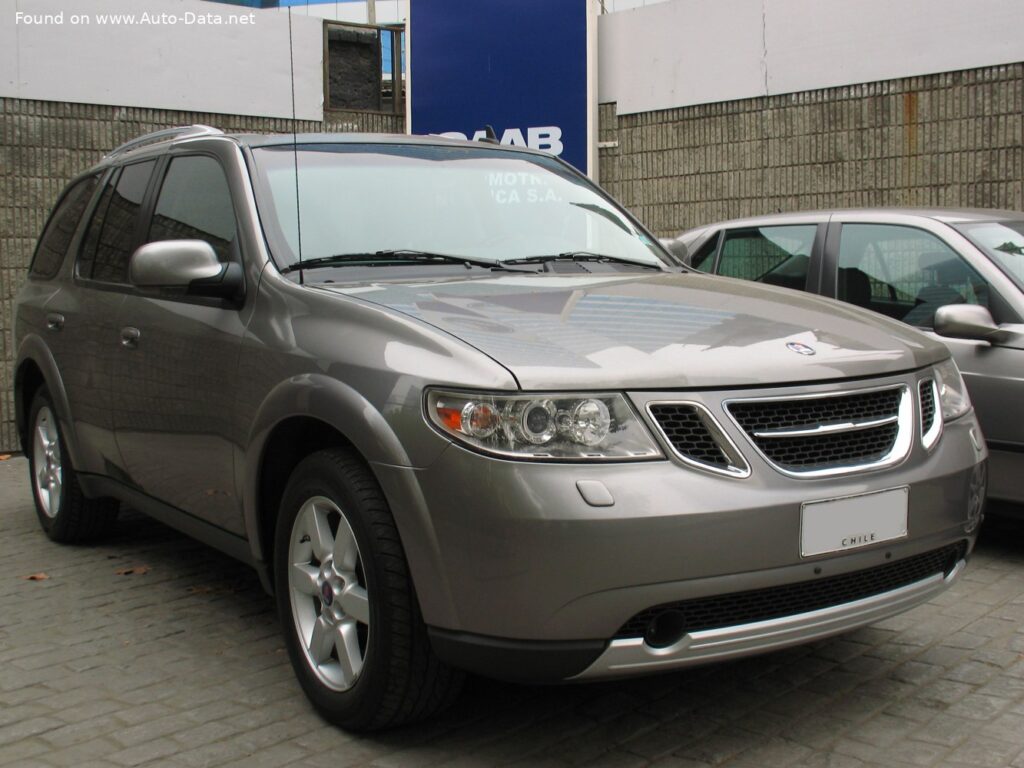
The Saab 9-7X is a mid-size SUV that was produced by Saab from 2004 to 2008. It represented Saab’s entry into the increasingly popular SUV segment, a market where the Swedish automaker had previously lacked a competitive offering. Crucially, the 9-7X was not a Saab-designed vehicle; it was a rebadged version of the GM TrailBlazer, a product of General Motors, who at the time held a significant stake in Saab. The 9-7X was primarily sold in North America, and its development was a direct response to market demands for a larger, more versatile vehicle bearing the Saab badge. The model was offered with a single engine option, a 5.3-liter V8, and was available in both two-wheel drive and all-wheel drive configurations.
Saab 9-7X 5.3i V8: Overview and Market Position
The Saab 9-7X 5.3i V8 occupied a unique position within Saab’s lineup. Historically known for its innovative, albeit unconventional, sedans and hatchbacks, Saab ventured into the SUV market to broaden its appeal and capture a larger share of the North American automotive market. The decision to utilize a GM platform was a pragmatic one, allowing Saab to quickly introduce a competitive SUV without the substantial investment required for a completely new design. While purists questioned the authenticity of a Saab SUV built on a GM chassis, the 9-7X provided a much-needed option for Saab customers seeking a larger vehicle with all-weather capability. The vehicle competed with other mid-size SUVs such as the Ford Explorer, Chevrolet TrailBlazer (its platform-mate), and Jeep Grand Cherokee.
Engine & Performance
The Saab 9-7X 5.3i V8 was powered by General Motors’ LM4 5.3-liter V8 engine. This naturally aspirated engine produced 304 horsepower at 5200 rpm and 329.69 lb-ft of torque at 4000 rpm. The engine featured a 9.9:1 compression ratio and utilized multi-port fuel injection. Power was delivered to the wheels via a four-speed automatic transmission. The 9-7X offered brisk acceleration, achieving 0-60 mph in approximately 7.1 seconds and a top speed of 118.68 mph (191 km/h). The weight-to-power ratio of 7.1 kg/Hp contributed to its responsive performance. Fuel economy was relatively low, typical for a V8 SUV of its era, with figures of 15.7 l/100 km (15 US mpg) in urban driving and 12.4 l/100 km (19 US mpg) on the highway. The engine’s longitudinal front-engine layout and available all-wheel drive system provided enhanced traction and stability.
Design & Features
The Saab 9-7X adopted the styling cues of the GM TrailBlazer, albeit with some subtle modifications to align with Saab’s design language. The exterior featured a relatively boxy silhouette, characteristic of SUVs from the early 2000s. Inside, the 9-7X offered seating for five passengers and a spacious interior. Key features included standard ABS (Anti-lock Braking System), and a generous cargo capacity ranging from 39.8 to 80.09 cubic feet with the rear seats folded down. The vehicle’s dimensions were substantial, measuring 193.78 inches in length, 75.39 inches in width, and 70.51 inches in height. The wheelbase was 112.99 inches. While not boasting the advanced safety features of modern SUVs, the 9-7X provided a reasonable level of occupant protection for its time. The vehicle’s curb weight was 4773.01 lbs, with a maximum weight capacity of 6000.98 lbs.
Technical Specifications
| Brand | Saab |
| Model | 9-7X |
| Generation | 9-7X |
| Type (Engine) | 5.3 i V8 (304 Hp) |
| Start of production | 2004 |
| End of production | 2008 |
| Powertrain Architecture | Internal Combustion engine |
| Body type | SUV |
| Seats | 5 |
| Doors | 5 |
| Fuel consumption (urban) | 15.7 l/100 km (15 US mpg) |
| Fuel consumption (extra urban) | 12.4 l/100 km (19 US mpg) |
| Fuel Type | Petrol (Gasoline) |
| Acceleration 0 – 100 km/h | 7.5 sec |
| Acceleration 0 – 62 mph | 7.5 sec |
| Acceleration 0 – 60 mph | 7.1 sec |
| Maximum speed | 191 km/h (118.68 mph) |
| Weight-to-power ratio | 7.1 kg/Hp |
| Weight-to-torque ratio | 4.8 kg/Nm |
| Power | 304 Hp @ 5200 rpm |
| Torque | 447 Nm @ 4000 rpm (329.69 lb.-ft. @ 4000 rpm) |
| Engine layout | Front, Longitudinal |
| Engine Model/Code | LM4 |
| Engine displacement | 5327 cm3 (325.07 cu. in.) |
| Number of cylinders | 8 |
| Engine configuration | V-engine |
| Cylinder Bore | 96 mm (3.78 in.) |
| Piston Stroke | 92 mm (3.62 in.) |
| Compression ratio | 9.9:1 |
| Number of valves per cylinder | 2 |
| Fuel injection system | Multi-port manifold injection |
| Engine aspiration | Naturally aspirated engine |
| Valvetrain | DOHC |
| Engine oil capacity | 5.7 l (6.02 US qt | 5.02 UK qt) |
| Coolant capacity | 11.6 l (12.26 US qt | 10.21 UK qt) |
| Kerb Weight | 2165 kg (4773.01 lbs.) |
| Max. weight | 2722 kg (6000.98 lbs.) |
| Max load | 557 kg (1227.97 lbs.) |
| Trunk (boot) space – minimum | 1127 l (39.8 cu. ft.) |
| Trunk (boot) space – maximum | 2268 l (80.09 cu. ft.) |
| Fuel tank capacity | 83 l (21.93 US gal | 18.26 UK gal) |
| Length | 4922 mm (193.78 in.) |
| Width | 1915 mm (75.39 in.) |
| Height | 1791 mm (70.51 in.) |
| Wheelbase | 2870 mm (112.99 in.) |
| Front track | 1603 mm (63.11 in.) |
| Rear track | 1577 mm (62.09 in.) |
| Drive wheel | All wheel drive (4×4) |
| Number of gears | 4 |
| Gearbox type | Automatic transmission |
| Front suspension | Spring Strut |
| Rear suspension | Coil spring |
| Front brakes | Ventilated discs |
| Rear brakes | Disc |
| Assisting systems | ABS (Anti-lock braking system) |
| Tires size | 255/55 R18 |
| Wheel rims size | 18 |
The Saab 9-7X, despite its reliance on a GM platform, offered Saab enthusiasts a larger vehicle option. However, its relatively short production run and the underlying platform’s origins ultimately limited its long-term success. The model remains a somewhat niche vehicle within the Saab community, representing a unique chapter in the brand’s history.
