
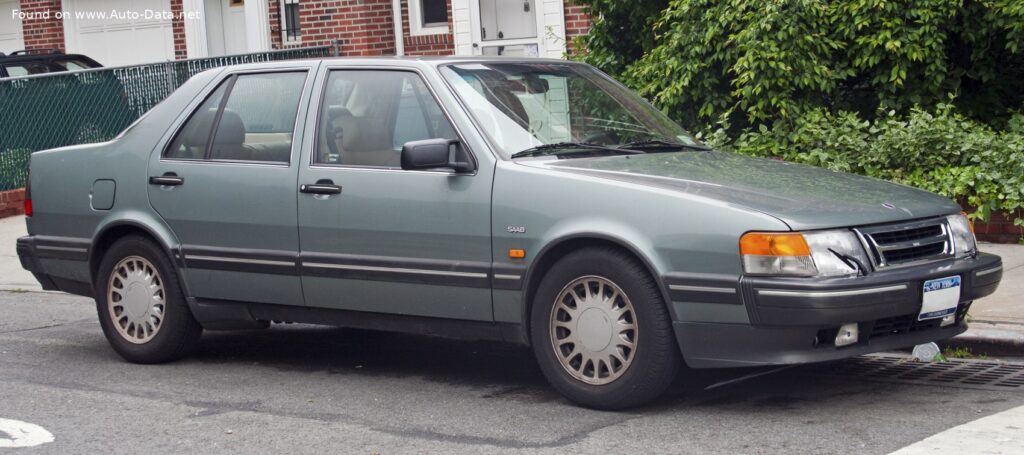
The Saab 9000 2.0 16V Turbo CD is a four-door, five-seat sedan produced by the Swedish manufacturer Saab between 1988 and 1993. Representing the upper end of Saab’s model range during its production run, the 9000 was intended as a replacement for the aging Saab 900 and aimed to compete with larger, more luxurious European sedans. This generation of the 9000, particularly the 2.0 16V Turbo CD variant, offered a blend of performance, comfort, and distinctive Saab styling. While not officially sold in large numbers in the United States, the 9000 gained a cult following among enthusiasts who appreciated its unique character and engineering.
Saab 9000 2.0 16V Turbo CD: Overview
The Saab 9000 was a significant departure for the company, moving away from the more compact offerings of the 900. It was designed to appeal to a broader market, offering more interior space and a more refined driving experience. The “CD” designation in the 2.0 16V Turbo CD model indicates a higher trim level, typically including more standard features and a more luxurious interior. The 16-valve turbocharged engine was a key selling point, providing a substantial power boost compared to naturally aspirated versions.
Engine & Performance
The heart of the Saab 9000 2.0 16V Turbo CD is its 2.0-liter, inline-four cylinder engine. This engine, designated the B202, utilizes a turbocharger and multi-port fuel injection to produce 163 horsepower at 5300 rpm and 257 Nm (189.55 lb.-ft.) of torque at 3000 rpm. This configuration delivers a power-to-weight ratio of 8.8 kg/Hp, contributing to respectable performance for its time. The engine’s 9:1 compression ratio and double overhead camshaft (DOHC) valvetrain further enhance its efficiency and power output.
Power is delivered to the front wheels via a four-speed automatic transmission. Acceleration from 0 to 100 km/h (0-62 mph) takes approximately 9.3 seconds, while the 0-60 mph sprint is achieved in around 8.8 seconds. The car boasts a maximum speed of 210 km/h (130.49 mph). Fuel economy is rated at 9.7 l/100 km (24.2 US mpg) combined, with figures of 14.5 l/100 km (16.2 US mpg) in urban driving and 7.9 l/100 km (29.8 US mpg) on the open road.
Design & Features
The Saab 9000’s design was characterized by its aerodynamic shape and distinctive front-end styling, featuring a prominent grille and integrated headlights. The sedan body style offered a practical and spacious interior, with ample room for passengers and luggage. The trunk provides between 625 and 1600 liters (22.07 to 56.5 cubic feet) of space depending on the rear seats being up or folded down.
Safety features for the era included an Anti-lock Braking System (ABS), which was becoming increasingly common on higher-end vehicles. The car’s hydraulic power steering and wishbone front suspension, coupled with a rear suspension featuring traction connecting levers, contribute to a comfortable and controlled ride. The 9000 2.0 16V Turbo CD also featured power windows, central locking, and other convenience features expected of a luxury sedan.
Technical Specifications
| Brand | Saab |
| Model | 9000 |
| Type (Engine) | 2.0 16V Turbo CD (163 Hp) Automatic |
| Start of production | 1988 |
| End of production | 1993 |
| Powertrain Architecture | Internal Combustion engine |
| Body type | Sedan |
| Seats | 5 |
| Doors | 4 |
| Fuel consumption (urban) | 14.5 l/100 km (16.2 US mpg) |
| Fuel consumption (extra urban) | 7.9 l/100 km (29.8 US mpg) |
| Fuel consumption (combined) | 9.7 l/100 km (24.2 US mpg) |
| Fuel Type | Petrol (Gasoline) |
| Acceleration 0 – 100 km/h | 9.3 sec |
| Acceleration 0 – 62 mph | 9.3 sec |
| Acceleration 0 – 60 mph | 8.8 sec |
| Maximum speed | 210 km/h (130.49 mph) |
| Weight-to-power ratio | 8.8 kg/Hp |
| Weight-to-torque ratio | 5.6 kg/Nm |
| Power | 163 Hp @ 5300 rpm |
| Torque | 257 Nm @ 3000 rpm (189.55 lb.-ft. @ 3000 rpm) |
| Engine layout | Front, Transverse |
| Engine Model/Code | B202 |
| Engine displacement | 1985 cm3 (121.13 cu. in.) |
| Number of cylinders | 4 |
| Engine configuration | Inline |
| Cylinder Bore | 90 mm (3.54 in.) |
| Piston Stroke | 78 mm (3.07 in.) |
| Compression ratio | 9:1 |
| Number of valves per cylinder | 4 |
| Fuel injection system | Multi-port manifold injection |
| Engine aspiration | Turbocharger |
| Valvetrain | DOHC |
| Engine oil capacity | 4.2 l (4.44 US qt | 3.7 UK qt) |
| Coolant capacity | 9 l (9.51 US qt | 7.92 UK qt) |
| Kerb Weight | 1440 kg (3174.66 lbs.) |
| Max. weight | 1900 kg (4188.78 lbs.) |
| Max load | 460 kg (1014.13 lbs.) |
| Trunk (boot) space – minimum | 625 l (22.07 cu. ft.) |
| Trunk (boot) space – maximum | 1600 l (56.5 cu. ft.) |
| Fuel tank capacity | 66 l (17.44 US gal | 14.52 UK gal) |
| Length | 4794 mm (188.74 in.) |
| Width | 1764 mm (69.45 in.) |
| Height | 1420 mm (55.91 in.) |
| Wheelbase | 2672 mm (105.2 in.) |
| Front track | 1522 mm (59.92 in.) |
| Rear track | 1492 mm (58.74 in.) |
| Drivetrain Architecture | Front wheel drive |
| Number of gears | 4 |
| Gearbox type | Automatic transmission |
| Front suspension | Wishbone |
| Rear suspension | Suspension with traction connecting levers |
| Front brakes | Ventilated discs |
| Rear brakes | Disc |
| Assisting systems | ABS (Anti-lock braking system) |
| Steering type | Steering rack and pinion |
| Power steering | Hydraulic Steering |
| Tires size | 205/55 R15 |
| Wheel rims size | 15 |
The Saab 9000 2.0 16V Turbo CD represents a high point in Saab’s engineering and design. While production ended in 1993, the car remains a popular choice among enthusiasts who appreciate its unique blend of performance, comfort, and Scandinavian design. Its legacy continues to influence automotive design and engineering, particularly in the areas of safety and aerodynamics.
