
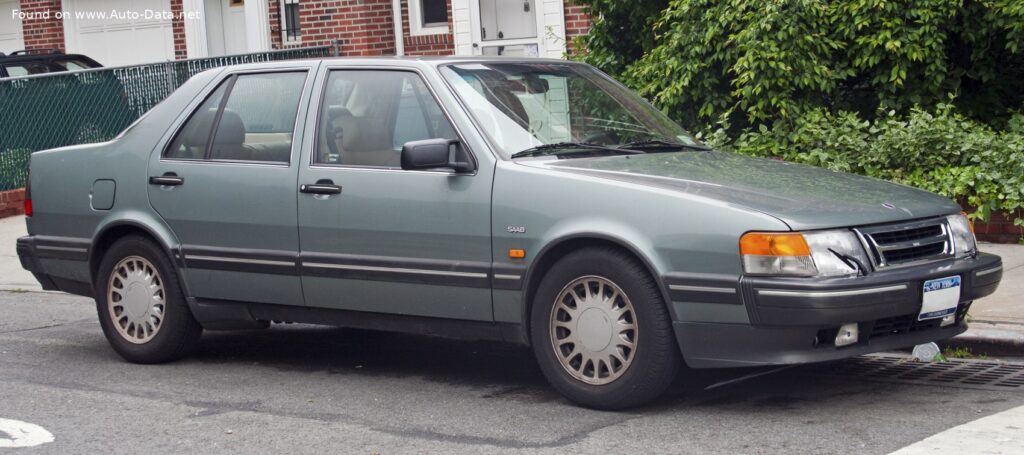
The Saab 9000 2.3 16V CDE Eco-Power is a four-door, five-seat sedan produced by the Swedish manufacturer Saab between 1993 and 1998. Representing the final evolution of the original 9000 series, this model aimed to balance performance with improved fuel efficiency, reflecting growing environmental concerns of the mid-1990s. The “Eco-Power” designation signified Saab’s efforts to reduce emissions and optimize fuel consumption without sacrificing the driving experience characteristic of the brand. While never a high-volume seller in the United States, the 9000 held a loyal following among those seeking a distinctive and technologically advanced alternative to mainstream European and Japanese sedans.
Saab 9000 2.3 16V CDE Eco-Power: Overview
The Saab 9000 was initially launched in 1984 as a replacement for the Saab 900. The 9000 represented a significant step upmarket for Saab, offering more space, comfort, and sophistication. The 2.3 16V CDE Eco-Power variant, introduced in 1993, was a key part of the model’s final refresh. The “CDE” designation refers to the engine management system, while “Eco-Power” highlighted the focus on fuel economy and reduced emissions. This model was primarily sold in Europe, where Saab enjoyed a stronger market presence, and appealed to buyers who valued Scandinavian design, safety, and a unique driving experience.
Engine & Performance
The heart of the Saab 9000 2.3 16V CDE Eco-Power is a 2.3-liter inline-four cylinder engine equipped with a turbocharger and multi-port fuel injection. This engine produced 170 horsepower at 5,500 rpm and 280 Nm (206.52 lb.-ft.) of torque at 1,800 rpm. The turbocharger provided a significant boost in power, enhancing acceleration and overall performance. The engine’s power-to-liter ratio was a respectable 74.2 hp/l. The 9000 achieved a 0-60 mph time of approximately 8.1 seconds and a top speed of 220 km/h (136.7 mph). Fuel economy was rated at 8.8 l/100 km (26.7 US mpg), a competitive figure for a turbocharged sedan of its era. The engine, designated B234, featured a double overhead camshaft (DOHC) valvetrain with four valves per cylinder, contributing to its efficient operation and power output. Power is delivered to the front wheels via a five-speed manual transmission.
Design & Features
The Saab 9000 2.3 16V CDE Eco-Power maintained the distinctive wedge-shaped silhouette that characterized the 9000 series. The body style is a traditional four-door sedan, offering a practical and spacious interior. Saab prioritized safety in its designs, and the 9000 included features such as ventilated front disc brakes, disc brakes in the rear, and an Anti-lock Braking System (ABS) as standard equipment. The interior was designed with ergonomics in mind, featuring comfortable seating and a driver-focused layout. The trunk offered a generous 556 liters (19.63 cu. ft.) of cargo space. The steering utilized a hydraulic power steering rack and pinion system for precise and responsive handling. The vehicle rode on 15-inch wheels with 195/65 R15 tires. While not overtly luxurious, the 9000 offered a refined and comfortable driving experience, emphasizing practicality and understated elegance.
Technical Specifications
| Brand | Saab |
| Model | 9000 |
| Generation | 9000 |
| Type (Engine) | 2.3 16V CDE Eco-Power (170 Hp) |
| Start of production | 1993 |
| End of production | 1998 |
| Powertrain Architecture | Internal Combustion engine |
| Body type | Sedan |
| Seats | 5 |
| Doors | 4 |
| Fuel consumption (combined) | 8.8 l/100 km |
| Fuel consumption (US mpg) | 26.7 US mpg |
| Fuel consumption (UK mpg) | 32.1 UK mpg |
| Fuel consumption (km/l) | 11.4 km/l |
| Fuel Type | Petrol (Gasoline) |
| Acceleration 0 – 100 km/h | 8.5 sec |
| Acceleration 0 – 62 mph | 8.5 sec |
| Acceleration 0 – 60 mph | 8.1 sec |
| Maximum speed | 220 km/h |
| Maximum speed (mph) | 136.7 mph |
| Weight-to-power ratio | 8 kg/Hp |
| Power per tonne | 125 Hp/tonne |
| Weight-to-torque ratio | 4.9 kg/Nm |
| Torque per tonne | 205.9 Nm/tonne |
| Power | 170 Hp @ 5500 rpm |
| Power per litre | 74.2 Hp/l |
| Torque | 280 Nm @ 1800 rpm |
| Torque (lb.-ft.) | 206.52 lb.-ft. @ 1800 rpm |
| Engine layout | Front, Transverse |
| Engine Model/Code | B234 |
| Engine displacement | 2290 cm3 |
| Engine displacement (cu. in.) | 139.74 cu. in. |
| Number of cylinders | 4 |
| Engine configuration | Inline |
| Cylinder Bore | 90 mm |
| Cylinder Bore (in.) | 3.54 in. |
| Piston Stroke | 90 mm |
| Piston Stroke (in.) | 3.54 in. |
| Compression ratio | 9.3:1 |
| Number of valves per cylinder | 4 |
| Fuel injection system | Multi-port manifold injection |
| Engine aspiration | Turbocharger |
| Valvetrain | DOHC |
| Engine oil capacity | 5 l |
| Engine oil capacity (US qt) | 5.28 US qt |
| Engine oil capacity (UK qt) | 4.4 UK qt |
| Coolant capacity | 9 l |
| Coolant capacity (US qt) | 9.51 US qt |
| Coolant capacity (UK qt) | 7.92 UK qt |
| Kerb Weight | 1360 kg |
| Kerb Weight (lbs.) | 2998.29 lbs. |
| Max. weight | 1900 kg |
| Max. weight (lbs.) | 4188.78 lbs. |
| Max load | 540 kg |
| Max load (lbs.) | 1190.5 lbs. |
| Trunk (boot) space – maximum | 556 l |
| Trunk (boot) space – maximum (cu. ft.) | 19.63 cu. ft. |
| Fuel tank capacity | 66 l |
| Fuel tank capacity (US gal) | 17.44 US gal |
| Fuel tank capacity (UK gal) | 14.52 UK gal |
| Length | 4794 mm |
| Length (in.) | 188.74 in. |
| Width | 1764 mm |
| Width (in.) | 69.45 in. |
| Height | 1420 mm |
| Height (in.) | 55.91 in. |
| Wheelbase | 2672 mm |
| Wheelbase (in.) | 105.2 in. |
| Front track | 1522 mm |
| Front track (in.) | 59.92 in. |
| Rear (Back) track | 1492 mm |
| Rear (Back) track (in.) | 58.74 in. |
| Drivetrain Architecture | The Internal combustion engine (ICE) drives the front wheels of the vehicle. |
| Drive wheel | Front wheel drive |
| Number of gears and type of gearbox | 5 gears, manual transmission |
| Front suspension | Wishbone |
| Rear suspension | Suspension with traction connecting levers |
| Front brakes | Ventilated discs |
| Rear brakes | Disc |
| Assisting systems | ABS (Anti-lock braking system) |
| Steering type | Steering rack and pinion |
| Power steering | Hydraulic Steering |
| Tires size | 195/65 R15 |
| Wheel rims size | 15 |
