
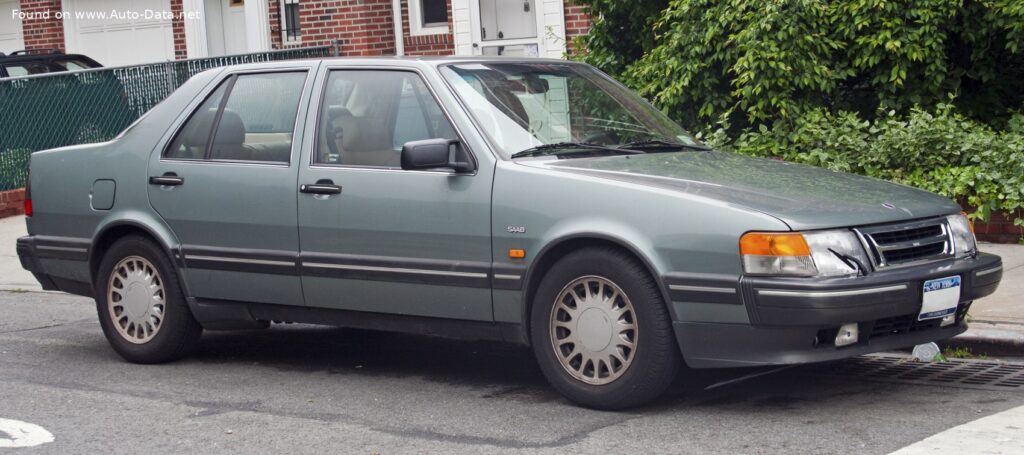
The Saab 9000 3.0 V6 24V CD/CDE, produced between 1994 and 1998, represents a high point in Saab’s commitment to distinctive design and engineering. As the flagship model of the Swedish automaker, the 9000 was a large family car positioned to compete with executive sedans from European manufacturers. While Saab never achieved the same sales volume as its German rivals, the 9000 cultivated a loyal following attracted to its blend of practicality, safety, and unconventional character. The 3.0 V6 variant, with its 211 horsepower engine, offered a significant performance upgrade over earlier models, solidifying the 9000’s reputation as a capable grand tourer.
The Saab 9000: A Legacy of Innovation
The 9000 was Saab’s attempt to move upmarket and replace the aging 900 model. Introduced in 1984, it represented a significant departure in terms of size and sophistication. The first generation (1984-1988) underwent a substantial redesign in 1988, resulting in the second generation, which included the 3.0 V6 models. This iteration featured improved aerodynamics, a more refined interior, and a wider range of engine options. The 9000 was never officially sold in the United States, but it was a popular choice in Europe, particularly among those seeking an alternative to more mainstream offerings. Its focus was on providing a comfortable and safe driving experience, with a strong emphasis on aerodynamic efficiency and driver ergonomics.
Engine & Performance
The heart of the Saab 9000 3.0 V6 24V CD/CDE is its 2.962-liter (180.75 cubic inch) naturally aspirated V6 engine. This engine, designated the B308, produces 211 horsepower at 6,200 rpm and 270 Nm (199.14 lb-ft) of torque at 3,300 rpm. The 24-valve cylinder head, featuring dual overhead camshafts (DOHC) and multi-port fuel injection, contributes to the engine’s smooth power delivery and relatively high specific output of 71.2 horsepower per liter. Power is delivered to the front wheels via a five-speed manual transmission. The 9000 3.0 V6 achieves a 0-60 mph (0-97 km/h) time of approximately 7.6 seconds and a top speed of 230 km/h (142.92 mph). The weight-to-power ratio of 6.5 kg/Hp and weight-to-torque ratio of 5.1 kg/Nm contribute to its responsive driving characteristics. Fuel consumption is rated at 9.3 liters per 100 kilometers (25.3 US mpg).
Design & Features
The Saab 9000 is a four-door sedan with a distinctive, aerodynamic profile. Its design, while not overtly flashy, is characterized by clean lines and a low-slung stance. The interior is spacious and ergonomically designed, reflecting Saab’s commitment to driver comfort. The 9000 prioritizes practicality with a trunk capacity of 556 liters (19.63 cubic feet). Safety was a key consideration in the 9000’s design, and it was equipped with an Anti-lock Braking System (ABS) as standard. The suspension utilizes a wishbone configuration at the front and a traction connecting lever system at the rear, providing a comfortable ride and predictable handling. Hydraulic power steering further enhances the driving experience. The vehicle rides on 15-inch wheels with 195/65 R15 tires.
Technical Specifications
| Brand | Saab |
| Model | 9000 |
| Generation | 9000 |
| Type (Engine) | 3.0 V6 24V CD/CDE (211 Hp) |
| Start of production | 1994 |
| End of production | 1998 |
| Powertrain Architecture | Internal Combustion engine |
| Body type | Sedan |
| Seats | 5 |
| Doors | 4 |
| Fuel consumption (combined) | 9.3 l/100 km |
| Fuel consumption (US mpg) | 25.3 US mpg |
| Fuel consumption (UK mpg) | 30.4 UK mpg |
| Fuel consumption (km/l) | 10.8 km/l |
| Fuel Type | Petrol (Gasoline) |
| Acceleration 0 – 100 km/h | 8 sec |
| Acceleration 0 – 62 mph | 8 sec |
| Acceleration 0 – 60 mph | 7.6 sec |
| Maximum speed | 230 km/h |
| Maximum speed (mph) | 142.92 mph |
| Weight-to-power ratio | 6.5 kg/Hp |
| Weight-to-torque ratio | 5.1 kg/Nm |
| Power | 211 Hp @ 6200 rpm |
| Power per litre | 71.2 Hp/l |
| Torque | 270 Nm @ 3300 rpm |
| Torque (lb.-ft.) | 199.14 lb.-ft. @ 3300 rpm |
| Engine layout | Front, Transverse |
| Engine Model/Code | B308 |
| Engine displacement | 2962 cm3 |
| Engine displacement (cu. in.) | 180.75 cu. in. |
| Number of cylinders | 6 |
| Engine configuration | V-engine |
| Cylinder Bore | 86 mm |
| Cylinder Bore (in.) | 3.39 in. |
| Piston Stroke | 85 mm |
| Piston Stroke (in.) | 3.35 in. |
| Compression ratio | 10.8:1 |
| Number of valves per cylinder | 4 |
| Fuel injection system | Multi-port manifold injection |
| Engine aspiration | Naturally aspirated engine |
| Valvetrain | DOHC |
| Engine oil capacity | 4.5 l |
| Engine oil capacity (US qt) | 4.76 US qt |
| Engine oil capacity (UK qt) | 3.96 UK qt |
| Coolant | 8 l |
| Coolant (US qt) | 8.45 US qt |
| Coolant (UK qt) | 7.04 UK qt |
| Kerb Weight | 1380 kg |
| Kerb Weight (lbs) | 3042.38 lbs |
| Max. weight | 1930 kg |
| Max. weight (lbs) | 4254.92 lbs |
| Max load | 550 kg |
| Max load (lbs) | 1212.54 lbs |
| Trunk (boot) space – maximum | 556 l |
| Trunk (boot) space – maximum (cu. ft.) | 19.63 cu. ft. |
| Fuel tank capacity | 66 l |
| Fuel tank capacity (US gal) | 17.44 US gal |
| Fuel tank capacity (UK gal) | 14.52 UK gal |
| Length | 4792 mm |
| Length (in.) | 188.66 in. |
| Width | 1764 mm |
| Width (in.) | 69.45 in. |
| Height | 1420 mm |
| Height (in.) | 55.91 in. |
| Wheelbase | 2672 mm |
| Wheelbase (in.) | 105.2 in. |
| Front track | 1522 mm |
| Front track (in.) | 59.92 in. |
| Rear (Back) track | 1492 mm |
| Rear (Back) track (in.) | 58.74 in. |
| Drivetrain Architecture | The Internal combustion engine (ICE) drives the front wheels of the vehicle. |
| Drive wheel | Front wheel drive |
| Number of gears and type of gearbox | 5 gears, manual transmission |
| Front suspension | Wishbone |
| Rear suspension | Suspension with traction connecting levers |
| Front brakes | Ventilated discs |
| Rear brakes | Disc |
| Assisting systems | ABS (Anti-lock braking system) |
| Steering type | Steering rack and pinion |
| Power steering | Hydraulic Steering |
| Tires size | 195/65 R15 |
| Wheel rims size | 15 |
The Saab 9000 3.0 V6 24V CD/CDE, though discontinued in 1998, remains a fondly remembered vehicle. It represents a unique blend of Swedish engineering, distinctive design, and a commitment to driver-focused experience. While Saab ultimately faced financial difficulties, the 9000 stands as a testament to the brand’s innovative spirit and enduring appeal.
