
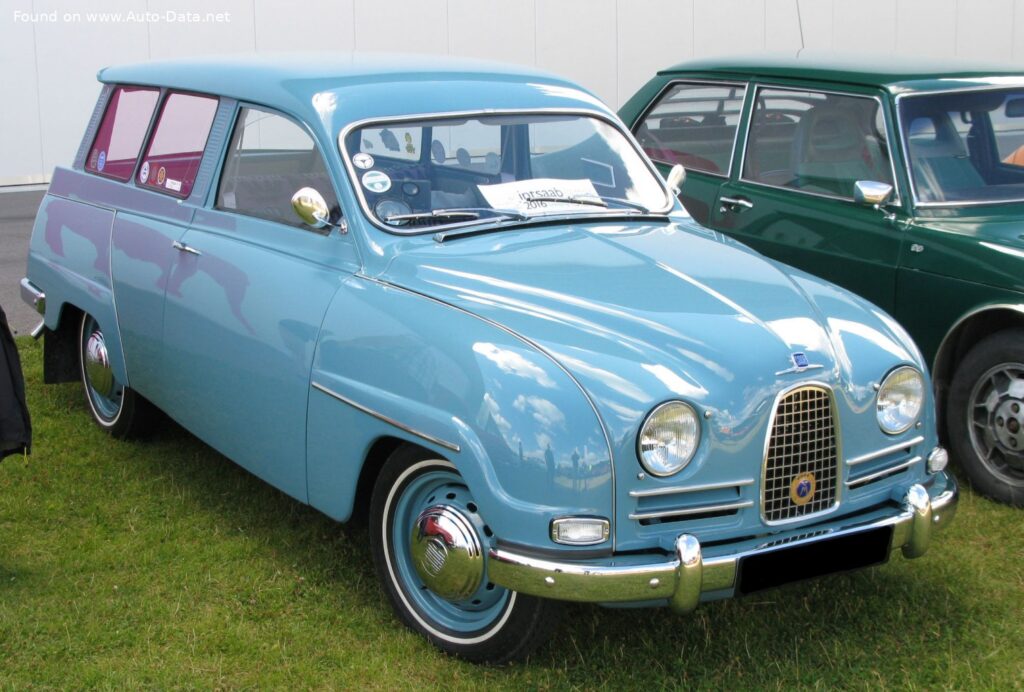
The Saab 95, produced between 1966 and 1975, represents a pivotal moment in the Swedish automaker’s history. As the first Saab to feature a five-door station wagon body style, the 95 significantly broadened the brand’s appeal and established Saab as a pioneer in practical, yet innovative, vehicle design. The 95 was a direct evolution of the earlier Saab 96, sharing its basic platform but offering increased space and versatility. This model, specifically equipped with the 1.5-liter V4 engine producing 65 horsepower, was a mainstay in European markets, offering a unique blend of Scandinavian practicality and engineering.
The Saab 95: A Pioneering Estate Car
The Saab 95 distinguished itself from many contemporary vehicles through its focus on safety and driver comfort. Its robust construction, coupled with a relatively spacious interior for its time, made it a popular choice for families. The five-door configuration, a relatively new concept in the mid-1960s, greatly enhanced accessibility and usability. While not a high-performance vehicle by modern standards, the 95 offered a comfortable and reliable driving experience, particularly well-suited to the demands of everyday motoring. The 95’s design language, characterized by its aerodynamic shape and distinctive grille, became synonymous with the Saab brand for years to come.
Engine & Performance
The 1.5 V4 engine powering the Saab 95 was sourced from Ford, a collaboration that provided Saab with a reliable and readily available powerplant. This 1498 cc (91.41 cu. in.) V4 engine produced 65 horsepower at 4600 rpm and 115 Nm (84.82 lb.-ft.) of torque at 2500 rpm. While modest by today’s standards, this output was adequate for the vehicle’s weight and intended purpose. The engine featured a 9:1 compression ratio and utilized a carburetor fuel injection system. The front, transverse engine layout contributed to the car’s relatively good handling characteristics. The 95 achieved a maximum speed of 155 km/h (96.31 mph). The weight-to-power ratio stood at 14.6 kg/Hp, and the weight-to-torque ratio was 8.2 kg/Nm. Power per liter was a respectable 43.4 Hp/l for the era. The engine’s oil capacity was 3.3 liters (3.49 US qt | 2.9 UK qt), and it required 7.1 liters (7.5 US qt | 6.25 UK qt) of coolant.
Design & Features
The Saab 95 was exclusively offered as a five-door station wagon (estate) with seating for up to seven passengers, although the rear-most seats were best suited for children or short journeys. Its body dimensions were 4270 mm (168.11 in.) in length, 1580 mm (62.2 in.) in width, and 1470 mm (57.87 in.) in height. The wheelbase measured 2490 mm (98.03 in.), with front and rear tracks of 1220 mm (48.03 in.). The car’s design prioritized practicality, with a large cargo area accessible through the rear tailgate. Safety features, while limited by the standards of the 1960s, included disc brakes on the front wheels and drum brakes on the rear. Steering was accomplished via a steering rack and pinion system. The 95 rode on 4J x 15 wheels fitted with 165/80 R15 tires. The interior was functional and durable, reflecting the car’s intended role as a family vehicle. The kerb weight of the vehicle was 946 kg (2085.57 lbs), and it had a fuel tank capacity of 43 liters (11.36 US gal | 9.46 UK gal).
Technical Specifications
| Brand | Saab |
| Model | 95 |
| Generation | 95 |
| Type (Engine) | 1.5 V4 (65 Hp) |
| Start of production | 1966 |
| End of production | 1975 |
| Powertrain Architecture | Internal Combustion engine |
| Body type | Station wagon (estate) |
| Seats | 7 |
| Doors | 3 |
| Fuel Type | Petrol (Gasoline) |
| Maximum speed | 155 km/h (96.31 mph) |
| Weight-to-power ratio | 14.6 kg/Hp |
| Weight-to-torque ratio | 8.2 kg/Nm |
| Power | 65 Hp @ 4600 rpm |
| Power per litre | 43.4 Hp/l |
| Torque | 115 Nm @ 2500 rpm (84.82 lb.-ft. @ 2500 rpm) |
| Engine layout | Front, Transverse |
| Engine Model/Code | Ford V-4 |
| Engine displacement | 1498 cm3 (91.41 cu. in.) |
| Number of cylinders | 4 |
| Engine configuration | V-engine |
| Cylinder Bore | 90 mm (3.54 in.) |
| Piston Stroke | 58.86 mm (2.32 in.) |
| Compression ratio | 9:1 |
| Number of valves per cylinder | 2 |
| Fuel injection system | Carburettor |
| Engine aspiration | Naturally aspirated engine |
| Engine oil capacity | 3.3 l (3.49 US qt | 2.9 UK qt) |
| Coolant | 7.1 l (7.5 US qt | 6.25 UK qt) |
| Kerb Weight | 946 kg (2085.57 lbs.) |
| Fuel tank capacity | 43 l (11.36 US gal | 9.46 UK gal) |
| Length | 4270 mm (168.11 in.) |
| Width | 1580 mm (62.2 in.) |
| Height | 1470 mm (57.87 in.) |
| Wheelbase | 2490 mm (98.03 in.) |
| Front track | 1220 mm (48.03 in.) |
| Rear (Back) track | 1220 mm (48.03 in.) |
| Drivetrain Architecture | The Internal combustion engine (ICE) drives the front wheels of the vehicle. |
| Drive wheel | Front wheel drive |
| Number of gears and type of gearbox | 4 gears, manual transmission |
| Front suspension | Coil spring |
| Rear suspension | Coil spring |
| Front brakes | Disc |
| Rear brakes | Drum |
| Steering type | Steering rack and pinion |
| Tires size | 165/80 R15 |
| Wheel rims size | 4J x 15 |
The Saab 95, particularly the 1.5 V4 variant, remains a cherished classic among Saab enthusiasts. Its innovative design, practical features, and enduring build quality have ensured its place in automotive history as a pioneering example of the modern station wagon.
