
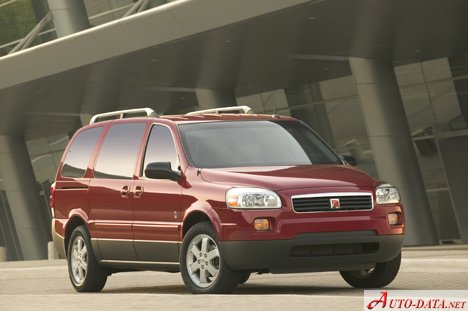
The Saturn Relay 3.5 i V6 S1 represents a significant, though ultimately short-lived, entry by Saturn into the minivan segment. Produced from 2004 to 2007, the Relay was part of the first generation of minivans offered by the brand, known for its polymer body panels and distinctive styling. The Relay shared its platform with other General Motors minivans of the era – the Chevrolet Uplander, Buick Terraza, and Pontiac Montana SV6 – representing a collaborative effort to broaden GM’s offerings in this popular family vehicle category. While not a massive sales success, the Relay offered a compelling package of space, features, and a relatively powerful V6 engine for the American market.
Saturn Relay 3.5 i V6 S1: Overview
The Saturn Relay was positioned as a practical and family-oriented vehicle, competing with established minivans like the Dodge Caravan, Chrysler Town & Country, and Honda Odyssey. It distinguished itself with Saturn’s signature styling cues, though the underlying mechanicals were largely shared with its GM siblings. The 3.5 i V6 S1 trim level represented a mid-range offering, balancing features and price. The Relay aimed to attract buyers seeking a comfortable and versatile vehicle for daily commutes, family road trips, and hauling cargo.
Engine & Performance
The heart of the Saturn Relay 3.5 i V6 S1 is the 3.5-liter LX9 V6 engine. This naturally aspirated powerplant produces 204 horsepower at 5600 rpm and 293 Nm (216.11 lb.-ft.) of torque at 4000 rpm. The engine features a 9.8:1 compression ratio and utilizes multi-port fuel injection. The engine’s power output translates to a respectable weight-to-power ratio of 9.9 kg/Hp (101 Hp/tonne) and a weight-to-torque ratio of 6.9 kg/Nm (145 Nm/tonne). Power is delivered to the front wheels via a 4-speed automatic transmission. The Relay achieves a maximum speed of 177 km/h (109.98 mph). Fuel economy is rated at 13.1 l/100 km (18 US mpg) in urban driving and 9.4 l/100 km (25 US mpg) on the highway. The engine’s transverse mounting and front-wheel-drive configuration contribute to efficient packaging and reasonable handling for a vehicle of its size.
Design & Features
The Saturn Relay is a five-door minivan with seating for seven passengers. Its body-on-frame construction provides a robust platform for carrying passengers and cargo. The Relay’s exterior styling incorporates Saturn’s distinctive rounded shapes and polymer body panels, designed to resist dents and corrosion. Inside, the Relay offers a spacious and configurable interior. The second and third-row seats can be folded flat or even removed entirely to maximize cargo space, ranging from a minimum of 762 liters (26.91 cu. ft.) to a maximum of 3865 liters (136.49 cu. ft.) with all rear seats stowed. Standard safety features included ABS (Anti-lock Braking System) and front and rear disc brakes. The Relay’s dimensions are substantial, measuring 5205 mm (204.92 in.) in length, 1830 mm (72.05 in.) in width, and 1830 mm (72.05 in.) in height, with a wheelbase of 3077 mm (121.14 in.).
Technical Specifications
| Brand | Saturn |
| Model | Relay |
| Generation | Relay |
| Type (Engine) | 3.5 i V6 S1 (204 Hp) |
| Start of production | June, 2004 |
| End of production | 2007 |
| Powertrain Architecture | Internal Combustion engine |
| Body type | Minivan |
| Seats | 7 |
| Doors | 5 |
| Fuel consumption (urban) | 13.1 l/100 km (18 US mpg) |
| Fuel consumption (extra urban) | 9.4 l/100 km (25 US mpg) |
| Fuel Type | Petrol (Gasoline) |
| Maximum speed | 177 km/h (109.98 mph) |
| Weight-to-power ratio | 9.9 kg/Hp |
| Weight-to-torque ratio | 6.9 kg/Nm |
| Power | 204 Hp @ 5600 rpm |
| Torque | 293 Nm @ 4000 rpm (216.11 lb.-ft. @ 4000 rpm) |
| Engine layout | Front, Transverse |
| Engine Model/Code | LX9 |
| Engine displacement | 3498 cm3 (213.46 cu. in.) |
| Number of cylinders | 6 |
| Engine configuration | V-engine |
| Cylinder Bore | 94 mm (3.7 in.) |
| Piston Stroke | 84 mm (3.31 in.) |
| Compression ratio | 9.8:1 |
| Number of valves per cylinder | 2 |
| Fuel injection system | Multi-port manifold injection |
| Engine aspiration | Naturally aspirated |
| Engine oil capacity | 3.8 l (4.02 US qt | 3.34 UK qt) |
| Coolant capacity | 10.7 l (11.31 US qt | 9.41 UK qt) |
| Kerb Weight | 2020 kg (4453.34 lbs.) |
| Trunk (boot) space – minimum | 762 l (26.91 cu. ft.) |
| Trunk (boot) space – maximum | 3865 l (136.49 cu. ft.) |
| Fuel tank capacity | 95 l (25.1 US gal | 20.9 UK gal) |
| Length | 5205 mm (204.92 in.) |
| Width | 1830 mm (72.05 in.) |
| Height | 1830 mm (72.05 in.) |
| Wheelbase | 3077 mm (121.14 in.) |
| Front track | 1586 mm (62.44 in.) |
| Rear track | 1598 mm (62.91 in.) |
| Drivetrain Architecture | Front wheel drive |
| Number of gears | 4 |
| Gearbox type | Automatic transmission |
| Front suspension | Spring Strut |
| Rear suspension | Spring Strut |
| Front brakes | Disc |
| Rear brakes | Disc |
| Assisting systems | ABS (Anti-lock braking system) |
| Steering type | Steering rack and pinion |
| Tires size | 225/60 R17 |
Despite its practicality and features, the Saturn Relay faced stiff competition in the minivan segment. Its relatively short production run reflects the challenges Saturn faced as a brand within General Motors, and ultimately, the brand was discontinued in 2010. The Relay remains a relatively uncommon sight on the road today, representing a unique chapter in Saturn’s history and a testament to GM’s attempt to diversify its minivan offerings.
