The Seat Ibiza IV (facelift 2015) 1.0 Eco TSI (95 Hp): A European Subcompact Standard-Bearer
The Seat Ibiza, a pivotal model for the Spanish automaker, represents a cornerstone in the highly competitive European subcompact, or B-segment, market. The fourth generation, known internally as the 6J, received a significant facelift in May 2015, extending its production run through 2017. This refresh brought a host of updates, particularly in its powertrain offerings and interior technology, to keep it relevant against a new wave of rivals. Among the most significant additions was the efficient 1.0 Eco TSI engine, a turbocharged gasoline unit that perfectly embodied the trend towards smaller displacement, high-efficiency engines. While the Seat brand is not officially sold in the United States, the Ibiza has carved out a strong niche in Europe, Latin America, and other international markets, celebrated for its blend of sporty styling, practical five-door hatchback utility, and Volkswagen Group engineering prowess. The Seat Ibiza IV (facelift 2015) 1.0 Eco TSI (95 Hp) variant, in particular, highlighted Seat’s commitment to delivering an engaging driving experience with a strong emphasis on fuel economy and reduced emissions, making it an ideal choice for urban environments and longer commutes alike.
Powertrain and Performance of the Seat Ibiza IV (facelift 2015)
At the heart of the Seat Ibiza IV (facelift 2015) 1.0 Eco TSI (95 Hp) lies a meticulously engineered 1.0-liter (999 cm³ or 60.96 cubic inches) three-cylinder inline engine. Designated with the model code CHZB, this powertrain is a prime example of modern downsizing technology. Featuring direct fuel injection, a turbocharger, and an intercooler, it manages to extract a robust 95 horsepower, available across a broad range from 5000 to 5500 revolutions per minute. This power output, especially for a one-liter engine, translates to an impressive 95.1 horsepower per liter, underscoring its advanced design.
More critically for everyday driving, the engine delivers a healthy 160 Newton-meters (approximately 118.01 pound-feet) of torque, which peaks early and sustains across a wide band from 1500 to 3500 rpm. This broad torque curve is a hallmark of turbocharged engines and significantly enhances the car’s responsiveness, particularly in city driving where low-end grunt is essential. Power is sent to the front wheels via a precise five-speed manual transmission, offering the driver direct control over the vehicle’s dynamics.
In terms of raw performance, the Ibiza 1.0 Eco TSI is no slouch for its class. It accelerates from 0 to 60 miles per hour in a respectable 9.9 seconds, with 0 to 100 kilometers per hour achieved in 10.4 seconds. Its maximum speed is rated at 187 km/h, or approximately 116.2 mph, making it perfectly capable of highway cruising. However, where this engine truly shines is its exceptional fuel efficiency. The combined fuel consumption is an impressive 4.2 liters per 100 kilometers, equating to an excellent 56 US miles per gallon. This efficiency is complemented by low CO2 emissions of just 97 grams per kilometer, allowing it to meet the stringent Euro 6 emission standard—a significant factor for European motorists facing increasingly strict environmental regulations. The car’s lightweight construction, with a curb weight of just 2248.72 pounds, contributes further to its agile performance and outstanding economy, resulting in a favorable weight-to-power ratio of 10.7 kg/Hp.
Design Evolution and Features
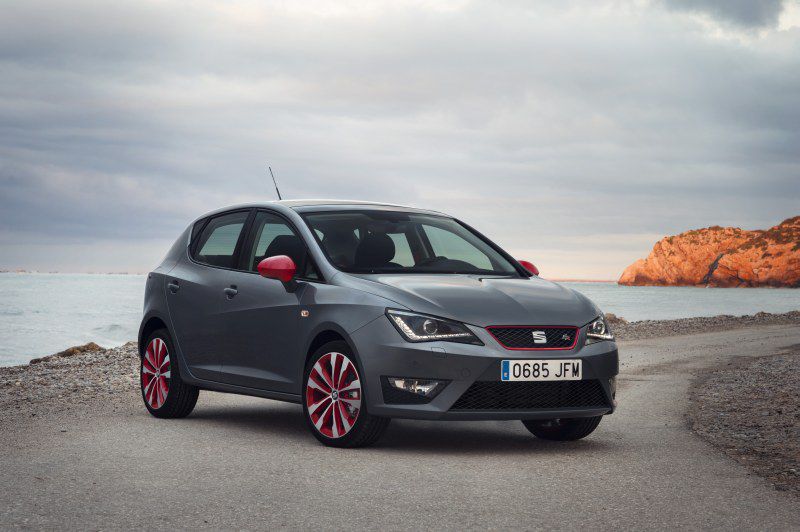
The Seat Ibiza IV (facelift 2015) retained the sporty and youthful aesthetic that has long defined the model, while incorporating subtle yet effective updates. As a five-door hatchback, it offered a practical and versatile body style, accommodating five occupants comfortably. The exterior received minor tweaks, including revised headlights with optional LED daytime running lights, a refreshed grille, and updated wheel designs, giving it a sharper, more contemporary look. Its compact dimensions—159.88 inches in length, 66.65 inches in width, and 56.89 inches in height—made it highly maneuverable in tight urban spaces, further aided by a minimum turning circle of just 32.81 feet.
Inside, the facelift brought more substantial improvements. The cabin received higher-quality materials, a redesigned instrument cluster, and a new infotainment system that was a significant upgrade over its predecessor. While the specific features could vary by trim level, the focus was on enhanced connectivity and user-friendliness, a crucial aspect for modern car buyers. Despite its compact footprint, the Ibiza offered a respectable 10.31 cubic feet of trunk space, expandable by folding the rear seats, making it practical for daily errands or weekend trips.
Safety features for the 2015 model year were in line with European expectations for the segment. Standard equipment included ABS (Anti-lock Braking System), a fundamental active safety system. Passive safety was addressed through a robust chassis design and multiple airbags. The suspension system comprised an independent McPherson-type setup with coil springs and an anti-roll bar at the front, paired with a semi-independent coil spring rear suspension. This configuration provided a good balance of comfort and dynamic handling, characteristic of Volkswagen Group vehicles. Braking was handled by ventilated discs at the front and drum brakes at the rear, a common and cost-effective setup for vehicles of this size and performance level. The car could be equipped with various tire sizes, ranging from 175/70 R14 to more performance-oriented 215/40 R17, depending on the chosen wheel rims (14-inch to 17-inch).
Technical Specifications: Seat Ibiza IV (facelift 2015) 1.0 Eco TSI (95 Hp)
| Category | Specification | US Equivalent / Notes |
|---|---|---|
| General Information | ||
| Brand | Seat | |
| Model | Ibiza | |
| Generation | Ibiza IV (facelift 2015) | |
| Type (Engine) | 1.0 Eco TSI (95 Hp) | |
| Start of Production | May, 2015 | |
| End of Production | 2017 | |
| Powertrain Architecture | Internal Combustion Engine | |
| Body Type | Hatchback | |
| Seats | 5 | |
| Doors | 5 | |
| Performance Specs | ||
| Fuel Consumption (Combined) | 4.2 l/100 km | 56 US mpg |
| CO2 Emissions | 97 g/km | |
| Fuel Type | Petrol (Gasoline) | |
| Acceleration 0 – 60 mph | 9.9 sec | |
| Acceleration 0 – 100 km/h | 10.4 sec | |
| Maximum Speed | 187 km/h | 116.2 mph |
| Emission Standard | Euro 6 | |
| Weight-to-Power Ratio | 10.7 kg/Hp | 93.1 Hp/tonne |
| Weight-to-Torque Ratio | 6.4 kg/Nm | 156.9 Nm/tonne |
| Engine Specs | ||
| Power | 95 Hp @ 5000-5500 rpm | |
| Power per Liter | 95.1 Hp/l | |
| Torque | 160 Nm @ 1500-3500 rpm | 118.01 lb.-ft. @ 1500-3500 rpm |
| Engine Layout | Front, Transverse | |
| Engine Model/Code | CHZB | |
| Engine Displacement | 999 cm³ | 1.0 Liter / 60.96 cu. in. |
| Number of Cylinders | 3 | |
| Engine Configuration | Inline | |
| Cylinder Bore | 74.5 mm | 2.93 in. |
| Piston Stroke | 76.4 mm | 3.01 in. |
| Compression Ratio | 10.5:1 | |
| Number of Valves per Cylinder | 4 | |
| Fuel Injection System | Direct Injection | |
| Engine Aspiration | Turbocharger, Intercooler | |
| Engine Oil Capacity | 4 l | 4.23 US qt |
| Coolant Capacity | 8 l | 8.45 US qt |
| Space, Volume and Weights | ||
| Kerb Weight | 1020 kg | 2248.72 lbs. |
| Max. Weight | 1590 kg | 3505.35 lbs. |
| Max Load | 570 kg | 1256.63 lbs. |
| Trunk (Boot) Space – Minimum | 292 l | 10.31 cu. ft. |
| Fuel Tank Capacity | 45 l | 11.89 US gal |
| Dimensions | ||
| Length | 4061 mm | 159.88 in. |
| Width | 1693 mm | 66.65 in. |
| Height | 1445 mm | 56.89 in. |
| Wheelbase | 2469 mm | 97.2 in. |
| Front Track | 1465 mm | 57.68 in. |
| Rear (Back) Track | 1457 mm | 57.36 in. |
| Minimum Turning Circle | 10 m | 32.81 ft. |
| Drivetrain, Brakes and Suspension Specs | ||
| Drivetrain Architecture | Front-wheel drive, Internal Combustion Engine | |
| Drive Wheel | Front-wheel drive | |
| Number of Gears and Type of Gearbox | 5 gears, Manual Transmission | |
| Front Suspension | Independent, type McPherson with coil spring and anti-roll bar | |
| Rear Suspension | Semi-independent, coil spring | |
| Front Brakes | Ventilated Discs | |
| Rear Brakes | Drum | |
| Assisting Systems | ABS (Anti-lock Braking System) | |
| Steering Type | Steering rack and pinion | |
| Tires Size | 175/70 R14; 185/60 R15; 215/45 R16; 215/40 R17 | |
| Wheel Rims Size | 14; 15; 16; 17 |
Legacy and Market Impact
The Seat Ibiza has consistently been one of Seat’s best-selling models since its inception, and the fourth generation, particularly after its 2015 facelift, continued this tradition. Its role in the European market was significant: it provided a more emotionally charged, “younger” alternative to its platform-sharing sibling, the Volkswagen Polo, while offering similar levels of build quality and engineering. For many European buyers, the Ibiza represented an accessible entry point into the Volkswagen Group’s ecosystem, blending Spanish flair with German precision.
In its primary markets, the Ibiza faced stiff competition from a plethora of established and new rivals. Key competitors included the Ford Fiesta, known for its dynamic handling; the aforementioned Volkswagen Polo, a benchmark for refinement; the Renault Clio, often praised for its comfort and design; the Peugeot 208, another style-focused French contender; and the Opel Corsa (Vauxhall Corsa in the UK), a perennial bestseller. Within the broader Volkswagen Group, it also competed indirectly with the Skoda Fabia, which offered a more value-oriented proposition. The Seat Ibiza IV (facelift 2015) 1.0 Eco TSI (95 Hp) distinguished itself with its sharp design, engaging driving dynamics, and the impressive efficiency of its Eco TSI engine, appealing to buyers who prioritized a sporty feel without sacrificing practicality or economy.
The introduction of the 1.0 Eco TSI engine was a particularly impactful move, demonstrating Seat’s commitment to modern powertrain technology. This downsized, turbocharged three-cylinder unit became a benchmark for efficiency and smooth performance in the subcompact segment, proving that small engines could deliver satisfying power while significantly reducing fuel consumption and emissions. This strategic shift helped the Ibiza maintain its competitive edge and cemented its reputation as a smart choice for urban and suburban drivers.
Ultimately, the Seat Ibiza IV (facelift 2015) played a crucial role in maintaining Seat’s market position, showcasing the brand’s ability to evolve with market demands for efficiency, technology, and design. Its legacy is that of a reliable, stylish, and economical hatchback that offered a compelling alternative in one of the automotive world’s most fiercely contested segments, laying important groundwork for future generations of the model and for Seat’s overall brand identity as a purveyor of “auto emoción.”