The Seat Ibiza IV SC 1.2 (70 Hp): A European Urban Contender (2008-2009)
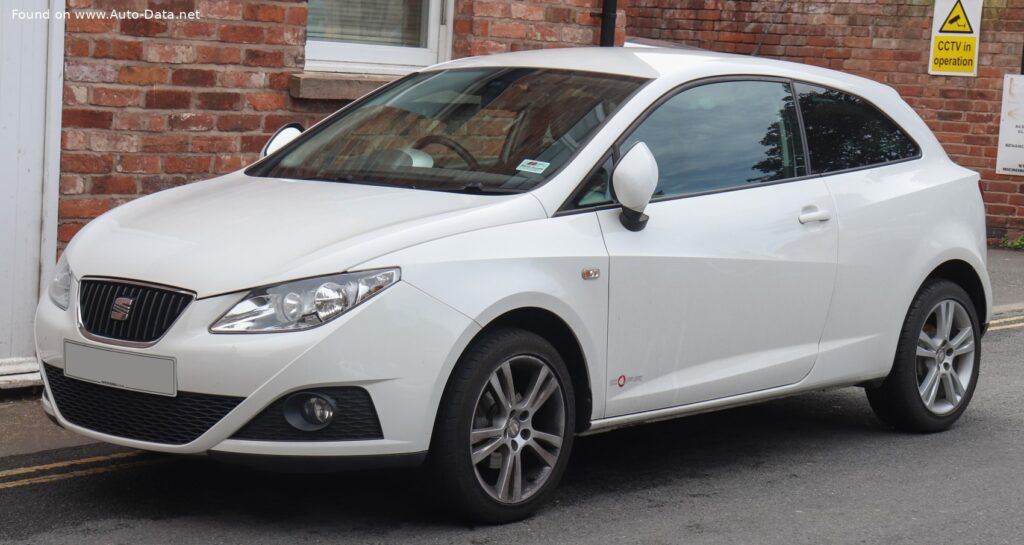
The Seat Ibiza IV SC 1.2 (70 Hp), produced between 2008 and 2009, represents a distinct chapter in the history of SEAT’s highly successful Ibiza lineage. As a cornerstone model for the Spanish automaker, part of the Volkswagen Group, the fourth-generation Ibiza, internally designated “6J,” made its debut with a fresh design language and improved mechanicals. The “SC” moniker, standing for “SportCoupe,” typically denoted the three-door variant of the Ibiza, emphasizing a more dynamic and youthful appeal compared to its more conventional five-door sibling. However, the specific data for this model indicates a unique configuration with five doors and three seats, suggesting a specialized or perhaps highly adaptable iteration within the SC lineup, or a unique interpretation of the “Coupe” designation for a five-door model.
Positioned squarely in Europe’s highly competitive B-segment (subcompact car class), the Ibiza IV SC aimed to attract urban dwellers and younger drivers with its blend of distinctive styling, practical dimensions, and Volkswagen Group engineering integrity. While never officially sold in the United States, the Ibiza played a crucial role in SEAT’s strategy to carve out a niche for sporty, affordable, and design-forward vehicles within the broader European market. This particular variant, powered by a modest yet efficient 1.2-liter engine, highlighted the brand’s commitment to offering economical transportation without sacrificing a certain level of driving enjoyment and aesthetic flair.
Engine and Performance of the Seat Ibiza IV SC 1.2 (70 Hp)
Under the hood, the Seat Ibiza IV SC 1.2 (70 Hp) was equipped with a compact and efficient 1.2-liter (1198 cm³) inline three-cylinder gasoline engine. This naturally aspirated powerplant, identified by engine codes such as BZG, CGPA, or CJLB, was engineered for fuel economy and reliability, characteristic of Volkswagen Group’s smaller displacement offerings. Featuring a Double Overhead Camshaft (DOHC) valvetrain with four valves per cylinder and a multi-port manifold injection system, the engine delivered 70 horsepower at 5400 rpm. Its peak torque output of 82.61 lb.-ft. (112 Nm) arrived at a relatively low 3000 rpm, providing adequate low-end responsiveness for urban driving.
Power was channeled to the front wheels via a five-speed manual transmission, a common and cost-effective choice for vehicles in this segment. This drivetrain architecture, combined with the engine’s modest output, resulted in performance figures tailored for city life rather than outright speed. The Ibiza IV SC 1.2 accelerated from 0 to 60 mph in a calculated 13.7 seconds, with a maximum speed of 102.53 mph (165 km/h). While these numbers might not impress on a drag strip, they were perfectly adequate for navigating congested city streets and maintaining highway speeds within European limits.
Fuel efficiency was a strong suit for this variant. According to the NEDC (New European Driving Cycle) standards of its time, the combined fuel consumption was an impressive 39.9 US mpg (5.9 l/100 km). Urban driving yielded approximately 30.9 US mpg (7.6 l/100 km), while extra-urban conditions saw consumption drop to an excellent 48 US mpg (4.9 l/100 km). With CO2 emissions rated at 139 g/km, the vehicle met the Euro 4 emission standard, reflecting a responsible approach to environmental impact for its era.
Design and Features of the {original_focus_keyword}
The fourth-generation Seat Ibiza, designed by Luc Donckerwolke, marked a significant departure from its predecessor with a sharper, more angular design language that SEAT dubbed the “Arrow Design.” The SC (SportCoupe) variant, in particular, was known for its sportier profile, often characterized by a three-door body style and a more rakish roofline. However, the specific data for this model indicates a “Coupe” body type with “5 Doors” and “3 Seats,” an unusual combination that suggests either a specific market variant or a flexible interior configuration. Typically, a “coupe” implies a two-door (or three-door for hatchbacks) vehicle with a sleek, sloping roofline, while five doors are characteristic of a conventional hatchback. The “3 Seats” configuration is also highly unique for a B-segment passenger car, which commonly offers four or five seats, hinting at a potentially specialized or youth-oriented interior layout.
Measuring 158.82 inches (4034 mm) in length, 66.65 inches (1693 mm) in width, and 56.22 inches (1428 mm) in height, the Ibiza IV SC maintained compact dimensions ideal for urban maneuverability. Its 97.2-inch (2469 mm) wheelbase contributed to a stable ride and nimble handling, further aided by a relatively tight turning circle of 34.38 feet (10.48 m). The exterior design featured prominent character lines, a distinctive front grille, and expressive headlights that gave the car a dynamic and aggressive stance.
Underneath its stylish exterior, the Ibiza IV SC utilized a robust chassis shared with other Volkswagen Group subcompacts like the VW Polo and Skoda Fabia. It featured an independent McPherson strut front suspension with coil springs and an anti-roll bar, providing responsive handling and comfortable ride quality. The rear suspension employed a semi-dependent torsion beam with a stabilizer for lateral stability, a cost-effective and space-efficient solution for small cars. Braking duties were handled by ventilated discs at the front (256×22 mm) and solid discs at the rear (232×9 mm), augmented by an Anti-lock Braking System (ABS) for enhanced safety. The electric power steering system offered light and precise control, particularly beneficial for city driving and parking maneuvers. Standard tire sizes included 175/70 R14 or 185/60 R15, fitted on 5J x 14 or 6J x 15 wheel rims, respectively.
Despite its compact footprint, the Ibiza IV SC offered practical cargo space, with a minimum trunk volume of 10.03 cu. ft. (284 liters), expandable to 32.84 cu. ft. (930 liters) with the rear seats folded down. This flexibility made it suitable for various urban transport needs, from daily commutes to weekend errands.
Technical Specifications: Seat Ibiza IV SC 1.2 (70 Hp)
| Category | Specification |
|---|---|
| Brand | Seat |
| Model | Ibiza |
| Generation | Ibiza IV SC |
| Type (Engine) | 1.2 (70 Hp) |
| Start of production | 2008 year |
| End of production | 2009 year |
| Powertrain Architecture | Internal Combustion engine |
| Body type | Coupe |
| Seats | 3 |
| Doors | 5 |
| Performance Specs | |
| Fuel consumption (economy) – urban (NEDC) | 7.6 l/100 km (30.9 US mpg) |
| Fuel consumption (economy) – extra urban (NEDC) | 4.9 l/100 km (48 US mpg) |
| Fuel consumption (economy) – combined (NEDC) | 5.9 l/100 km (39.9 US mpg) |
| CO2 emissions (NEDC) | 139 g/km |
| Fuel Type | Petrol (Gasoline) |
| Acceleration 0 – 60 mph | 13.7 sec |
| Acceleration 0 – 100 km/h | 14.4 sec |
| Maximum speed | 165 km/h (102.53 mph) |
| Emission standard | Euro 4 |
| Weight-to-power ratio | 13.9 kg/Hp (71.9 Hp/tonne) |
| Weight-to-torque ratio | 8.7 kg/Nm (115 Nm/tonne) |
| Engine Specs | |
| Power | 70 Hp @ 5400 rpm |
| Power per liter | 58.4 Hp/l |
| Torque | 112 Nm (82.61 lb.-ft.) @ 3000 rpm |
| Engine layout | Front, Transverse |
| Engine Model/Code | BZG, CGPA, CJLB |
| Engine displacement | 1198 cm³ (73.11 cu. in.) |
| Number of cylinders | 3 |
| Engine configuration | Inline |
| Cylinder Bore | 76.5 mm (3.01 in.) |
| Piston Stroke | 86.9 mm (3.42 in.) |
| Compression ratio | 10.5:1 |
| Number of valves per cylinder | 4 |
| Fuel injection system | Multi-port manifold injection |
| Engine aspiration | Naturally aspirated engine |
| Valvetrain | DOHC |
| Engine oil capacity | 3 l (3.17 US qt) |
| Coolant | 5.6 l (5.92 US qt) |
| Space, Volume and Weights | |
| Kerb Weight | 974 kg (2147.3 lbs) |
| Max. weight (Gross Vehicle Weight) | 1475 kg (3251.82 lbs) |
| Max load | 501 kg (1104.52 lbs) |
| Trunk (boot) space – minimum | 284 l (10.03 cu. ft.) |
| Trunk (boot) space – maximum | 930 l (32.84 cu. ft.) |
| Fuel tank capacity | 45 l (11.89 US gal) |
| Max. roof load | 75 kg (165.35 lbs) |
| Permitted trailer load with brakes (12%) | 800 kg (1763.7 lbs) |
| Permitted trailer load without brakes | 520 kg (1146.4 lbs) |
| Permitted towbar download | 50 kg (110.23 lbs) |
| Dimensions | |
| Length | 4034 mm (158.82 in.) |
| Width | 1693 mm (66.65 in.) |
| Height | 1428 mm (56.22 in.) |
| Wheelbase | 2469 mm (97.2 in.) |
| Front track | 1465 mm (57.68 in.) |
| Rear (Back) track | 1457 mm (57.36 in.) |
| Front overhang | 848 mm (33.39 in.) |
| Rear overhang | 717 mm (28.23 in.) |
| Minimum turning circle (turning diameter) | 10.48 m (34.38 ft.) |
| Drivetrain, Brakes and Suspension Specs | |
| Drivetrain Architecture | The Internal combustion engine (ICE) drives the front wheels of the vehicle. |
| Drive wheel | Front wheel drive |
| Number of gears and type of gearbox | 5 gears, manual transmission |
| Front suspension | Independent, type McPherson with coil spring and anti-roll bar |
| Rear suspension | Semi-dependent beam with stabilizer lateral stability |
| Front brakes | Ventilated discs, 256×22 mm |
| Rear brakes | Disc, 232×9 mm |
| Assisting systems | ABS (Anti-lock braking system) |
| Steering type | Steering rack and pinion |
| Power steering | Electric Steering |
| Tires size | 175/70 R14; 185/60 R15 |
| Wheel rims size | 5J x 14; 6J x 15 |
Legacy and Market Impact
The Seat Ibiza IV SC 1.2 (70 Hp), like the broader fourth-generation Ibiza range, played a vital role in solidifying SEAT’s identity as the “sporty” brand within the Volkswagen Group. Its sharp design, robust underpinnings shared with the acclaimed VW Polo, and competitive pricing made it a strong contender in the fiercely competitive European B-segment. While its 1.2-liter engine was positioned at the entry-level, it offered a compelling balance of affordability, fuel efficiency, and sufficient performance for its target audience.
In Europe, the Ibiza competed against a formidable array of rivals, including the Ford Fiesta, Renault Clio, Peugeot 207, Opel Corsa, and its platform-mate, the Volkswagen Polo. Against these competitors, the Ibiza consistently stood out for its more expressive styling and slightly firmer, sportier ride, appealing to buyers who prioritized aesthetics and dynamic feel. The “SC” variant, despite its unusual “5 Doors, 3 Seats” configuration in this specific data set, generally reinforced