The Seat Ibiza IV SC 1.4 TDI (80 Hp) DPF: A European Compact Contender
The Seat Ibiza IV SC 1.4 TDI (80 Hp) DPF represents a significant model within the fourth generation of the Seat Ibiza lineage, a popular subcompact car produced by the Spanish automaker Seat, a subsidiary of the Volkswagen Group. Unveiled in 2008, this particular variant, the “SC” (SportCoupé), marked a more dynamic and youthful approach to the B-segment (subcompact) market in Europe, where the Ibiza has historically been a strong performer. Not officially sold in the United States, the Ibiza IV SC carved out its niche in European and select international markets by combining Volkswagen Group engineering with Seat’s distinct, sportier design philosophy. This specific model, produced between 2008 and 2010, was notable for its focus on fuel efficiency and lower emissions, thanks to its advanced 1.4-liter turbocharged diesel engine equipped with a Diesel Particulate Filter (DPF), making it a compelling choice for European drivers navigating rising fuel costs and stricter environmental regulations.
Engine and Performance of the Seat Ibiza IV SC 1.4 TDI (80 Hp) DPF
At the heart of the Seat Ibiza IV SC 1.4 TDI (80 Hp) DPF lies a compact yet potent 1.4-liter (1422 cm³ or 86.78 cu. in.) inline three-cylinder diesel engine. Codenamed BMS, this powertrain was engineered for efficiency and robust low-end torque, characteristics highly valued in the European market. The engine features a sophisticated common-rail fuel injection system and is boosted by a turbocharger and intercooler, ensuring a responsive power delivery despite its small displacement. It generates a respectable 80 horsepower at 4000 rpm, translating to a power-per-liter output of 56.3 Hp/l. More crucially for everyday driving, the engine produces a healthy 195 Nm (143.82 lb-ft) of torque, available at a low 2200 rpm, which provides ample grunt for city driving and confident highway cruising.
The power is channeled to the front wheels via a 5-speed automatic transmission. While a manual gearbox was more common for this segment and power output, the automatic option offered convenience for urban commuters. This drivetrain architecture, combined with a relatively light curb weight of 2369.97 lbs (1075 kg), allows the Ibiza SC 1.4 TDI to achieve decent, if not exhilarating, performance figures. It accelerates from 0 to 60 mph in a calculated 12.3 seconds and reaches a top speed of 105.63 mph (170 km/h).
Where this particular Ibiza truly shines is in its fuel economy. With an urban consumption rated at 5.6 l/100 km (42 US mpg), an extra-urban figure of 3.6 l/100 km (65.3 US mpg), and a combined cycle average of 4.3 l/100 km (54.7 US mpg), the 1.4 TDI engine proved incredibly frugal. Its compliance with the Euro 4 emission standard, aided by the integrated Diesel Particulate Filter (DPF), underscored its commitment to environmental responsibility during its production era. The DPF system was crucial for reducing soot emissions, a common concern with diesel engines, and positioning the Ibiza as a cleaner option within its segment.
Design and Features
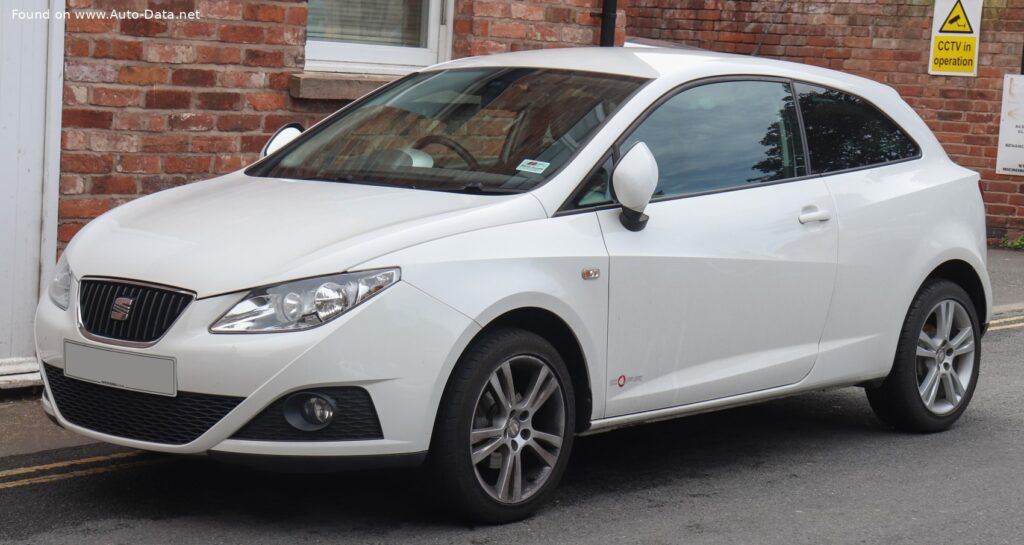
The Seat Ibiza IV SC adopted a distinctive “Coupe” body type, characterized by its three-door configuration and a more rakish, sporty profile compared to its five-door hatchback sibling. Designed under the leadership of Luc Donckerwolke, the Ibiza IV SC showcased Seat’s then-new “Arrow Design” language, featuring sharp lines, prominent wheel arches, and a distinctive front fascia that gave it a youthful and dynamic appearance. With an overall length of 158.82 inches (4034 mm), a width of 66.65 inches (1693 mm), and a height of 56.22 inches (1428 mm), the Ibiza SC was perfectly sized for maneuvering through crowded European city streets while still offering a practical interior. Its wheelbase of 97.2 inches (2469 mm) contributed to agile handling and a comfortable ride.
Despite its compact exterior, the Ibiza IV SC provided seating for five occupants, making it a versatile option for small families or groups. The trunk space offered a minimum of 10.03 cubic feet (284 liters), which was competitive for its class and sufficient for daily errands or weekend trips.
Standard features for the era included a robust safety suite with an Anti-lock Braking System (ABS) and front ventilated disc brakes, complemented by ventilated disc brakes at the rear – an uncommon but welcome feature for a subcompact of this vintage, usually equipped with rear drums. The hydraulic power steering system provided direct feedback and ease of maneuverability, particularly useful in urban environments. The suspension setup featured an independent McPherson strut system with coil springs and an anti-roll bar at the front, while the rear utilized hydraulic elements, balancing ride comfort with responsive handling. The car offered a range of tire sizes from 175/70 R14 up to 215/40 R17, allowing for varying levels of grip and aesthetic appeal.
Technical Specifications
| Category | Specification | US Equivalent (Approx.) |
|---|---|---|
| General Information | ||
| Brand | Seat | |
| Model | Ibiza | |
| Generation | Ibiza IV SC | |
| Type (Engine) | 1.4 TDI (80 Hp) DPF | |
| Start of Production | 2008 year | |
| End of Production | 2010 year | |
| Powertrain Architecture | Internal Combustion engine | |
| Body Type | Coupe (3 Doors) | |
| Seats | 5 | |
| Doors | 3 | |
| Performance Specifications | ||
| Fuel Consumption (Urban) | 5.6 l/100 km | 42 US mpg |
| Fuel Consumption (Extra Urban) | 3.6 l/100 km | 65.3 US mpg |
| Fuel Consumption (Combined) | 4.3 l/100 km | 54.7 US mpg |
| Fuel Type | Diesel | |
| Acceleration 0 – 60 mph | 12.3 sec | |
| Acceleration 0 – 100 km/h | 12.9 sec | |
| Maximum Speed | 170 km/h | 105.63 mph |
| Emission Standard | Euro 4 | |
| Weight-to-Power Ratio | 13.4 kg/Hp | 29.54 lbs/Hp |
| Weight-to-Torque Ratio | 5.5 kg/Nm | 12.13 lbs/Nm |
| Engine Specifications | ||
| Power | 80 Hp @ 4000 rpm | |
| Power per Liter | 56.3 Hp/l | |
| Torque | 195 Nm @ 2200 rpm | 143.82 lb-ft @ 2200 rpm |
| Engine Layout | Front, Transverse | |
| Engine Model/Code | BMS | |
| Engine Displacement | 1422 cm³ | 86.78 cu. in. (1.4 L) |
| Number of Cylinders | 3 | |
| Engine Configuration | Inline | |
| Cylinder Bore | 79.5 mm | 3.13 in. |
| Piston Stroke | 95.5 mm | 3.76 in. |
| Compression Ratio | 19.5:1 | |
| Number of Valves per Cylinder | 2 | |
| Fuel Injection System | Diesel Commonrail | |
| Engine Aspiration | Turbocharger, Intercooler | |
| Valvetrain | OHC | |
| Engine Oil Capacity | 4.4 l | 4.65 US qt |
| Coolant Capacity | 8 l | 8.45 US qt |
| Engine Systems | Particulate filter | |
| Space, Volume, and Weights | ||
| Kerb Weight | 1075 kg | 2369.97 lbs |
| Max. Weight | 1576 kg | 3474.49 lbs |
| Max Load | 501 kg | 1104.52 lbs |
| Trunk (Boot) Space – Minimum | 284 l | 10.03 cu. ft. |
| Fuel Tank Capacity | 45 l | 11.89 US gal |
| Dimensions | ||
| Length | 4034 mm | 158.82 in. |
| Width | 1693 mm | 66.65 in. |
| Height | 1428 mm | 56.22 in. |
| Wheelbase | 2469 mm | 97.2 in. |
| Front Track | 1465 mm | 57.68 in. |
| Rear (Back) Track | 1457 mm | 57.36 in. |
| Minimum Turning Circle | 10.48 m | 34.38 ft. |
| Drivetrain, Brakes, and Suspension | ||
| Drivetrain Architecture | Front-wheel drive, Internal Combustion Engine (ICE) | |
| Drive Wheel | Front-wheel drive | |
| Number of Gears and Type of Gearbox | 5 gears, automatic transmission | |
| Front Suspension | Independent, McPherson with coil spring and anti-roll bar | |
| Rear Suspension | Hydraulic elements | |
| Front Brakes | Ventilated discs | |
| Rear Brakes | Ventilated discs | |
| Assisting Systems | ABS (Anti-lock braking system) | |
| Power Steering | Hydraulic Steering | |
| Tires Size | 175/70 R14, 185/60 R15, 215/45 R16, 215/40 R17 | |
| Wheel Rims Size | 5.0J x 14; 6.0J x 15; 7.0J x 16; 7.0J x 17 | |
Legacy and Market Impact
The Seat Ibiza, particularly its fourth generation, played a crucial role in solidifying Seat’s identity within the competitive European automotive landscape. As a brand within the Volkswagen Group, Seat was positioned to offer a more emotional, youthful, and sporty alternative to its more conservative siblings like the Volkswagen Polo (with which it shared its platform). The Ibiza IV SC 1.4 TDI (80 Hp) DPF perfectly embodied this philosophy, offering a visually appealing, spirited compact car that didn’t compromise on the practicality and exceptional fuel economy demanded by European consumers.
In its primary markets, the Ibiza IV SC faced stiff competition from established players in the B-segment. Key rivals included the Volkswagen Polo, Ford Fiesta, Renault Clio, Peugeot 207, and Opel Corsa. What set the Ibiza SC apart was its distinctive design, which often appealed to buyers looking for something a bit more expressive than the segment’s mainstream offerings. The “SC” designation emphasized its sportier, three-door coupe-like styling, drawing in younger demographics or those prioritizing aesthetics and agility over maximum practicality.
The 1.4 TDI (80 Hp) DPF variant, in particular, contributed to the Ibiza’s reputation for efficiency. During its production run, diesel engines were highly popular in Europe due to their superior fuel economy and torque characteristics, especially important with rising fuel prices. The inclusion of a Diesel Particulate Filter (DPF) was a forward-thinking move, aligning with evolving emission standards and showcasing Seat’s commitment to cleaner diesel technology. This made the Ibiza a smart choice for long-distance commuters and environmentally conscious buyers alike.
Historically, the Ibiza IV SC helped to cement Seat’s image as a brand that offered stylish, well-engineered cars with a Spanish flair. It demonstrated that a compact car could be both economical and engaging to drive, without needing a high-performance engine. Its robust chassis, shared with the VW Polo, provided a solid foundation for dynamic handling, further enhancing its appeal. While it may not have been a direct competitor in the North American market, the Seat Ibiza IV SC 1.4 TDI (80 Hp) DPF remains a significant example of European automotive engineering, balancing design, efficiency, and driving pleasure in a compact package that resonated strongly with its target audience. Its legacy lies in its contribution to the evolution of the modern subcompact, proving that small cars could be both practical and passionate.