Introduction to the Seat Ibiza IV SC 1.6 MPI (105 Hp)
The Seat Ibiza IV SC 1.6 MPI (105 Hp) represents a distinct chapter in the history of SEAT, the Spanish automotive manufacturer known for its vibrant designs and sporty driving dynamics. Introduced in 2008 as part of the fourth generation Ibiza lineup, the SC (SportCoupe) variant brought a more athletic and visually striking 3-door body style to the highly competitive European supermini segment. While SEAT vehicles are not typically sold in the United States, the Ibiza has long been a cornerstone of the brand’s success in its primary European and other international markets, embodying SEAT’s “Auto Emoción” philosophy. This specific model, produced from 2008 to November 2009, was powered by a reliable 1.6-liter Multi-Point Injection (MPI) gasoline engine, offering a blend of efficiency, adequate performance, and stylish packaging for urban drivers and young professionals seeking a spirited compact car.
The fourth-generation Ibiza, designed under the leadership of Luc Donckerwolke, marked a significant evolution for the model, moving to the Volkswagen Group’s PQ25 platform, which it shared with the contemporary Volkswagen Polo and Skoda Fabia. This platform provided a solid foundation for improved ride quality, handling, and safety. The SC variant, in particular, was aimed at buyers who prioritized aesthetics and a sportier image over the absolute practicality of the 5-door hatchback, offering a more dynamic profile without sacrificing the compact dimensions ideal for European city driving.
Engine and Performance of the Seat Ibiza IV SC 1.6 MPI (105 Hp)
At the heart of the Seat Ibiza IV SC 1.6 MPI (105 Hp) was a naturally aspirated, 1.6-liter (1598 cm³ or 97.52 cubic inches) inline-four gasoline engine. This powerplant, designated with the internal code BTS, was engineered for dependable performance and reasonable fuel efficiency within its class. It delivered a peak output of 105 horsepower at 5600 rpm, providing a lively character for a vehicle of its size and weight. Torque figures stood at 112.85 lb.-ft. (153 Nm) available at 3800 rpm, ensuring accessible pulling power in everyday driving scenarios.
Power was transmitted to the front wheels through a precise 5-speed manual transmission, a common and engaging choice for supermini vehicles of this era. This drivetrain architecture allowed the Ibiza SC 1.6 MPI to accelerate from 0 to 60 mph in a respectable 9.9 seconds (0-100 km/h in 10.4 seconds), with a maximum speed reaching 117.44 mph (189 km/h). These figures positioned the Ibiza SC as a capable performer for its segment, suitable for both city commutes and occasional highway excursions.
Fuel economy was a key consideration, and the 1.6 MPI engine offered competitive numbers for its time. The combined fuel consumption was rated at 37.3 US mpg (6.3 l/100 km), with urban driving yielding approximately 28 US mpg (8.4 l/100 km) and extra-urban conditions achieving an impressive 47 US mpg (5 l/100 km). This efficiency, coupled with a 11.89 US gallon (45 liter) fuel tank, provided a practical cruising range. Furthermore, the engine adhered to the Euro 4 emission standard, reflecting its environmental compliance for the period. The vehicle’s weight-to-power ratio was 9.7 kg/Hp (103.4 Hp/tonne), underscoring its nimble and responsive nature.
Design and Features
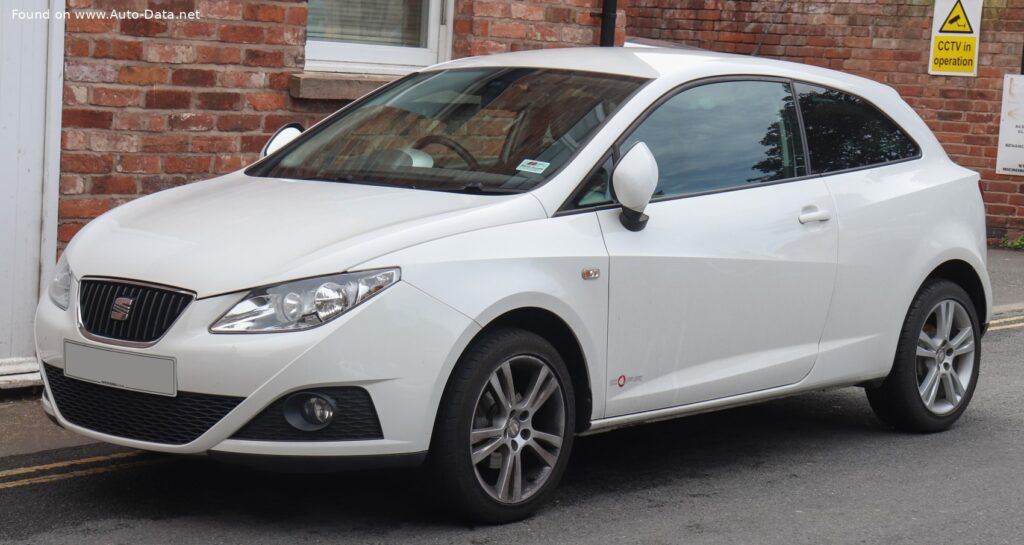
The design of the Seat Ibiza IV SC was a significant departure from its predecessor, introducing SEAT’s “Arrow Design” language. The 3-door “SportCoupe” body type, measuring 159.17 inches (4043 mm) in length, 66.65 inches (1693 mm) in width, and 56.22 inches (1428 mm) in height, featured sharp lines, a distinctive grille, and angular headlights that gave it a much more aggressive and contemporary look. The coupe profile, with its sloping roofline and pronounced shoulder line, emphasized its sporty intentions, appealing to a younger, design-conscious demographic. Despite its coupe designation, it offered seating for five, though rear passenger comfort would naturally be more constrained than in the 5-door hatchback.
Inside, the Ibiza SC featured a functional and modern cabin. While specific luxury features varied by trim level, the core design emphasized ergonomics and a driver-focused layout. The trunk space offered a practical 10.03 cubic feet (284 liters), which was commendable for a compact 3-door vehicle. Key technical features contributing to its driving dynamics and safety included an independent McPherson strut front suspension with a coil spring and anti-roll bar, paired with a trailing arm rear suspension. This setup provided a balanced ride and handling experience.
Braking duties were handled by ventilated discs at the front and solid discs at the rear, augmented by an Anti-lock Braking System (ABS) for enhanced stopping power and control. Steering was managed by a hydraulic rack and pinion system, offering direct feedback to the driver, a characteristic appreciated by enthusiasts. The Ibiza SC was available with a range of tire and wheel sizes, from 185/60 R15 to sportier 215/45 R16 and 215/40 R17 options, allowing for personalization and further enhancing its visual appeal and handling capabilities. The vehicle’s compact dimensions and a minimum turning circle of 34.38 feet (10.48 m) made it highly maneuverable in urban environments.
Technical Specifications
| Feature | Specification |
|---|---|
| Brand | Seat |
| Model | Ibiza IV SC |
| Type (Engine) | 1.6 MPI (105 Hp) |
| Production Start | 2008 |
| Production End | November, 2009 |
| Powertrain Architecture | Internal Combustion engine |
| Body Type | Coupe (3 Doors) |
| Seats | 5 |
| Fuel Consumption (Urban) | 28 US mpg (8.4 l/100 km) |
| Fuel Consumption (Extra Urban) | 47 US mpg (5 l/100 km) |
| Fuel Consumption (Combined) | 37.3 US mpg (6.3 l/100 km) |
| Fuel Type | Gasoline |
| Acceleration 0 – 60 mph | 9.9 seconds |
| Acceleration 0 – 62 mph (100 km/h) | 10.4 seconds |
| Maximum Speed | 117.44 mph (189 km/h) |
| Emission Standard | Euro 4 |
| Curb Weight | 2237.69 lbs (1015 kg) |
| Max. Weight | 3342.21 lbs (1516 kg) |
| Max Load | 1104.52 lbs (501 kg) |
| Weight-to-Power Ratio | 9.7 kg/Hp (103.4 Hp/tonne) |
| Weight-to-Torque Ratio | 6.6 kg/Nm (150.7 Nm/tonne) |
| Power | 105 Hp @ 5600 rpm |
| Power per Liter | 65.7 Hp/l |
| Torque | 112.85 lb.-ft. (153 Nm) @ 3800 rpm |
| Engine Layout | Front, Transverse |
| Engine Model/Code | BTS |
| Engine Displacement | 1.6 Liters (1598 cm³ / 97.52 cu. in.) |
| Number of Cylinders | 4 |
| Engine Configuration | Inline |
| Cylinder Bore | 3.01 in (76.5 mm) |
| Piston Stroke | 3.42 in (86.9 mm) |
| Valves per Cylinder | 4 |
| Fuel Injection System | Multi-port manifold injection |
| Engine Aspiration | Naturally aspirated |
| Engine Oil Capacity | 3.8 US qt (3.6 l) |
| Engine Oil Specification | Not specified in data |
| Coolant Capacity | 5.92 US qt (5.6 l) |
| Trunk Space (Minimum) | 10.03 cu. ft. (284 l) |
| Fuel Tank Capacity | 11.89 US gal (45 l) |
| Length | 159.17 in (4043 mm) |
| Width | 66.65 in (1693 mm) |
| Height | 56.22 in (1428 mm) |
| Wheelbase | 97.2 in (2469 mm) |
| Front Track | 57.68 in (1465 mm) |
| Rear Track | 57.36 in (1457 mm) |
| Minimum Turning Circle | 34.38 ft (10.48 m) |
| Drivetrain Architecture | Front-wheel drive (ICE drives front wheels) |
| Drive Wheel | Front-wheel drive |
| Number of Gears | 5 |
| Gearbox Type | Manual transmission |
| Front Suspension | Independent, McPherson with coil spring and anti-roll bar |
| Rear Suspension | Trailing arm |
| Front Brakes | Ventilated discs |
| Rear Brakes | Disc |
| Assisting Systems | ABS (Anti-lock braking system) |
| Steering Type | Steering rack and pinion |
| Power Steering | Hydraulic Steering |
| Tire Sizes | 185/60 R15; 215/45 R16; 215/40 R17 |
| Wheel Rims Size | 15; 16; 17 |
Legacy and Market Impact
The fourth-generation Seat Ibiza, including the SC variant, played a pivotal role in solidifying SEAT’s brand identity within the Volkswagen Group. Positioned as the sportier, more emotionally driven sibling to the Volkswagen Polo, the Ibiza leveraged its “Auto Emoción” tagline to appeal to a younger, more dynamic customer base. The introduction of the SC body style was particularly significant, as it allowed SEAT to offer a more overtly sporting and design-focused option in a segment traditionally dominated by practical 5-door hatchbacks. This bold move helped differentiate the Ibiza from its platform mates and other competitors.
In its primary European market, the Seat Ibiza IV SC 1.6 MPI (105 Hp) faced stiff competition from a multitude of well-established supermini rivals. Key competitors included the Ford Fiesta, Opel Corsa (Vauxhall Corsa in the UK), Renault Clio, Peugeot 207, and, of course, the Volkswagen Polo. What set the Ibiza SC apart was its distinctive styling and a perceived sportiness in its handling, offering a more engaging driving experience than some of its more comfort-oriented peers. While the 1.6 MPI engine was not the most powerful in the lineup, it struck a commendable balance between performance, reliability, and running costs, making it a popular choice for many buyers.
Despite the relatively short production run for this specific 1.6 MPI engine variant (2008-2009) within the broader fourth generation, which continued until 2017, it contributed to the Ibiza’s overall success. The model’s impact extended beyond sales figures; it helped shape SEAT’s design language for subsequent models, influencing the aesthetic direction of the brand for years to come. The Ibiza SC’s bold lines and dynamic proportions demonstrated SEAT’s capability to produce vehicles that were not only practical and efficient but also imbued with a strong sense of style and personality. It remains a testament to SEAT’s commitment to offering compelling alternatives in the competitive compact car segment, appealing to those who desire a touch of flair with their daily driver. Its legacy is that of an accessible, stylish, and fun-to-drive European compact that punched above its weight in terms of visual appeal and driving engagement.