The SEAT Ibiza IV SC 1.6 MPI DSG: A Dynamic European Compact (2008-2009)
The SEAT Ibiza IV SC 1.6 MPI (105 Hp) DSG represents a significant iteration of the popular Spanish automaker’s subcompact offering, specifically the “SportCoupe” variant from its fourth generation. Launched in 2008, this particular model, with its 1.6-liter Multi-Point Injection gasoline engine and advanced 7-speed Direct-Shift Gearbox (DSG), carved out a niche in the highly competitive European B-segment. Produced for a relatively short period, concluding in November 2009, the Ibiza IV SC underscored SEAT’s commitment to delivering stylish, sporty, and technologically current vehicles to its primary markets across Europe and beyond. While never officially sold in the United States, the Ibiza is a cornerstone of SEAT’s product lineup, embodying the brand’s youthful and passionate design philosophy within the Volkswagen Group portfolio. This generation, designed under the leadership of Luc Donckerwolke, moved the Ibiza’s styling forward, presenting a more angular and assertive aesthetic compared to its predecessors.
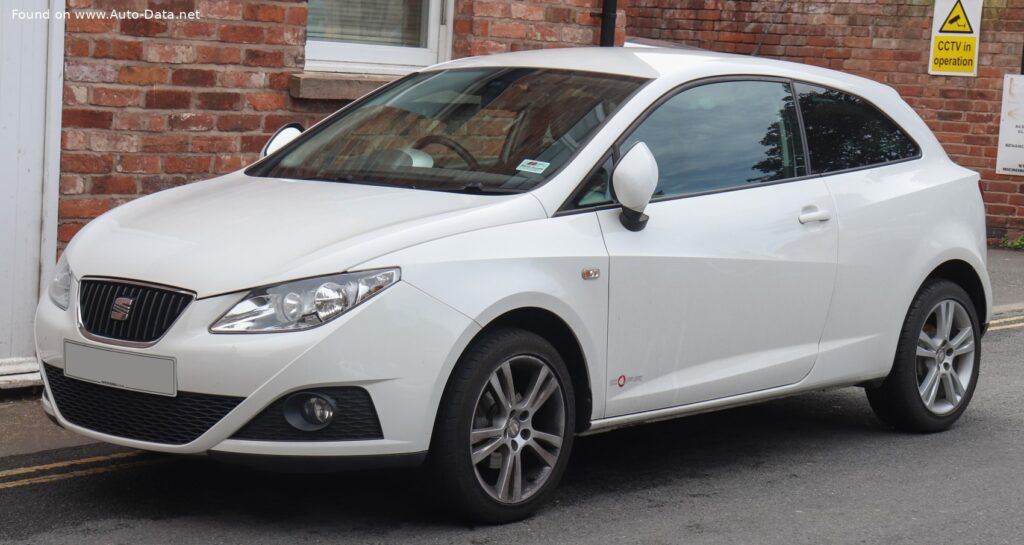
The “SC” designation, signifying SportCoupe, highlighted its three-door body style, which offered a more dynamic and less utilitarian appeal than its five-door hatchback sibling. This configuration targeted younger buyers or those seeking a more personal, sport-oriented vehicle without sacrificing the practicalities inherent in a compact car. The integration of the DSG transmission, a sophisticated dual-clutch automatic gearbox, was a notable technological advancement for a vehicle in this class during its production run, promising both efficiency and engaging performance. The Seat Ibiza IV SC 1.6 MPI DSG was engineered to provide a compelling blend of everyday usability, spirited driving dynamics, and contemporary features, all wrapped in a distinctive European package.
Engine and Performance: The 1.6 MPI Heart of the Seat Ibiza IV SC 1.6 MPI DSG
At the core of this particular SEAT Ibiza IV SC was a naturally aspirated 1.6-liter (1598 cm³ or 97.52 cu. in.) Multi-Point Injection (MPI) gasoline engine, identified by the engine code BTS. This inline four-cylinder unit, with four valves per cylinder, was configured in a front, transverse layout, driving the front wheels. It produced a respectable 105 horsepower at 5600 revolutions per minute (rpm) and 112.85 lb.-ft. of torque at 3800 rpm. For a vehicle of its size and segment, these figures provided a lively, yet economical, performance profile suitable for urban commuting and highway cruising alike. The engine’s multi-port manifold injection system ensured efficient fuel delivery, contributing to its Euro 5 emission standard compliance, which was a strong environmental credential for its time.
A standout feature of the powertrain was the sophisticated 7-speed DSG (Direct-Shift Gearbox) automatic transmission. This dual-clutch unit was a significant technological differentiator in the compact segment, offering rapid, smooth gear changes that traditionally only manual transmissions could provide with such efficiency. The DSG contributed significantly to the car’s performance metrics, enabling the Ibiza IV SC 1.6 MPI to accelerate from 0 to 60 mph in a brisk 9.6 seconds. This placed it competitively against other hot hatches and compact coupes of the era. Its top speed was rated at 116.82 mph, demonstrating its capability for sustained highway speeds.
Fuel economy was also a strong suit, thanks in part to the efficient engine design and the DSG’s ability to maintain optimal engine speeds. The combined fuel consumption was an impressive 40.6 US miles per gallon (5.8 liters per 100 km). Urban driving yielded around 30.5 US mpg, while extra-urban conditions saw it achieve an excellent 49 US mpg. These figures highlighted the Ibiza’s appeal as an economical daily driver, especially important in fuel-conscious European markets. The engine oil capacity was 3.8 US quarts, and the cooling system held 5.92 US quarts, indicating a compact and well-integrated powertrain design.
Design and Features: The SportCoupe Aesthetic
The SEAT Ibiza IV SC distinguished itself visually with its three-door “Coupe” body style, a departure from the more common five-door hatchback. This design choice gave the vehicle a sportier, more dynamic stance, emphasizing its youthful appeal. Its exterior dimensions were compact yet purposeful: a length of 158.82 inches, a width of 66.65 inches, and a height of 56.22 inches. The wheelbase measured 97.2 inches, providing a stable platform for its agile handling characteristics. The design language, characterized by sharp lines, pronounced wheel arches, and a distinctive “arrow design” front end, was both modern and assertive for the late 2000s.
Despite its coupe designation, the Ibiza IV SC was designed to comfortably accommodate five occupants, making it a versatile option for small families or groups of friends. Trunk space was a respectable 10.03 cubic feet (284 liters), offering sufficient capacity for groceries, luggage, or sports equipment. The fuel tank capacity of 11.89 US gallons provided a decent range, complementing its efficient fuel consumption.
Underneath its stylish exterior, the Ibiza IV SC featured a well-engineered chassis. The front suspension utilized an independent McPherson strut setup with coil springs and an anti-roll bar, a common and effective design for precise steering and ride comfort. The rear suspension employed a trailing arm design, a compact and robust solution for front-wheel-drive compacts. Braking performance was handled by ventilated discs at the front and solid discs at the rear, augmented by an Anti-lock Braking System (ABS) for enhanced safety and control during emergency stops. The steering system was an electric power-assisted rack and pinion unit, providing light effort at low speeds for parking and more feedback at higher speeds. Tire options ranged from 185/60 R15 for comfort and efficiency, up to 215/40 R17 for improved grip and a sportier aesthetic, reflecting the car’s dynamic capabilities.
Technical Specifications
| Attribute | Specification |
|---|---|
| Brand | SEAT |
| Model | Ibiza IV SC |
| Type (Engine) | 1.6 MPI (105 Hp) DSG |
| Start of Production | 2008 |
| End of Production | November, 2009 |
| Body Type | Coupe (3 Doors) |
| Seats | 5 |
| Powertrain Architecture | Internal Combustion engine |
| Fuel Type | Petrol (Gasoline) |
| Engine Layout | Front, Transverse |
| Engine Model/Code | BTS |
| Engine Displacement | 1598 cm³ (1.6 Liters / 97.52 cu. in.) |
| Number of Cylinders | 4 (Inline) |
| Cylinder Bore | 3.01 in. (76.5 mm) |
| Piston Stroke | 3.42 in. (86.9 mm) |
| Number of Valves per Cylinder | 4 |
| Fuel Injection System | Multi-port manifold injection |
| Engine Aspiration | Naturally aspirated |
| Power | 105 Hp @ 5600 rpm |
| Power per Liter | 65.7 Hp/l |
| Torque | 112.85 lb.-ft. (153 Nm) @ 3800 rpm |
| Acceleration 0-60 mph | 9.6 sec |
| Acceleration 0-62 mph (0-100 km/h) | 10.1 sec |
| Maximum Speed | 116.82 mph (188 km/h) |
| Fuel Consumption (Urban) | 30.5 US mpg (7.7 l/100 km) |
| Fuel Consumption (Extra Urban) | 49 US mpg (4.8 l/100 km) |
| Fuel Consumption (Combined) | 40.6 US mpg (5.8 l/100 km) |
| Emission Standard | Euro 5 |
| Drivetrain Architecture | Front-wheel drive |
| Number of Gears & Gearbox Type | 7 gears, automatic transmission DSG |
| Front Suspension | Independent, McPherson with coil spring and anti-roll bar |
| Rear Suspension | Trailing arm |
| Front Brakes | Ventilated discs |
| Rear Brakes | Disc |
| Assisting Systems | ABS (Anti-lock braking system) |
| Steering Type | Steering rack and pinion |
| Power Steering | Electric Steering |
| Tires Size | 185/60 R15; 215/45 R16; 215/40 R17 |
| Wheel Rims Size | 15; 16; 17 |
| Length | 158.82 in. (4034 mm) |
| Width | 66.65 in. (1693 mm) |
| Height | 56.22 in. (1428 mm) |
| Wheelbase | 97.2 in. (2469 mm) |
| Front Track | 57.68 in. (1465 mm) |
| Rear Track | 57.36 in. (1457 mm) |
| Minimum Turning Circle | 34.38 ft. (10.48 m) |
| Kerb Weight | 2303.83 lbs. (1045 kg) |
| Max. Weight | 3408.35 lbs. (1546 kg) |
| Max Load | 1104.52 lbs. (501 kg) |
| Weight-to-Power Ratio | 10 kg/Hp (100.5 Hp/tonne) |
| Weight-to-Torque Ratio | 6.8 kg/Nm (146.4 Nm/tonne) |
| Trunk (boot) Space – Minimum | 10.03 cu. ft. (284 l) |
| Fuel Tank Capacity | 11.89 US gal (45 l) |
| Engine Oil Capacity | 3.8 US qt (3.6 l) |
| Coolant Capacity | 5.92 US qt (5.6 l) |
Legacy and Market Impact
The SEAT Ibiza IV SC 1.6 MPI (105 Hp) DSG, while a specific variant, contributed to the overall success and reputation of the fourth-generation Ibiza. In its primary European markets, the Ibiza was a direct competitor to established segment leaders such as the Volkswagen Polo (with which it shared its PQ25 platform), Ford Fiesta, Renault Clio, and Peugeot 207. SEAT’s strategy was to position the Ibiza as the sportier, more emotionally charged alternative within the compact segment, appealing to buyers who valued design and driving engagement. The SC variant, in particular, offered a stylish coupe-like silhouette that stood out from the more conventional five-door hatchbacks dominating the segment.
The introduction of the 7-speed DSG transmission in a mass-market compact car like the Ibiza was a significant technological statement for SEAT and the Volkswagen Group. It demonstrated that advanced, efficient, and performance-oriented automatic transmissions were becoming accessible even in smaller, more affordable vehicles, moving beyond the traditional torque-converter automatics or less sophisticated automated manuals of the time. This move helped to elevate the Ibiza’s perceived sophistication and driving appeal.
Though its production run for this specific engine and transmission combination was relatively brief (2008-2009), it played a crucial role in establishing the fourth-generation Ibiza’s credentials as a modern, well-equipped, and dynamically capable compact car. It reinforced SEAT’s brand identity as the “hot-blooded” Spanish marque within the VW Group, known for its blend of German engineering and Mediterranean flair. The Ibiza IV, and particularly its SC variant, helped SEAT maintain its strong market presence in countries like Spain, Germany, and the UK, and laid the groundwork for future generations of the Ibiza to continue as a core pillar of the brand’s global strategy. Its legacy is one of a stylish, efficient, and technologically forward-thinking compact that offered a compelling alternative in a crowded segment.