Introduction to the Seat Ibiza IV SC (facelift 2012) 1.2 TSI (105 Hp) Eco Technology
The Seat Ibiza, a cornerstone of the Spanish automaker’s lineup, has long been recognized for its blend of spirited driving dynamics, contemporary design, and practical urban usability. The fourth generation, introduced in 2008, received a significant refresh in 2012, bringing updated aesthetics and refined powertrains to the popular supermini segment. Among the variants, the Seat Ibiza IV SC (facelift 2012) 1.2 TSI (105 Hp) Eco Technology stood out as a compelling option, particularly in its primary European market. The “SC” designation, short for SportCoupé, denoted the three-door body style, emphasizing a sportier profile compared to its five-door sibling.
Produced from 2012 to 2015, this specific iteration of the Ibiza was a prime example of Volkswagen Group’s strategy of offering advanced, downsized turbocharged engines across its brands. The “Eco Technology” label highlighted Seat’s commitment to efficiency, integrating features designed to minimize fuel consumption and emissions without sacrificing performance. While the Seat brand is not officially sold in the United States, the Ibiza’s role in Europe is akin to popular subcompacts like the Ford Fiesta or Chevrolet Sonic, serving as an accessible and stylish entry point into the automotive market, particularly for younger buyers or those prioritizing urban maneuverability and fuel economy.
Engine and Performance of the Seat Ibiza IV SC (facelift 2012) 1.2 TSI (105 Hp) Eco Technology
At the heart of the Seat Ibiza IV SC (facelift 2012) 1.2 TSI (105 Hp) Eco Technology lies a highly efficient 1.2-liter (1197 cm3 or 73.05 cu. in.) turbocharged inline-four gasoline engine. This direct-injection unit, designated with the internal code CBZB, was a testament to the advancements in small-displacement engine technology during the early 2010s. Despite its modest size, the turbocharger and intercooler allowed it to punch well above its weight, delivering a respectable 105 horsepower at 5000 revolutions per minute. This power output, combined with the engine’s inherent efficiency, resulted in a power-per-liter ratio of 87.7 Hp/l, impressive for a non-performance-oriented compact car.
Perhaps even more crucial than its horsepower figure was the torque delivery. The 1.2 TSI engine produced a robust 175 Nm (129.07 lb.-ft.) of torque, available across a broad and usable rev range from 1550 to 4100 rpm. This wide torque band was a hallmark of TSI engines, ensuring strong acceleration from low speeds and reducing the need for frequent gear changes, a significant benefit in both city driving and highway cruising. Power was sent to the front wheels via a smooth-shifting 5-speed manual transmission, a common and reliable choice for this segment.
Performance figures for the Seat Ibiza IV SC (facelift 2012) 1.2 TSI (105 Hp) Eco Technology were competitive for its class. It could accelerate from 0 to 60 mph in a brisk 9.3 seconds (0-100 km/h in 9.8 seconds) and reach a top speed of 118.06 mph (190 km/h). These numbers showcased its capability as a nimble and responsive daily driver. Furthermore, the “Eco Technology” moniker wasn’t just marketing; the car achieved excellent fuel economy, with a combined rating of 46.1 US mpg (5.1 l/100 km) and an impressive 52.3 US mpg (4.5 l/100 km) on the extra-urban cycle. It also met the Euro 5 emission standard, reflecting its commitment to environmental responsibility.
Design and Features of the Ibiza SC Facelift
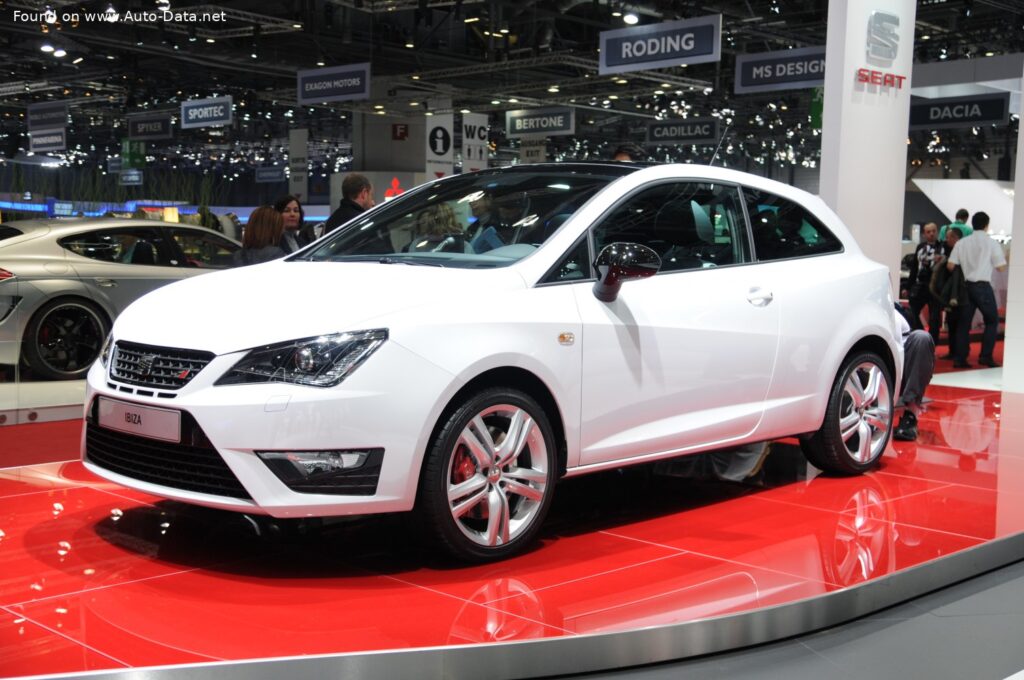
The 2012 facelift brought a sharper, more aggressive aesthetic to the fourth-generation Ibiza, particularly evident in the SC (SportCoupé) three-door variant. Seat, often described as the “sporty” brand within the Volkswagen Group, infused the Ibiza SC with design cues that conveyed dynamism and youthfulness. The front fascia received redesigned headlights with optional LED daytime running lights, a more angular grille, and a sportier bumper, giving the car a more assertive presence. The overall silhouette of the Seat Ibiza IV SC (facelift 2012) remained sleek, characterized by its coupé-like roofline and strong character lines running along the flanks.
Measuring 159.17 inches (4043 mm) in length, 66.65 inches (1693 mm) in width, and 56.22 inches (1428 mm) in height, with a wheelbase of 97.2 inches (2469 mm), the Ibiza SC was compact yet offered a surprisingly spacious interior for its segment. Despite being a three-door “coupé,” it was still designed to comfortably seat five occupants, although the rear seats were best suited for shorter journeys or children. The trunk space was a practical 10.03 cu. ft. (284 liters), competitive for a car of its size, providing enough room for groceries or weekend luggage.
Inside, the facelift introduced updated materials and minor ergonomic improvements. While not luxurious, the cabin was well-built with typical Volkswagen Group solidity. Standard features for the era included power steering (electric, for improved efficiency), a basic audio system, and climate control. Safety was a key consideration, and the Ibiza SC came equipped with an Anti-lock Braking System (ABS), ventilated discs at the front, and disc brakes at the rear, ensuring confident stopping power. Various wheel and tire options were available, ranging from 185/60 R15 to sportier 215/40 R17 setups, allowing buyers to customize the car’s stance and handling characteristics. The suspension setup, featuring independent McPherson struts with coil springs and an anti-roll bar at the front and a trailing arm design at the rear, provided a good balance of comfort and agile handling, staying true to Seat’s sporty image.
Technical Specifications: Seat Ibiza IV SC (facelift 2012) 1.2 TSI (105 Hp) Eco Technology
| General Information | |
|---|---|
| Brand | Seat |
| Model | Ibiza |
| Generation | Ibiza IV SC (facelift 2012) |
| Type (Engine) | 1.2 TSI (105 Hp) Eco Technology |
| Start of production | 2012 year |
| End of production | 2015 year |
| Powertrain Architecture | Internal Combustion engine |
| Body type | Coupe |
| Seats | 5 |
| Doors | 3 |
| Performance Specifications | |
| Fuel consumption (economy) – urban | 6 l/100 km (39.2 US mpg) |
| Fuel consumption (economy) – extra urban | 4.5 l/100 km (52.3 US mpg) |
| Fuel consumption (economy) – combined | 5.1 l/100 km (46.1 US mpg) |
| Fuel Type | Petrol (Gasoline) |
| Acceleration 0 – 60 mph | 9.3 sec |
| Acceleration 0 – 100 km/h | 9.8 sec |
| Maximum speed | 190 km/h (118.06 mph) |
| Emission standard | Euro 5 |
| Weight-to-power ratio | 10.4 kg/Hp (22.93 lbs/Hp), 95.9 Hp/tonne |
| Weight-to-torque ratio | 6.3 kg/Nm (13.89 lbs/Nm), 159.8 Nm/tonne |
| Engine Specifications | |
| Power | 105 Hp @ 5000 rpm |
| Power per liter | 87.7 Hp/l |
| Torque | 175 Nm @ 1550-4100 rpm (129.07 lb.-ft. @ 1550-4100 rpm) |
| Engine layout | Front, Transverse |
| Engine Model/Code | CBZB |
| Engine displacement | 1197 cm3 (73.05 cu. in.) |
| Number of cylinders | 4 |
| Engine configuration | Inline |
| Cylinder Bore | 71 mm (2.8 in.) |
| Piston Stroke | 75.6 mm (2.98 in.) |
| Number of valves per cylinder | 2 |
| Fuel injection system | Direct injection |
| Engine aspiration | Turbocharger, Intercooler |
| Engine oil capacity | 3.9 l (4.12 US qt) |
| Coolant | 5.6 l (5.92 US qt) |
| Space, Volume and Weights | |
| Kerb Weight | 1095 kg (2414.06 lbs) |
| Max. weight | 1546 kg (3408.35 lbs) |
| Max load | 451 kg (994.28 lbs) |
| Trunk (boot) space – minimum | 284 l (10.03 cu. ft.) |
| Fuel tank capacity | 45 l (11.89 US gal) |
| Dimensions | |
| Length | 4043 mm (159.17 in.) |
| Width | 1693 mm (66.65 in.) |
| Height | 1428 mm (56.22 in.) |
| Wheelbase | 2469 mm (97.2 in.) |
| Front track | 1465 mm (57.68 in.) |
| Rear (Back) track | 1457 mm (57.36 in.) |
| Minimum turning circle (turning diameter) | 10.48 m (34.38 ft.) |
| Drivetrain, Brakes and Suspension Specifications | |
| Drivetrain Architecture | The Internal combustion engine (ICE) drives the front wheels of the vehicle. |
| Drive wheel | Front wheel drive |
| Number of gears and type of gearbox | 5 gears, manual transmission |
| Front suspension | Independent, type McPherson with coil spring and anti-roll bar |
| Rear suspension | Trailing arm |
| Front brakes | Ventilated discs |
| Rear brakes | Disc |
| Assisting systems | ABS (Anti-lock braking system) |
| Steering type | Steering rack and pinion |
| Power steering | Electric Steering |
| Tires size | 185/60 R15; 215/45 R16; 215/40 R17 |
| Wheel rims size | 6J x 15; 7J x 16; 7J x 17 |
Legacy and Market Impact
The Seat Ibiza has consistently been a strong performer for the Spanish brand, and the fourth-generation facelift, particularly models like the Seat Ibiza IV SC (facelift 2012) 1.2 TSI (105 Hp) Eco Technology, played a crucial role in maintaining its competitive edge in the fiercely contested European supermini segment. As a member of the Volkswagen Group, the Ibiza benefited from shared platforms and powertrains with its cousins, the Volkswagen Polo and Skoda Fabia. This allowed Seat to offer advanced engineering and reliability at a more accessible price point, often with a distinctively sportier design flair.
In its market, the Ibiza SC competed against formidable rivals such as the Ford Fiesta, Renault Clio, Peugeot 208, and Opel Corsa (Vauxhall Corsa in the UK). What set the Ibiza apart was its emphasis on a youthful, dynamic driving experience coupled with practical efficiency. The 1.2 TSI engine, in particular, was lauded for its impressive blend of performance and fuel economy, making it an attractive proposition for drivers seeking a car that was both fun to drive and economical to own. The “Eco Technology” features further enhanced its appeal to environmentally conscious buyers and those looking to minimize running costs.
The Ibiza’s reputation as a reliable, stylish, and engaging compact car solidified Seat’s position as a key player in the European automotive landscape. The SC variant, with its three-door coupé styling, resonated with buyers who prioritized aesthetics and a sportier image over maximum practicality. While not a global model, the success of the Ibiza, including this specific facelifted generation, allowed Seat to grow its brand identity and market share, proving that a blend of German engineering and Spanish passion could create a compelling product. The Seat Ibiza IV SC (facelift 2012) 1.2 TSI (105 Hp) Eco Technology remains a significant example of how compact cars can deliver a complete package of style, performance, and efficiency, setting a benchmark for its segment during its production run.