The Seat Ibiza IV SC (facelift 2012) 1.2 TSI (105 Hp) Start/Stop: A European Hot Hatch Contender
The
Seat Ibiza IV SC (facelift 2012) 1.2 TSI (105 Hp) start/stop
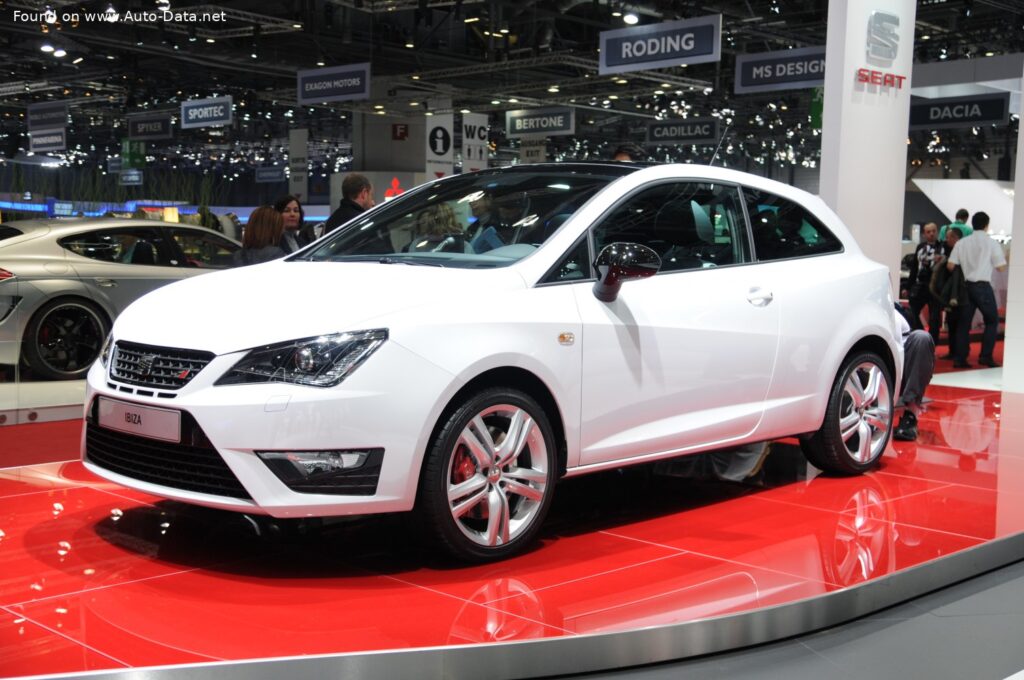
represents a significant chapter in the history of SEAT, the Spanish automotive manufacturer known for its vibrant, youth-oriented vehicles within the Volkswagen Group. Launched in 2012 as a refreshed iteration of the fourth-generation Ibiza, this specific model, the “SC” (Sport Coupe), offered a more dynamic and visually appealing three-door body style. While SEAT vehicles are not officially sold in the United States, the Ibiza is a cornerstone of the European B-segment (subcompact) market, competing fiercely against popular models like the Volkswagen Polo, Ford Fiesta, and Renault Clio. The 2012 facelift introduced subtle yet effective design enhancements, improved interior materials, and crucial technological updates, including the efficient 1.2-liter TSI engine paired with a start/stop system, aiming to strike an ideal balance between performance, fuel economy, and environmental responsibility for its target demographic. This particular variant, produced from 2012 to 2015, cemented its role as a stylish and practical choice for urban dwellers and younger drivers across the continent, embodying SEAT’s “Auto Emoción” philosophy with its spirited driving dynamics and distinctive Spanish flair.
Engine and Performance: The Heart of the
Seat Ibiza IV SC (facelift 2012)
Under the hood of the
Seat Ibiza IV SC (facelift 2012) 1.2 TSI (105 Hp) start/stop
lies a modern and highly efficient powertrain designed to deliver a lively driving experience without compromising on fuel economy. This particular model is equipped with a 1.2-liter (1197 cm3 or 73.05 cu. in.) inline four-cylinder engine, designated by the code CBZB. Far from being a basic naturally aspirated unit, this engine benefits from advanced turbocharging and an intercooler, a configuration that allows it to punch above its weight in terms of power output and torque delivery. It generates a respectable 105 horsepower at 5000 revolutions per minute (rpm), translating to a healthy 87.7 horsepower per liter.
Crucially, the engine’s turbocharging system ensures a broad and accessible torque band. It produces 175 Newton-meters (129.07 lb.-ft.) of torque, available across a wide range from a low 1550 rpm up to 4100 rpm. This characteristic is vital for everyday driving, providing strong acceleration from low speeds and reducing the need for constant gear changes, making it particularly well-suited for city driving and highway cruising. Power is sent to the front wheels via a precise five-speed manual transmission, offering direct engagement and control for the driver.
Performance figures for the
Seat Ibiza IV SC (facelift 2012) 1.2 TSI (105 Hp) start/stop
are competitive within its segment. It can accelerate from 0 to 60 mph in a brisk 9.3 seconds (0-100 km/h in 9.8 seconds), and reach a top speed of 118.06 mph (190 km/h). These numbers highlight its capability as a nimble and responsive vehicle, perfectly capable of handling both urban sprints and longer journeys.
Beyond raw performance, efficiency is a core tenet of this powertrain. The inclusion of a start/stop system is a key feature, automatically shutting off the engine when the vehicle is stationary (e.g., at traffic lights) and restarting it seamlessly when the clutch is engaged. This technology significantly contributes to reducing fuel consumption and CO2 emissions, especially in stop-and-go traffic. The combined fuel economy is rated at an impressive 48 US mpg (4.9 l/100 km), with extra-urban figures reaching 54.7 US mpg (4.3 l/100 km). CO2 emissions stand at a low 113 g/km, allowing it to meet the stringent Euro 5 emission standard, underscoring SEAT’s commitment to environmental responsibility.
Design and Features: Sporty Aesthetics and Practicality
The
Seat Ibiza IV SC (facelift 2012)
in its “SC” (Sport Coupe) guise is characterized by its distinctive three-door body and dynamic styling. The 2012 facelift brought subtle yet effective revisions that sharpened its appearance and modernized its appeal. Key exterior updates included redesigned headlights with available LED daytime running lights, a more aggressive grille, and updated bumper designs that gave the car a wider, more planted stance. The Sport Coupe moniker emphasized its sleeker profile compared to the more conventional five-door hatchback, featuring a more raked roofline and sportier rear quarter panels.
Measuring 159.17 inches (4043 mm) in length, 66.65 inches (1693 mm) in width, and 56.22 inches (1428 mm) in height, the Ibiza SC maintains compact dimensions, making it highly maneuverable in tight urban environments. Its wheelbase of 97.2 inches (2469 mm) contributes to both stable handling and a reasonably spacious cabin for a subcompact. The minimum turning circle of 34.38 feet (10.48 m) further enhances its agility in city driving.
Inside, the facelifted Ibiza received attention to detail aimed at improving perceived quality and ergonomics. While still a subcompact, the cabin offered seating for five, though the rear seats were more suited for two adults on shorter journeys or children. Material upgrades, revised instrument cluster graphics, and new infotainment options (depending on trim level, though not detailed here) enhanced the user experience. Standard features for the era typically included air conditioning, power windows, and a decent audio system.
From a safety perspective, the
Seat Ibiza IV SC (facelift 2012)
was equipped with essential modern safety systems. Anti-lock Braking System (ABS) was standard, ensuring controlled braking even under harsh conditions. The car featured ventilated discs at the front and disc brakes at the rear, providing confident stopping power for its relatively light 2414.06 lbs (1095 kg) curb weight. The chassis, featuring an independent McPherson strut front suspension with an anti-roll bar and a semi-independent coil spring rear suspension, provided a good balance of comfort and dynamic handling, characteristic of Volkswagen Group platforms. The steering system, a rack and pinion setup, offered precise and responsive feedback, contributing to the Ibiza’s engaging driving character.
Practicality was also considered, with a minimum trunk space of 10.03 cu. ft. (284 liters), which was competitive for its segment and body style. The fuel tank capacity of 11.89 US gallons (45 liters) combined with its excellent fuel economy provided a good cruising range. Tire options ranged from 185/60 R15 for efficiency to sportier 215/40 R17 for enhanced grip and aesthetics, allowing owners to customize the car’s look and feel.
Technical Specifications
| Category | Specification |
|---|---|
| General Information | |
| Brand | Seat |
| Model | Ibiza |
| Generation | Ibiza IV SC (facelift 2012) |
| Type (Engine) | 1.2 TSI (105 Hp) start/stop |
| Start of production | 2012 year |
| End of production | 2015 year |
| Powertrain Architecture | Internal Combustion engine |
| Body type | Coupe (3 Doors) |
| Seats | 5 |
| Doors | 3 |
| Performance Specs | |
| Fuel consumption (economy) – urban | 5.9 l/100 km (39.9 US mpg) |
| Fuel consumption (economy) – extra urban | 4.3 l/100 km (54.7 US mpg) |
| Fuel consumption (economy) – combined | 4.9 l/100 km (48 US mpg) |
| CO2 emissions | 113 g/km |
| Fuel Type | Petrol (Gasoline) |
| Acceleration 0 – 60 mph | 9.3 sec |
| Acceleration 0 – 100 km/h | 9.8 sec |
| Maximum speed | 190 km/h (118.06 mph) |
| Emission standard | Euro 5 |
| Weight-to-power ratio | 10.4 kg/Hp, 95.9 Hp/tonne |
| Weight-to-torque ratio | 6.3 kg/Nm, 159.8 Nm/tonne |
| Engine Specs | |
| Power | 105 Hp @ 5000 rpm |
| Power per liter | 87.7 Hp/l |
| Torque | 175 Nm @ 1550-4100 rpm (129.07 lb.-ft.) |
| Engine layout | Front, Transverse |
| Engine Model/Code | CBZB |
| Engine displacement | 1197 cm3 (73.05 cu. in.) |
| Number of cylinders | 4 |
| Engine configuration | Inline |
| Cylinder Bore | 71 mm (2.8 in.) |
| Piston Stroke | 75.6 mm (2.98 in.) |
| Compression ratio | 10:1 |
| Number of valves per cylinder | 2 |
| Fuel injection system | Direct injection |
| Engine aspiration | Turbocharger, Intercooler |
| Engine oil capacity | 3.9 l (4.12 US qt) |
| Coolant | 5.6 l (5.92 US qt) |
| Engine systems | Start & Stop System |
| Space, Volume and Weights | |
| Kerb Weight | 1095 kg (2414.06 lbs) |
| Max. weight | 1546 kg (3408.35 lbs) |
| Max load | 451 kg (994.28 lbs) |
| Trunk (boot) space – minimum | 284 l (10.03 cu. ft.) |
| Fuel tank capacity | 45 l (11.89 US gal) |
| Dimensions | |
| Length | 4043 mm (159.17 in.) |
| Width | 1693 mm (66.65 in.) |
| Height | 1428 mm (56.22 in.) |
| Wheelbase | 2469 mm (97.2 in.) |
| Front track | 1465 mm (57.68 in.) |
| Rear (Back) track | 1457 mm (57.36 in.) |
| Minimum turning circle | 10.48 m (34.38 ft.) |
| Drivetrain, Brakes and Suspension Specs | |
| Drivetrain Architecture | Front wheel drive. Internal Combustion engine. |
| Drive wheel | Front wheel drive |
| Number of gears and type of gearbox | 5 gears, manual transmission |
| Front suspension | Independent, type McPherson with coil spring and anti-roll bar |
| Rear suspension | Semi-independent, coil spring |
| Front brakes | Ventilated discs |
| Rear brakes | Disc |
| Assisting systems | ABS (Anti-lock braking system) |
| Steering type | Steering rack and pinion |
| Tires size | 185/60 R15; 215/45 R16; 215/40 R17 |
| Wheel rims size | 6.0J x 15; 7.0J x 16; 7.0J x 17 |
Legacy and Market Impact: The
Seat Ibiza IV SC (facelift 2012)
in Context
The
Seat Ibiza IV SC (facelift 2012) 1.2 TSI (105 Hp) start/stop
played a crucial role in maintaining SEAT’s strong position within the fiercely competitive European B-segment. As a brand, SEAT is often positioned as the sporty, design-led arm of the Volkswagen Group, sharing platforms and technology with Volkswagen and Skoda but infusing them with a distinct Spanish character and a more youthful appeal. The Ibiza, particularly in its SC form, perfectly encapsulated this brand identity.
In its primary European market, the Ibiza faced off against a formidable array of rivals. Key competitors included its platform-mate, the more conservative Volkswagen Polo, the dynamically acclaimed Ford Fiesta, the stylish Renault Clio, the practical Skoda Fabia, and other strong contenders like the Peugeot 208 and Opel Corsa. The Ibiza SC differentiated itself with its sharper styling, particularly appealing to buyers looking for a sportier aesthetic than a typical five-door hatchback without stepping into a full-blown hot hatch category.
The 1.2 TSI engine, a staple across the VW Group’s smaller models, was instrumental in the Ibiza’s success. It offered a compelling blend of performance and efficiency that resonated with a broad spectrum of buyers. For many, the 105 horsepower variant provided ample power for daily commutes and occasional spirited drives, while the impressive fuel economy (up to 48 US mpg combined) and low CO2 emissions (113 g/km) made it an economical choice to run, especially in countries with emissions-based taxation. The integration of the start/stop system further underscored its modern, eco-conscious credentials, a feature becoming increasingly expected in modern vehicles during this period.
The legacy of the
Seat Ibiza IV SC (facelift 2012)
is one of solid engineering combined with distinctive design. It built upon the Ibiza’s long-standing reputation as a reliable and enjoyable subcompact. While it might not have been a groundbreaking innovator in every aspect, its consistent performance, attractive styling, and strong value proposition ensured its popularity. It helped solidify SEAT’s image as a brand that offered stylish, well-engineered cars with a touch of Mediterranean flair, appealing to a demographic that valued both practicality and a hint of sportiness. Its success paved the way for future generations of the Ibiza, continuing its tradition as one of Europe’s best-selling and most recognizable subcompacts, a testament to its enduring appeal and well-executed design and engineering.