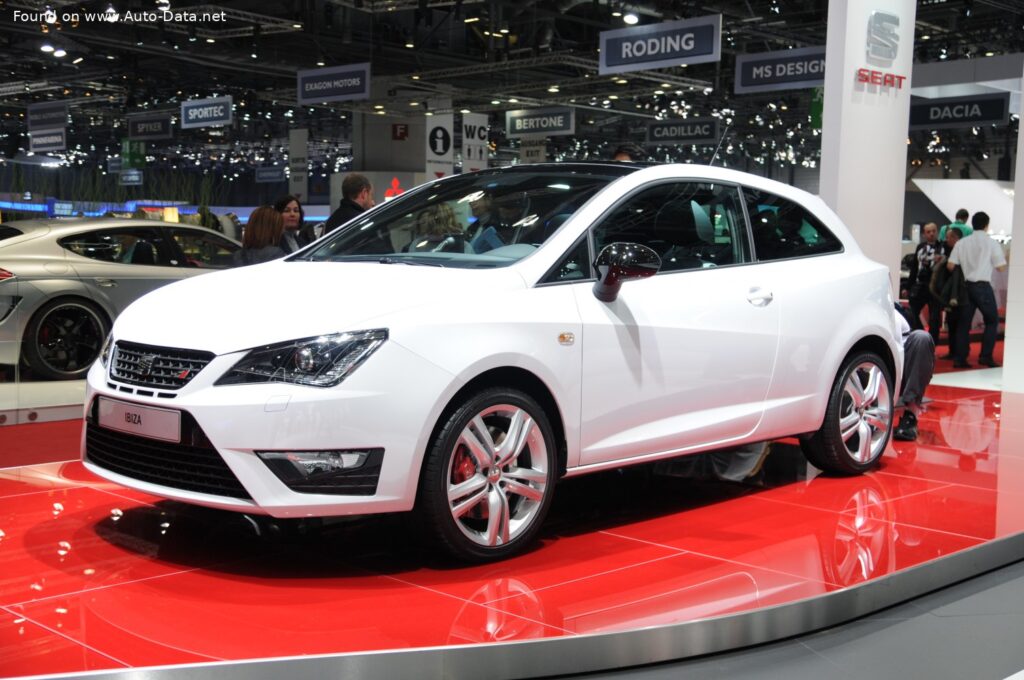
Introduction to the Seat Ibiza IV SC (facelift 2012) 1.2 TSI (85 Hp)
The Seat Ibiza IV SC (facelift 2012) 1.2 TSI (85 Hp) represents a significant iteration of Seat’s highly successful subcompact car, the Ibiza. As a cornerstone of the Spanish automaker’s lineup, the Ibiza has consistently served as a stylish and dynamic entry in the fiercely competitive European B-segment. The fourth generation, codenamed 6J, was initially launched in 2008, with the “SC” (SportCoupe) designation indicating a more athletic, three-door body style. The 2012 facelift, which this specific model embodies, brought a series of aesthetic and technical refinements, ensuring the Ibiza remained fresh and competitive against rivals from across the continent.
Seat, a proud member of the Volkswagen Group, is renowned for infusing its vehicles with a distinctive blend of Latin flair and German engineering precision. The Ibiza, sharing its platform with the venerable Volkswagen Polo and Skoda Fabia, leveraged this robust foundation to offer a compelling package of practicality, driving enjoyment, and design appeal. This particular variant, produced from 2012 to 2015, featured a modern 1.2-liter turbocharged gasoline engine, balancing performance with impressive fuel efficiency, a crucial factor in its primary European markets. It targeted a younger demographic and those seeking a more spirited driving experience in a compact footprint.
Engine and Performance: The Heart of the Seat Ibiza IV SC (facelift 2012)
Powering the Seat Ibiza IV SC (facelift 2012) 1.2 TSI (85 Hp) is a sophisticated 1.2-liter (1197 cm3 or 73.05 cu. in.) inline four-cylinder engine, designated by the code CBZA. This unit is a prime example of the Volkswagen Group’s commitment to downsizing, employing turbocharging and direct fuel injection to extract substantial power and torque from a relatively small displacement. The engine is mounted transversely at the front, driving the front wheels, a conventional and efficient layout for this class of vehicle.
The 1.2 TSI engine delivers a respectable 85 horsepower at 4800 rpm, translating to a power-per-liter output of 71 horsepower per liter, which is quite efficient for its time. More importantly, it generates a robust 118.01 lb-ft of torque across a broad and accessible rev range, from 1500 to 3500 rpm. This wide torque band is a hallmark of turbocharged engines, providing excellent low-end grunt that makes urban driving effortless and contributes to confident highway cruising. The inclusion of an intercooler further enhances performance by ensuring cooler, denser air reaches the turbocharger.
Mated to a precise five-speed manual transmission, the powertrain allows the Ibiza SC to accelerate from 0 to 60 mph in a commendable 10.7 seconds (0-100 km/h in 11.3 seconds). Its top speed reaches 111.85 mph (180 km/h), demonstrating its capability beyond city limits. Despite its spirited performance, the 1.2 TSI engine is remarkably efficient. The combined fuel economy is rated at 46.1 US mpg (5.1 l/100 km), with extra-urban figures reaching an impressive 53.5 US mpg (4.4 l/100 km). This efficiency, coupled with CO2 emissions of 119 g/km, allowed the vehicle to meet stringent Euro 5 emission standards, making it an environmentally conscious choice for European consumers. The fuel tank capacity of 11.89 US gallons (45 liters) provides a respectable cruising range.
Design and Features of the Seat Ibiza IV SC (facelift 2012)
The Seat Ibiza IV SC (facelift 2012) is characterized by its “SportCoupe” or 3-door hatchback body style, presenting a more dynamic and youthful silhouette compared to its five-door sibling. The 2012 facelift introduced several visual enhancements, including a redesigned front fascia with sharper headlamps, a more aggressive grille, and revised bumper designs that gave the car a more assertive and contemporary look. At the rear, updated taillight clusters completed the refresh, maintaining the Ibiza’s reputation for stylish design.
With an overall length of 159.17 inches (4043 mm), a width of 66.65 inches (1693 mm), and a height of 56.22 inches (1428 mm), the Ibiza SC strikes an excellent balance between compact dimensions for urban maneuverability and a surprisingly spacious interior. The wheelbase measures 97.2 inches (2469 mm), contributing to stable handling. Despite its compact exterior, the interior is designed to comfortably accommodate five occupants, though rear access in a three-door can be somewhat restricted. The trunk space offers 10.03 cubic feet (284 liters) of cargo capacity, which is competitive for the segment and expandable by folding the rear seats.
The Ibiza SC features an independent McPherson strut front suspension with coil springs and an anti-roll bar, providing responsive handling and a comfortable ride. The rear utilizes a trailing arm setup, a cost-effective and space-efficient solution typical for this class. Braking performance is handled by ventilated discs at the front and solid discs at the rear, complemented by an Anti-lock Braking System (ABS) for enhanced safety. The steering system is a hydraulic rack and pinion unit, offering a direct and communicative feel that enthusiasts appreciate. Standard tire sizes ranged from 185/60 R15, with options up to 215/45 R16 or even 215/40 R17 for a sportier stance and improved grip. The kerb weight of the vehicle is a trim 2403.04 lbs (1090 kg), contributing to its agile performance and favorable weight-to-power ratio of 12.8 kg/Hp.
Technical Specifications
| Category | Specification | US/Imperial Equivalent |
|---|---|---|
| General Information | ||
| Brand | Seat | |
| Model | Ibiza IV SC (facelift 2012) | |
| Type (Engine) | 1.2 TSI (85 Hp) | |
| Start of production | 2012 year | |
| End of production | 2015 year | |
| Powertrain Architecture | Internal Combustion engine | |
| Body type | Coupe (3-door Hatchback) | |
| Seats | 5 | |
| Doors | 3 | |
| Performance Specifications | ||
| Fuel consumption (economy) – urban | 6.5 l/100 km | 36.2 US mpg |
| Fuel consumption (economy) – extra urban | 4.4 l/100 km | 53.5 US mpg |
| Fuel consumption (economy) – combined | 5.1 l/100 km | 46.1 US mpg |
| CO2 emissions | 119 g/km | |
| Fuel Type | Petrol (Gasoline) | |
| Acceleration 0 – 60 mph | 10.7 sec | |
| Acceleration 0 – 100 km/h | 11.3 sec | |
| Maximum speed | 180 km/h | 111.85 mph |
| Emission standard | Euro 5 | |
| Weight-to-power ratio | 12.8 kg/Hp | 78 Hp/tonne |
| Weight-to-torque ratio | 6.8 kg/Nm | 146.8 Nm/tonne |
| Engine Specifications | ||
| Power | 85 Hp @ 4800 rpm | |
| Power per liter | 71 Hp/l | |
| Torque | 160 Nm @ 1500-3500 rpm | 118.01 lb.-ft. @ 1500-3500 rpm |
| Engine layout | Front, Transverse | |
| Engine Model/Code | CBZA | |
| Engine displacement | 1197 cm3 | 1.2 liters (73.05 cu. in.) |
| Number of cylinders | 4 | |
| Engine configuration | Inline | |
| Cylinder Bore | 71 mm | 2.8 in. |
| Piston Stroke | 75.6 mm | 2.98 in. |
| Compression ratio | 10:1 | |
| Number of valves per cylinder | 2 | |
| Fuel injection system | Direct injection | |
| Engine aspiration | Turbocharger, Intercooler | |
| Engine oil capacity | 3.6 l | 3.8 US qt |
| Coolant capacity | 5.6 l | 5.92 US qt |
| Space, Volume and Weights | ||
| Kerb Weight | 1090 kg | 2403.04 lbs. |
| Max. weight | 1570 kg | 3461.26 lbs. |
| Max load | 480 kg | 1058.22 lbs. |
| Trunk (boot) space – minimum | 284 l | 10.03 cu. ft. |
| Fuel tank capacity | 45 l | 11.89 US gal |
| Dimensions | ||
| Length | 4043 mm | 159.17 in. |
| Width | 1693 mm | 66.65 in. |
| Height | 1428 mm | 56.22 in. |
| Wheelbase | 2469 mm | 97.2 in. |
| Front track | 1465 mm | 57.68 in. |
| Rear (Back) track | 1457 mm | 57.36 in. |
| Minimum turning circle (turning diameter) | 10.48 m | 34.38 ft. |
| Drivetrain, Brakes and Suspension Specifications | ||
| Drivetrain Architecture | Internal combustion engine (ICE) drives the front wheels. | |
| Drive wheel | Front wheel drive | |
| Number of gears and type of gearbox | 5 gears, manual transmission | |
| Front suspension | Independent, type McPherson with coil spring and anti-roll bar | |
| Rear suspension | Trailing arm | |
| Front brakes | Ventilated discs | |
| Rear brakes | Disc | |
| Assisting systems | ABS (Anti-lock braking system) | |
| Steering type | Steering rack and pinion | |
| Power steering | Hydraulic Steering | |
| Tires size | 185/60 R15; 215/45 R16; 215/40 R17 | |
| Wheel rims size | 6J x 15; 7J x 16; 7J x 17 | |
Legacy and Market Impact of the Seat Ibiza IV SC (facelift 2012)
The Seat Ibiza IV SC (facelift 2012) 1.2 TSI (85 Hp) played a vital role in maintaining the Ibiza’s strong presence in the highly competitive European subcompact segment. While the Ibiza was never officially sold in the United States, its impact across Europe, Latin America, and parts of Asia was considerable. Seat positioned the Ibiza as a more emotionally charged and sportier alternative to its platform siblings, the Volkswagen Polo and Skoda Fabia, appealing to buyers who valued design and driving dynamics without sacrificing practicality or efficiency.
In its primary European markets, the Ibiza SC faced stiff competition from a broad array of established rivals, including the Ford Fiesta, Renault Clio, Opel/Vauxhall Corsa, Peugeot 208, and the aforementioned Volkswagen Polo. What set the Ibiza apart was its distinctive “auto emoción” brand philosophy, emphasizing a fun-to-drive character and expressive styling. The 2012 facelift, with its sharpened aesthetics, helped to keep the fourth-generation model visually appealing against newer entrants.
The 1.2 TSI engine, in particular, was a key selling point. Its combination of adequate power for daily driving, excellent fuel economy, and compliance with Euro 5 emission standards made it an economically sensible choice for private buyers and fleet operators alike. The widespread adoption of small-capacity turbocharged engines across the industry at this time underscored the Ibiza’s modernity and forward-thinking engineering. This powertrain configuration offered a compelling blend of performance and low running costs, which resonated strongly with European consumers facing rising fuel prices and stricter environmental regulations.
The Ibiza’s legacy is one of consistent sales success and critical acclaim within its segment. It cemented Seat’s reputation as a purveyor of stylish, well-engineered, and engaging compact cars. The SC variant, with its three-door body, catered to a specific niche of buyers looking for a sportier, more coupe-like aesthetic, often younger individuals or those without regular rear-seat passengers. Its enduring popularity ensured that the Ibiza remained a pillar of Seat’s product strategy, setting the stage for subsequent generations and contributing significantly to the brand’s overall market share and identity within the Volkswagen Group. The Ibiza’s blend of Spanish passion and German precision made it a perennial favorite, a testament to its well-rounded package.