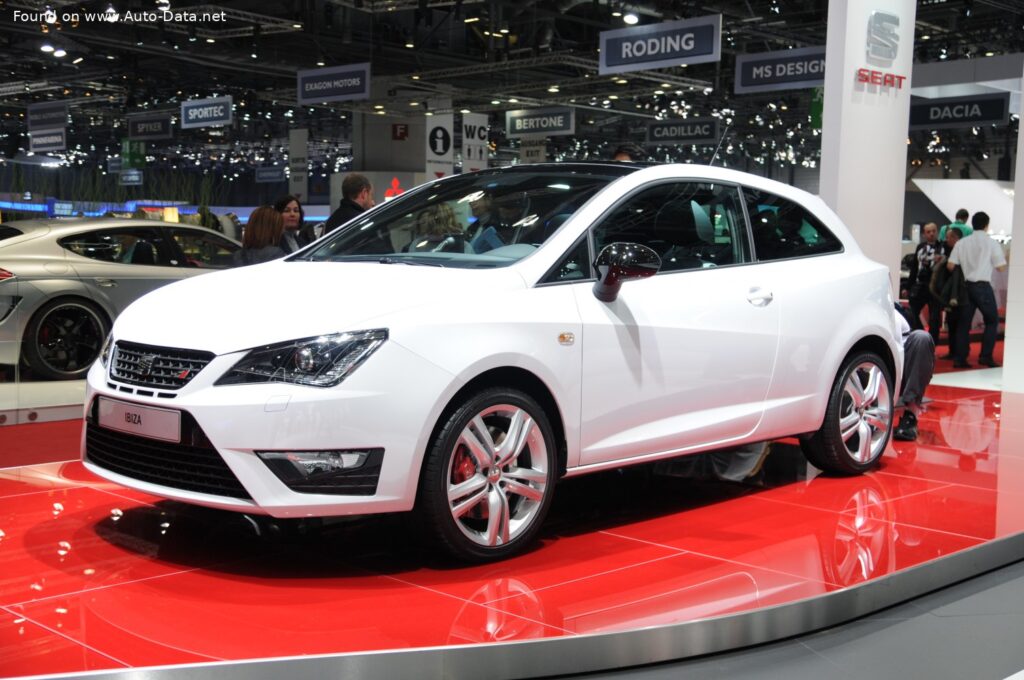
The SEAT Ibiza IV SC (facelift 2012) 1.6 (81 Hp) LPG: A European Efficiency Champion
The SEAT Ibiza, a cornerstone of the Spanish automaker’s lineup, represents a significant player in the highly competitive European subcompact segment. The fourth generation, known internally as the 6J, received a notable facelift in 2012, bringing refreshed aesthetics and updated technology. Among its diverse powertrain offerings, the SEAT Ibiza IV SC (facelift 2012) 1.6 (81 Hp) LPG variant stands out for its innovative bi-fuel capability, catering to efficiency-conscious consumers in its primary markets. As a brand under the Volkswagen Group umbrella, SEAT vehicles, including the Ibiza, are not officially sold in the United States, yet they embody the engineering prowess and design sensibilities that define modern European automotive trends. This specific model, with its Sport Coupe (SC) designation, combined a youthful 3-door body style with the economic advantages of Liquefied Petroleum Gas (LPG) operation, making it a compelling choice for urban and suburban drivers across Europe from its production start in 2012 until 2015.
Engine and Performance of the SEAT Ibiza IV SC (facelift 2012) 1.6 (81 Hp) LPG
At the heart of the SEAT Ibiza IV SC (facelift 2012) 1.6 (81 Hp) LPG lies a robust 1.6-liter (1598 cm3 or 97.52 cu. in.) naturally aspirated inline-four engine. This powerplant, identified by the code CNKA, is engineered for reliability and efficient operation, particularly when running on its alternative fuel source. It delivers a modest but practical 81 horsepower, achieved across a broad rev range from 4000 to 6000 rpm. Torque output is rated at 106.95 lb.-ft. (145 Nm) peaking at 3800 rpm, providing adequate pulling power for city driving and comfortable cruising. The engine features a multi-port manifold injection system and a compression ratio of 10.5:1, with four valves per cylinder, optimizing combustion for both gasoline and LPG.
The most distinctive feature of this Ibiza variant is its bi-fuel capability, allowing drivers to switch seamlessly between conventional gasoline and LPG. This dual-fuel system significantly enhances the vehicle’s versatility and running costs. When operating on gasoline, the combined fuel economy is approximately 39.2 US mpg (6.0 l/100 km), while on LPG, the combined figure is 7.6 l/100 km. The LPG system offers a substantial reduction in CO2 emissions, dropping from 139 g/km on gasoline to 123 g/km on LPG, aligning with the Euro 5 emission standard. This makes the Ibiza 1.6 LPG an environmentally friendlier option, particularly important in European markets with stringent emission regulations and incentives for cleaner vehicles.
Power is channeled to the front wheels via a smooth-shifting 5-speed manual transmission, a common and reliable setup for vehicles in this class. While not a performance-oriented model, the Ibiza 1.6 LPG offers respectable acceleration for its segment, achieving 0 to 60 mph in a calculated 11.6 seconds, or 0 to 100 km/h in 12.2 seconds. Its maximum speed is 108.12 mph (174 km/h), making it suitable for highway travel, though its primary strengths lie in urban maneuverability and fuel efficiency. The curb weight of 2519.88 lbs. (1143 kg) contributes to a weight-to-power ratio of 14.1 kg/Hp, indicating a balanced approach to performance and economy.
Design and Features
Exterior and Interior Design
The SEAT Ibiza IV SC (facelift 2012) presents itself as a stylish and youthful 3-door coupe, designated “SC” for Sport Coupe. The 2012 facelift introduced subtle but effective design enhancements, including revised headlights, a redesigned front grille, and updated bumper styling, giving the car a sharper, more contemporary look. Its compact dimensions – 159.17 inches (4043 mm) in length, 66.65 inches (1693 mm) in width, and 56.22 inches (1428 mm) in height – make it agile and easy to park in congested urban environments. The 97.2-inch (2469 mm) wheelbase provides a stable ride for its size, while the minimum turning circle of 34.38 feet (10.48 m) ensures excellent maneuverability.
Inside, the Ibiza SC offers seating for five, though the rear seats are best suited for children or shorter journeys due to the 3-door configuration. The interior design reflects SEAT’s commitment to functionality and ergonomics, with clear instrumentation and intuitive controls. While compact, the trunk space offers a practical 7.7 cu. ft. (218 liters), which can be expanded by folding down the rear seats, enhancing its utility for daily errands or weekend trips. The dual fuel tanks – 11.89 US gallons (45 liters) for gasoline and 52.8 liters for LPG – are cleverly integrated, minimizing intrusion into passenger or cargo space.
Chassis and Safety
The Ibiza’s chassis architecture is shared with other Volkswagen Group subcompacts, providing a solid foundation. The front suspension employs an independent McPherson strut setup with coil springs and an anti-roll bar, offering a good balance of comfort and handling precision. The rear utilizes a semi-independent arrangement with coil springs, a cost-effective and space-efficient solution typical for this segment. Braking performance is handled by ventilated discs measuring 256×22 mm at the front and drum brakes (200×40 mm) at the rear, complemented by an Anti-lock Braking System (ABS) for enhanced safety during emergency stops. The steering system is a rack and pinion type, providing direct and responsive feedback. Various tire and wheel size options, from 175/70 R14 to 215/40 R17, allowed buyers to customize the vehicle’s stance and handling characteristics.
Technical Specifications
| General Information | |
|---|---|
| Brand | SEAT |
| Model | Ibiza |
| Generation | Ibiza IV SC (facelift 2012) |
| Type (Engine) | 1.6 (81 Hp) LPG |
| Start of Production | 2012 year |
| End of Production | 2015 year |
| Powertrain Architecture | Internal Combustion engine |
| Body Type | Coupe |
| Seats | 5 |
| Doors | 3 |
| Performance Specifications | |
| Fuel Consumption (Economy) – Urban | 8.1 l/100 km (29 US mpg) |
| Fuel Consumption (Economy) – Urban (LPG) | 10.4 l/100 km |
| Fuel Consumption (Economy) – Extra Urban | 4.8 l/100 km (49 US mpg) |
| Fuel Consumption (Economy) – Extra Urban (LPG) | 6.0 l/100 km |
| Fuel Consumption (Economy) – Combined | 6.0 l/100 km (39.2 US mpg) |
| Fuel Consumption (Economy) – Combined (LPG) | 7.6 l/100 km |
| CO2 Emissions | 139 g/km |
| CO2 Emissions (LPG) | 123 g/km |
| Fuel Type | Petrol / LPG |
| Acceleration 0 – 60 mph | 11.6 sec |
| Maximum Speed | 108.12 mph (174 km/h) |
| Emission Standard | Euro 5 |
| Weight-to-Power Ratio | 14.1 kg/Hp |
| Weight-to-Torque Ratio | 7.9 kg/Nm |
| Engine Specifications | |
| Power | 81 Hp @ 4000-6000 rpm |
| Power per Liter | 50.7 Hp/l |
| Torque | 106.95 lb.-ft. (145 Nm) @ 3800 rpm |
| Engine Layout | Front, Transverse |
| Engine Model/Code | CNKA |
| Engine Displacement | 1.6 liters (1598 cm3 / 97.52 cu. in.) |
| Number of Cylinders | 4 |
| Engine Configuration | Inline |
| Cylinder Bore | 3.01 in. (76.5 mm) |
| Piston Stroke | 3.42 in. (86.9 mm) |
| Compression Ratio | 10.5:1 |
| Number of Valves per Cylinder | 4 |
| Fuel Injection System | Multi-port manifold injection |
| Engine Aspiration | Naturally aspirated engine |
| Engine Oil Capacity | 3.8 US qt (3.6 l) |
| Coolant Capacity | 5.92 US qt (5.6 l) |
| Space, Volume, and Weights | |
| Kerb Weight | 2519.88 lbs. (1143 kg) |
| Max. Weight | 3549.44 lbs. (1610 kg) |
| Max Load | 1029.56 lbs. (467 kg) |
| Trunk (Boot) Space – Minimum | 7.7 cu. ft. (218 l) |
| Fuel Tank Capacity (Petrol) | 11.89 US gal (45 l) |
| Fuel Tank Capacity (LPG) | 52.8 l |
| Permitted Trailer Load with Brakes (12%) | 2204.62 lbs. (1000 kg) |
| Dimensions | |
| Length | 159.17 in. (4043 mm) |
| Width | 66.65 in. (1693 mm) |
| Height | 56.22 in. (1428 mm) |
| Wheelbase | 97.2 in. (2469 mm) |
| Front Track | 57.68 in. (1465 mm) |
| Rear (Back) Track | 57.36 in. (1457 mm) |
| Minimum Turning Circle (Turning Diameter) | 34.38 ft. (10.48 m) |
| Drivetrain, Brakes, and Suspension Specifications | |
| Drivetrain Architecture | Front wheel drive; Internal Combustion engine drives the front wheels. |
| Drive Wheel | Front wheel drive |
| Number of Gears and Type of Gearbox | 5 gears, manual transmission |
| Front Suspension | Independent, type McPherson with coil spring and anti-roll bar |
| Rear Suspension | Semi-independent, coil spring |
| Front Brakes | Ventilated discs, 256×22 mm |
| Rear Brakes | Drum, 200×40 mm |
| Assisting Systems | ABS (Anti-lock braking system) |
| Steering Type | Steering rack and pinion |
| Tires Size | 175/70 R14; 185/60 R15; 215/45 R16; 215/40 R17 |
| Wheel Rims Size | 5.0J x 14; 6.0J x 15; 7.0J x 16; 7.0J x 17 |
Legacy and Market Impact
The SEAT Ibiza has a long-standing legacy as one of SEAT’s most successful models, consistently ranking among the top-selling subcompacts in Europe. The fourth-generation Ibiza, particularly after its 2012 facelift, continued this tradition by offering a blend of sharp styling, practical packaging, and accessible technology. In its primary European markets, the Ibiza IV SC (facelift 2012) 1.6 (81 Hp) LPG competed against a formidable array of rivals, including the Ford Fiesta, Renault Clio, Peugeot 208, and its platform sibling, the Volkswagen Polo.
What set the LPG variant apart was its strategic positioning as an economical and environmentally conscious choice. In many European countries, LPG is significantly cheaper than gasoline or diesel, and vehicles running on it often benefit from tax incentives or lower road tolls. This made the 1.6 LPG model particularly attractive to fleet operators, young drivers, and families looking to minimize running costs without sacrificing modern amenities. The ability to switch to gasoline provided range assurance, mitigating concerns about LPG refueling infrastructure, which, while growing, is not as ubiquitous as gasoline stations.
The Ibiza’s reputation is built on its dynamic driving characteristics, often described as more engaging than some of its direct competitors, a trait inherited from its Volkswagen Group engineering but infused with SEAT’s distinct “auto emoción” philosophy. The Sport Coupe (SC) body style further amplified this youthful and sporty image, appealing to buyers who prioritized aesthetics and a more assertive road presence over the practicality of a 5-door hatchback.
Historically, the Ibiza has been crucial for SEAT, acting as an entry point into the brand for many customers and showcasing the company’s design direction. The 2012 facelift, while not a radical overhaul, ensured the Ibiza remained fresh and competitive in a segment where design and efficiency are paramount. The inclusion of the LPG option demonstrated SEAT’s commitment to offering diverse powertrain solutions that address real-world consumer needs for lower operating costs and reduced environmental impact. Although never officially imported to the U.S., the Ibiza IV SC (facelift 2012) 1.6 (81 Hp) LPG remains a testament to European automotive engineering, blending practicality, style, and innovative bi-fuel technology into a popular and enduring subcompact package.