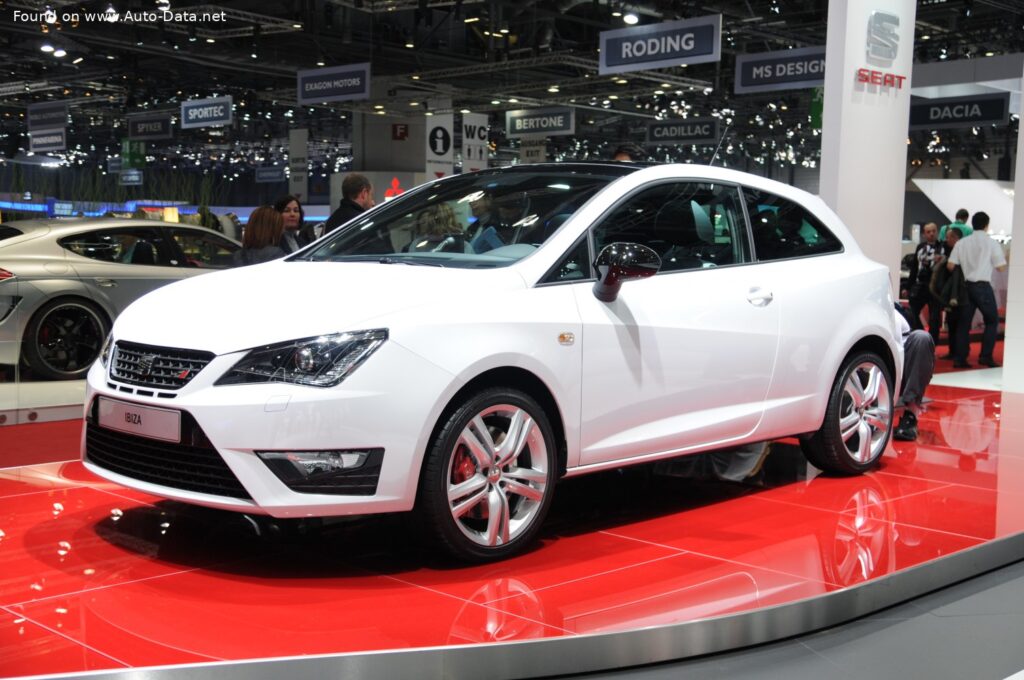
The Seat Ibiza IV SC (facelift 2012) Cupra 1.4 TSI (180 Hp) DSG represents a compelling chapter in the history of compact performance vehicles, particularly within the European market. Unveiled as part of the fourth-generation Ibiza’s refreshed lineup in 2012, this model showcased SEAT’s commitment to delivering accessible performance with a distinct Spanish flair. As a product of the Volkswagen Group, the Ibiza Cupra benefited from advanced powertrain technology and a finely tuned chassis, positioning it as a potent contender in the competitive hot hatch segment.
The “SC” designation stands for “Sport Coupe,” indicating its three-door body style, which further emphasized its dynamic and youthful character. This iteration of the Ibiza Cupra was more than just a cosmetic update; it integrated a sophisticated 1.4-liter TSI engine, renowned for its twin-charging technology, paired with a rapid-shifting 7-speed Direct Shift Gearbox (DSG). While SEAT vehicles are not typically sold in the United States, the brand holds a significant presence across Europe and other international markets, where the Ibiza Cupra carved out a niche for enthusiasts seeking a blend of everyday usability and exhilarating performance in a compact package.
Engine and Performance: The Heart of the Seat Ibiza IV SC (facelift 2012) Cupra 1.4 TSI (180 Hp) DSG
At the core of the Seat Ibiza IV SC (facelift 2012) Cupra 1.4 TSI (180 Hp) DSG lies a remarkable piece of engineering: the 1.4-liter TSI (Turbocharged Stratified Injection) inline four-cylinder engine. This specific variant, identifiable by engine codes such as CAVE, CTHE, or CTJC, was celebrated for its “twin-charging” technology. Unlike conventional turbocharged engines, this 1.4-liter unit utilized both a supercharger and a turbocharger working in tandem to deliver power across the entire rev range. The supercharger provided instant boost at lower engine speeds, effectively eliminating turbo lag and ensuring strong off-the-line acceleration. As engine speeds increased, the turbocharger took over, providing a sustained surge of power to the redline.
This sophisticated setup allowed the compact 1.4-liter engine to produce an impressive 180 horsepower at 6200 rpm, translating to a potent 129.5 horsepower per liter. Torque output was equally robust, peaking at 184.39 lb.-ft. (250 Nm) and available across a broad plateau from 2000 to 4500 rpm. This wide torque band, a direct benefit of the twin-charging system, ensured responsive acceleration in almost any driving scenario.
Power was efficiently delivered to the front wheels via a 7-speed DSG automatic transmission. This dual-clutch gearbox was a hallmark of Volkswagen Group performance vehicles, offering lightning-fast gear changes and contributing significantly to both performance and fuel efficiency. The result was a spirited driving experience, with the Ibiza Cupra capable of accelerating from 0 to 60 mph in a swift 6.6 seconds and reaching a top speed of 141.67 mph. Despite its performance credentials, the engine maintained a commendable fuel economy, with a combined rating of 39.9 US mpg, and adhered to the Euro 5 emission standard, producing 139 g/km of CO2.
Design and Features
The 2012 facelift brought a sharper and more aggressive aesthetic to the Ibiza SC Cupra, reinforcing its position as a performance variant. The three-door “Sport Coupe” body style inherently lent itself to a more dynamic silhouette, characterized by its shorter wheelbase compared to the five-door model and a more pronounced rake to the rear. Exterior updates included redesigned headlights, often featuring LED daytime running lights, a revised grille, and a more sculpted front bumper that incorporated larger air intakes, hinting at the car’s sporting intentions. At the rear, updated taillights and a subtly integrated diffuser with a central exhaust outlet completed the performance look.
Inside, the Seat Ibiza IV SC (facelift 2012) Cupra 1.4 TSI (180 Hp) DSG offered a cabin that balanced sportiness with practicality. The five-seat configuration provided enough space for a compact family, though the rear seats were best suited for shorter journeys or children. Key features included bolstered sport seats, a flat-bottomed steering wheel with Cupra branding, and aluminum pedals, all designed to enhance the driving experience. While infotainment systems of the era were less sophisticated than today’s touchscreens, the Ibiza Cupra would have offered a functional audio system and connectivity options relevant for its time.
Underneath, the Ibiza Cupra featured a performance-oriented suspension setup. The front utilized an independent McPherson strut system with coil springs and an anti-roll bar, while the rear employed a trailing arm setup. This combination, along with a stiffer tuning compared to standard Ibiza models, provided agile handling and reduced body roll. Braking was handled by ventilated discs at the front and solid discs at the rear, complemented by an Anti-lock Braking System (ABS) for enhanced safety. Electric power steering offered precise control and feedback, making the car engaging to drive on winding roads. The vehicle rode on distinctive 17-inch alloy wheels wrapped in 215/40 R17 tires, further underscoring its performance aspirations.
Technical Specifications
| Category | Specification |
|---|---|
| Brand | Seat |
| Model | Ibiza IV SC (facelift 2012) Cupra 1.4 TSI (180 Hp) DSG |
| Generation | Ibiza IV SC (facelift 2012) |
| Start of production | 2012 year |
| End of production | 2015 year |
| Body type | Coupe |
| Seats | 5 |
| Doors | 3 |
| Fuel consumption (economy) – urban | 31.4 US mpg |
| Fuel consumption (economy) – extra urban | 46.1 US mpg |
| Fuel consumption (economy) – combined | 39.9 US mpg |
| CO2 emissions | 139 g/km |
| Fuel Type | Petrol (Gasoline) |
| Acceleration 0 – 60 mph | 6.6 sec |
| Maximum speed | 141.67 mph |
| Emission standard | Euro 5 |
| Power | 180 Hp @ 6200 rpm |
| Torque | 184.39 lb.-ft. @ 2000-4500 rpm |
| Engine displacement | 1.4 liters (84.82 cu. in.) |
| Number of cylinders | 4, Inline |
| Engine aspiration | Turbocharger, Intercooler (Twin-charged with Supercharger) |
| Kerb Weight | 2775.62 lbs. (1259 kg) |
| Max. weight | 3681.72 lbs. (1670 kg) |
| Trunk (boot) space – minimum | 8.33 cu. ft. (236 l) |
| Fuel tank capacity | 11.89 US gal (45 l) |
| Length | 159.65 in. (4055 mm) |
| Width | 66.65 in. (1693 mm) |
| Height | 55.91 in. (1420 mm) |
| Wheelbase | 97.2 in. (2469 mm) |
| Drive wheel | Front wheel drive |
| Number of gears and type of gearbox | 7 gears, automatic transmission DSG |
| Front suspension | Independent, type McPherson with coil spring and anti-roll bar |
| Rear suspension | Trailing arm |
| Front brakes | Ventilated discs |
| Rear brakes | Disc |
| Assisting systems | ABS (Anti-lock braking system) |
| Tires size | 215/40 R17 |
| Wheel rims size | 7J x 17 |
Legacy and Market Impact
The Seat Ibiza IV SC (facelift 2012) Cupra 1.4 TSI (180 Hp) DSG holds a significant place in the European hot hatch landscape, embodying SEAT’s “auto emoción” philosophy. It was a car designed to inject excitement and sportiness into the compact segment, appealing to a younger demographic and those seeking an engaging driving experience without the premium price tag of some competitors.
In its primary markets, the Ibiza Cupra competed directly with other formidable compact performance cars. Its most direct rivals often included the Volkswagen Polo GTI and the Skoda Fabia RS, both of which shared the same fundamental platform and the innovative 1.4-liter twin-charged engine and DSG gearbox. However, the Ibiza Cupra distinguished itself with a more aggressive styling, a slightly firmer suspension tune, and SEAT’s distinct brand identity, often perceived as the sportier, more passionate sibling within the VW Group’s small car portfolio. Beyond its group siblings, it faced competition from the likes of the Ford Fiesta ST, Renault Clio RS, and Peugeot 208 GTI, each offering their own take on the compact performance formula.
Historically, the Ibiza Cupra, particularly this twin-charged iteration, represents a fascinating period of powertrain development. The 1.4 TSI twin-charger was a technical marvel, showcasing how a small displacement engine could deliver impressive power and torque with surprising efficiency. While the complexity and cost of the twin-charging system eventually led to its replacement by simpler, turbo-only engines in later models, this specific engine cemented its place as a high-point in compact engine design. It allowed SEAT to offer genuinely quick performance in a lightweight, agile package, making it a compelling option for enthusiasts.
The Ibiza Cupra’s legacy is one of democratizing performance. It made spirited driving accessible to a broader audience, blending everyday usability with the thrill of a performance car. Its sharp handling, potent engine, and rapid-fire DSG transmission created a driving experience that was both rewarding and practical for European roads. Even after its production ceased in 2015, this generation of the Ibiza Cupra remains a well-regarded used performance car, celebrated for its unique engine technology and its vibrant character in the ever-evolving hot hatch segment.