Introduction to the Seat Ibiza IV ST 1.6 TDI (90 Hp)
The Seat Ibiza IV ST 1.6 TDI (90 Hp) represents a practical and efficient offering from the Spanish automaker SEAT, a subsidiary of the Volkswagen Group, during its production run from 2010 to 2012. As part of the fourth generation of the popular Ibiza model line, the “ST” designation, signifying “Sport Tourer” or station wagon (estate), highlighted its extended cargo capacity and family-friendly utility. Positioned within Europe’s highly competitive B-segment (subcompact or supermini class), this particular variant was designed to appeal to buyers seeking the compact dimensions and maneuverability of a small car combined with the increased versatility and load-carrying ability typically found in larger vehicles. While SEAT vehicles are not officially sold in the United States, the Ibiza IV ST was a significant player in its primary European market, embodying a blend of SEAT’s characteristic sporty design language with Volkswagen Group’s renowned engineering for efficiency and reliability.
Engine and Performance of the Seat Ibiza IV ST 1.6 TDI (90 Hp)
At the heart of the Seat Ibiza IV ST 1.6 TDI (90 Hp) lies a robust and highly efficient 1.6-liter (1598 cm³) inline four-cylinder diesel engine. Coded CAYB, this powerplant was a staple across various Volkswagen Group compact models, celebrated for its strong torque delivery and impressive fuel economy. The engine utilizes a common rail direct fuel injection system, paired with a turbocharger and an intercooler, to produce its maximum output of 90 horsepower at 4200 revolutions per minute. More importantly for everyday driving, it generates a substantial 230 Nm (approximately 169.64 lb.-ft.) of torque, available across a broad rev range from 1500 to 2500 rpm. This low-end torque made the Ibiza ST feel responsive and capable, particularly in urban environments and during highway cruising, despite its modest horsepower rating.
Power is channeled to the front wheels via a smooth-shifting 5-speed manual transmission, a common choice for its balance of efficiency and driver engagement in this segment. Performance figures for the Ibiza IV ST 1.6 TDI were respectable for its class, with an acceleration time from 0 to 60 mph (0-97 km/h) recorded at 11.6 seconds, and a top speed reaching 110.6 mph (178 km/h). However, where this powertrain truly shone was in its fuel efficiency. Under the NEDC (New European Driving Cycle) testing, the vehicle achieved an impressive combined fuel consumption of 4.2 liters per 100 kilometers, translating to an excellent 56 US miles per gallon. Urban driving yielded 46.1 US mpg, while extra-urban conditions pushed efficiency even higher to 65.3 US mpg. With CO2 emissions rated at 109 g/km, the Ibiza ST 1.6 TDI met the Euro 5 emission standard, further underscoring its environmentally conscious design for its era and its suitability for markets with strict emissions regulations. A particulate filter was standard, helping to reduce harmful emissions.
Design and Features
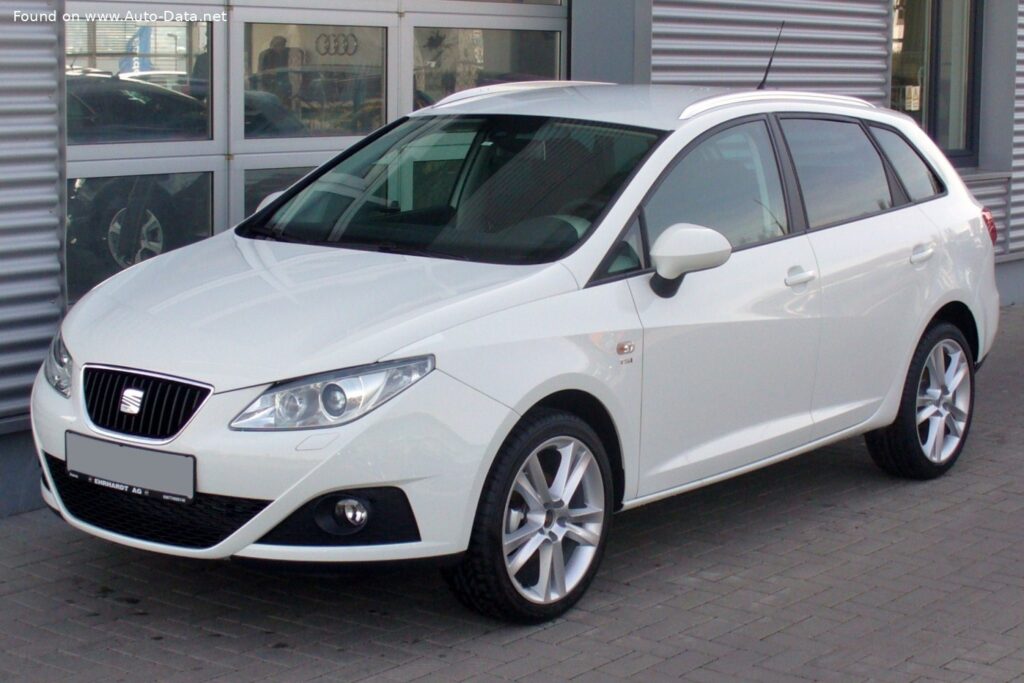
The fourth-generation SEAT Ibiza, initially launched as a hatchback, was extended into the ST (Sport Tourer) body style to offer enhanced practicality. The Seat Ibiza IV ST 1.6 TDI (90 Hp) features a distinctive 5-door station wagon profile, maintaining the youthful and dynamic aesthetic characteristic of SEAT while significantly boosting its cargo versatility. With an overall length of 166.42 inches (4227 mm), a width of 66.65 inches (1693 mm), and a height of 56.89 inches (1445 mm), the Ibiza ST remained compact enough for easy city maneuvering and parking, yet its extended rear section provided a substantial 15.19 cubic feet (430 liters) of trunk space. This was a critical selling point in Europe, where compact wagons offered a compelling alternative to larger, less fuel-efficient vehicles for families.
Inside, the Ibiza ST offered seating for five occupants, designed with a focus on practicality and robust materials suitable for daily use. The cabin, while not luxurious, was ergonomically sound, featuring controls that were intuitive and within easy reach. The car’s architecture, based on the Volkswagen Group’s PQ25 platform (shared with the VW Polo and Skoda Fabia), ensured solid build quality and a comfortable ride.
In terms of chassis and handling, the Ibiza IV ST utilized a conventional yet effective setup. The front suspension featured independent McPherson struts with coil springs and an anti-roll bar, providing a good balance of comfort and dynamic stability. The rear employed a semi-dependent beam with a stabilizer for lateral stability, a cost-effective and space-efficient solution typical of the segment. Braking performance was handled by ventilated discs at the front (256×22 mm) and solid discs at the rear (232×9 mm), complemented by an Anti-lock Braking System (ABS) for enhanced safety. The steering system was an electric power-assisted rack and pinion unit, offering light effort at low speeds for urban driving and more feedback as speeds increased. Standard tire sizes included 185/60 R15, with an option for 215/45 R16 on larger wheels, contributing to the car’s balanced handling characteristics.
Technical Specifications
| Category | Specification | US Equivalent (where applicable) |
|---|---|---|
| Brand | Seat | |
| Model | Ibiza | |
| Generation | Ibiza IV ST | |
| Type (Engine) | 1.6 TDI (90 Hp) | |
| Production Start | 2010 year | |
| Production End | 2012 year | |
| Powertrain Architecture | Internal Combustion engine | |
| Body type | Station wagon (estate) | |
| Seats | 5 | |
| Doors | 5 | |
| Performance Specs | ||
| Fuel consumption – urban (NEDC) | 5.1 l/100 km | 46.1 US mpg |
| Fuel consumption – extra urban (NEDC) | 3.6 l/100 km | 65.3 US mpg |
| Fuel consumption – combined (NEDC) | 4.2 l/100 km | 56 US mpg |
| CO2 emissions (NEDC) | 109 g/km | |
| Fuel Type | Diesel | |
| Acceleration 0 – 60 mph | 11.6 sec | |
| Acceleration 0 – 100 km/h | 12.2 sec | |
| Maximum speed | 178 km/h | 110.6 mph |
| Emission standard | Euro 5 | |
| Weight-to-power ratio | 12.8 kg/Hp | 78.3 Hp/tonne |
| Weight-to-torque ratio | 5 kg/Nm | 200 Nm/tonne |
| Engine Specs | ||
| Power | 90 Hp @ 4200 rpm | |
| Power per liter | 56.3 Hp/l | |
| Torque | 230 Nm @ 1500-2500 rpm | 169.64 lb.-ft. @ 1500-2500 rpm |
| Engine layout | Front, Transverse | |
| Engine Model/Code | CAYB | |
| Engine displacement | 1598 cm³ | 97.52 cu. in. |
| Number of cylinders | 4 | |
| Engine configuration | Inline | |
| Cylinder Bore | 79.5 mm | 3.13 in. |
| Piston Stroke | 80.5 mm | 3.17 in. |
| Compression ratio | 16.5:1 | |
| Number of valves per cylinder | 4 | |
| Fuel injection system | Diesel Commonrail | |
| Engine aspiration | Turbocharger, Intercooler | |
| Valvetrain | DOHC | |
| Engine oil capacity | 4.3 l | 4.54 US qt |
| Coolant | 8 l | 8.45 US qt |
| Engine systems | Particulate filter | |
| Space, Volume and Weights | ||
| Kerb Weight | 1150 kg | 2535.32 lbs. |
| Max. weight (GVWR) | 1665 kg | 3670.7 lbs. |
| Max load | 515 kg | 1135.38 lbs. |
| Trunk (boot) space – minimum | 430 l | 15.19 cu. ft. |
| Fuel tank capacity | 45 l | 11.89 US gal |
| Permitted trailer load with brakes (12%) | 1000 kg | 2204.62 lbs. |
| Dimensions | ||
| Length | 4227 mm | 166.42 in. |
| Width | 1693 mm | 66.65 in. |
| Height | 1445 mm | 56.89 in. |
| Wheelbase | 2469 mm | 97.2 in. |
| Front track | 1465 mm | 57.68 in. |
| Rear (Back) track | 1457 mm | 57.36 in. |
| Minimum turning circle | 10.48 m | 34.38 ft. |
| Drivetrain, Brakes and Suspension Specs | ||
| Drivetrain Architecture | Internal combustion engine drives the front wheels. | |
| Drive wheel | Front wheel drive | |
| Number of gears and type of gearbox | 5 gears, manual transmission | |
| Front suspension | Independent, type McPherson with coil spring and anti-roll bar | |
| Rear suspension | Semi-dependent beam with stabilizer lateral stability | |
| Front brakes | Ventilated discs, 256×22 mm | |
| Rear brakes | Disc, 232×9 mm | |
| Assisting systems | ABS (Anti-lock braking system) | |
| Steering type | Steering rack and pinion | |
| Power steering | Electric Steering | |
| Tires size | 185/60 R15; 215/45 R16 | |
| Wheel rims size | 6J x 15; 7J x 16 | |
Legacy and Market Impact
The SEAT Ibiza IV ST, particularly the 1.6 TDI (90 Hp) variant, played a crucial role in SEAT’s strategy to broaden its appeal in the European market. As a brand within the Volkswagen Group, SEAT was often positioned as the “sportier” and more design-focused alternative to its German and Czech siblings, Volkswagen and Skoda. The Ibiza ST exemplified this philosophy by taking the established and reliable PQ25 platform (shared with the Volkswagen Polo and Skoda Fabia) and wrapping it in a more expressive and youthful design, while adding the highly practical station wagon body style.
In Europe, compact station wagons like the Ibiza ST fulfilled a significant market niche. They offered families and individuals who needed more cargo space than a typical hatchback but desired the lower running costs, easier maneuverability, and smaller footprint of a subcompact car. The 1.6 TDI engine, with its exceptional fuel economy and strong torque, made the Ibiza ST a particularly attractive proposition for high-mileage drivers and those prioritizing low running costs. Its Euro 5 emission compliance was also a key factor in its market acceptance, especially in countries with stringent environmental regulations and tax incentives for cleaner vehicles.
Competitors in this segment included the Skoda Fabia Combi (sharing the same platform and engines), the Renault Clio Estate, and the Peugeot 207 SW. The Ibiza ST distinguished itself with its sharp styling, which many found more appealing than its more conservative rivals. While it did not offer groundbreaking technology for its time, its reliance on proven Volkswagen Group components ensured a reputation for reliability and solid engineering. The availability of electric power steering, ABS, and a particulate filter were standard features that contributed to its competitive standing.
The legacy of the Seat Ibiza IV ST 1.6 TDI (90 Hp) is one of pragmatic innovation. It demonstrated SEAT’s ability to diversify its popular Ibiza line, catering to a wider range of customer needs without compromising the brand’s energetic image. It solidified SEAT’s position as a provider of stylish, well-engineered, and efficient vehicles, particularly within the highly contested European B-segment. Though never imported to the USA, this model highlights the distinct market dynamics and consumer preferences prevalent in Europe, where compact, fuel-efficient diesel station wagons were, and to some extent still are, a highly valued commodity. Its success contributed to the overall strength of the Ibiza nameplate, which remains a cornerstone of SEAT’s product portfolio.