Overview of the Seat Ibiza IV ST (facelift 2015)
The Seat Ibiza IV ST (facelift 2015) represents a significant iteration of the Spanish automaker’s popular subcompact (B-segment) model. Launched in May 2015, this specific variant, known as the Sport Tourer (ST), was the station wagon or estate version of the fourth-generation Ibiza, which itself received a comprehensive facelift for the 2015 model year. Produced until 2017, the Ibiza ST was tailored primarily for the European market, where its blend of compact dimensions, practical cargo space, and economical engines made it a compelling choice for families and individuals seeking versatility without the bulk of a larger vehicle.
Seat, a brand within the Volkswagen Group, is known for infusing a sporty and youthful character into its vehicles, and the Ibiza ST was no exception, even in its more utilitarian form. The 2015 facelift brought subtle but meaningful enhancements, including revised styling cues, updated interior materials, and crucially, a new range of efficient powertrains, exemplified by the 1.0 Eco TSI engine. This three-cylinder turbocharged gasoline unit, producing 95 horsepower, was a cornerstone of Seat’s strategy to offer impressive fuel economy and lower emissions in a segment increasingly focused on environmental performance and running costs. The Ibiza ST carved out a niche as a practical, stylish, and engaging-to-drive option in a competitive market segment.
Powertrain: The 1.0 Eco TSI Engine in the Seat Ibiza IV ST (facelift 2015)
At the heart of this particular Seat Ibiza IV ST (facelift 2015) model was the innovative 1.0 Eco TSI engine, a testament to modern downsizing trends in automotive engineering. This compact 999 cm³ (approximately 1.0-liter or 60.96 cubic inches) inline three-cylinder gasoline engine was equipped with both a turbocharger and an intercooler, allowing it to punch above its weight in terms of both power and efficiency. Despite its small displacement, the engine generated a respectable 95 horsepower (Hp) at 5000-5500 rpm, delivering a power-per-liter figure of 95.1 Hp/l. More importantly for daily driving, it produced a robust 160 Newton-meters (Nm), equivalent to 118.01 lb.-ft. of torque, available across a broad rev range from 1500 to 3500 rpm. This wide torque band ensured responsive acceleration and minimized the need for frequent gear changes, a common characteristic of well-engineered small turbocharged engines.
Power was delivered to the front wheels via a smooth-shifting 5-speed manual transmission, a common and reliable setup for vehicles in this segment. This drivetrain architecture, combined with the engine’s characteristics, allowed the Ibiza ST to achieve a 0-60 mph acceleration time of 10.3 seconds and a top speed of 116.2 mph (187 km/h). While not a performance car, these figures were more than adequate for urban commuting and comfortable highway cruising.
Fuel efficiency was a major highlight, with a combined consumption rating of 4.2 liters per 100 kilometers, translating to an impressive 56 US miles per gallon. This efficiency was complemented by low CO2 emissions of just 97 g/km, allowing the vehicle to meet the stringent Euro 6 emission standard. The engine featured direct fuel injection and a compression ratio of 10.5:1, further optimizing combustion and fuel economy. The front, transverse engine layout contributed to efficient packaging and front-wheel-drive dynamics, making the Ibiza ST a predictable and easy-to-drive vehicle.
Design and Practicality of the Seat Ibiza IV ST (facelift 2015)
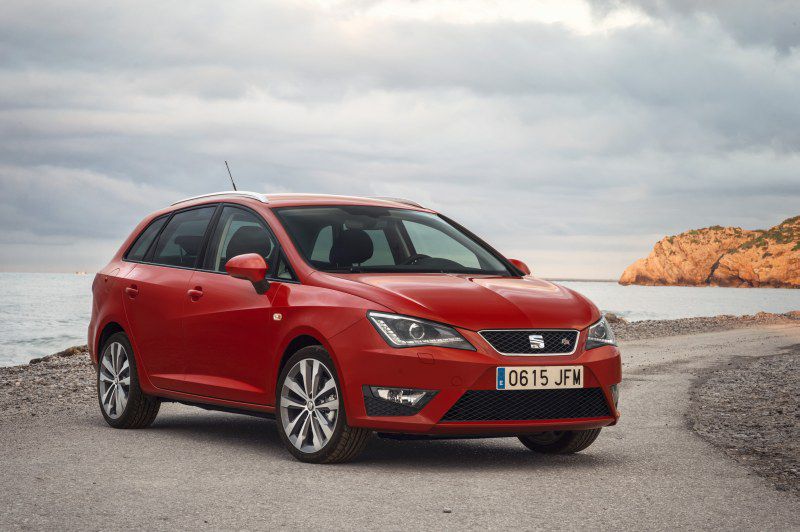
The Seat Ibiza IV ST (facelift 2015) retained the sharp, angular design language characteristic of Seat vehicles, even in its more family-oriented station wagon form. The facelift introduced subtle refinements, including updated headlamps, revised grille, and new wheel designs, giving it a fresher and more contemporary look. The body type, a 5-door station wagon (often referred to as an “estate” in Europe), was a key differentiator, offering significantly enhanced practicality compared to the standard hatchback.
Measuring 166.77 inches (4236 mm) in length, 66.65 inches (1693 mm) in width, and 56.89 inches (1445 mm) in height, the Ibiza ST maintained a relatively compact footprint, making it nimble in city traffic and easy to park, a crucial consideration in dense European urban environments. Despite its modest exterior dimensions, the interior was cleverly packaged to accommodate five occupants comfortably. The standout feature, however, was its cargo capacity. With a minimum trunk space of 430 liters (15.19 cubic feet), the Ibiza ST offered substantially more utility than its hatchback sibling, making it ideal for grocery runs, luggage for road trips, or transporting larger items. This generous cargo volume was a significant selling point, often rivaling vehicles from the segment above.
Inside, the 2015 facelift brought improved materials, updated infotainment options, and a generally more refined cabin ambiance. While specifics on advanced driver-assistance systems are not detailed in the provided data, standard safety features for a modern European car of this era would typically include ABS (Anti-lock braking system), multiple airbags, and electronic stability control. The steering system utilized a rack and pinion setup, providing precise and direct feedback, contributing to Seat’s reputation for engaging driving dynamics. The suspension system featured an independent McPherson strut design with coil springs and an anti-roll bar at the front, paired with a semi-independent coil spring setup at the rear, striking a balance between ride comfort and handling agility. Braking was handled by ventilated discs at the front and disc brakes at the rear, ensuring confident stopping power. Various tire and wheel size options, ranging from 14-inch to 17-inch, allowed for personalization and different performance characteristics.
Technical Specifications
| Parameter | Value |
|---|---|
| General Information | |
| Brand | Seat |
| Model | Ibiza |
| Generation | Ibiza IV ST (facelift 2015) |
| Engine Type | 1.0 Eco TSI (95 Hp) |
| Production Start | May, 2015 |
| Production End | 2017 |
| Powertrain Architecture | Internal Combustion engine |
| Body Type | Station wagon (estate) |
| Seats | 5 |
| Doors | 5 |
| Performance Specifications | |
| Fuel Consumption (Combined) | 4.2 l/100 km (56 US mpg) |
| CO2 Emissions | 97 g/km |
| Fuel Type | Petrol (Gasoline) |
| Acceleration 0-60 mph | 10.3 sec |
| Acceleration 0-62 mph (0-100 km/h) | 10.8 sec |
| Maximum Speed | 116.2 mph (187 km/h) |
| Emission Standard | Euro 6 |
| Weight-to-Power Ratio | 11.3 kg/Hp (88.8 Hp/tonne) |
| Weight-to-Torque Ratio | 6.7 kg/Nm (149.5 Nm/tonne) |
| Engine Specifications | |
| Power | 95 Hp @ 5000-5500 rpm |
| Power per Liter | 95.1 Hp/l |
| Torque | 160 Nm (118.01 lb.-ft.) @ 1500-3500 rpm |
| Engine Layout | Front, Transverse |
| Engine Model/Code | CHZB |
| Engine Displacement | 999 cm³ (60.96 cu. in.) |
| Number of Cylinders | 3 |
| Engine Configuration | Inline |
| Cylinder Bore | 74.5 mm (2.93 in.) |
| Piston Stroke | 76.4 mm (3.01 in.) |
| Compression Ratio | 10.5:1 |
| Valves per Cylinder | 4 |
| Fuel Injection System | Direct injection |
| Engine Aspiration | Turbocharger, Intercooler |
| Engine Oil Capacity | 4 l (4.23 US qt) |
| Coolant Capacity | 8 l (8.45 US qt) |
| Dimensions, Volume, and Weights | |
| Kerb Weight | 1070 kg (2358.95 lbs.) |
| Maximum Weight | 1630 kg (3593.53 lbs.) |
| Maximum Load | 560 kg (1234.59 lbs.) |
| Trunk Space (Minimum) | 430 l (15.19 cu. ft.) |
| Fuel Tank Capacity | 45 l (11.89 US gal) |
| Length | 4236 mm (166.77 in.) |
| Width | 1693 mm (66.65 in.) |
| Height | 1445 mm (56.89 in.) |
| Wheelbase | 2469 mm (97.2 in.) |
| Front Track | 1465 mm (57.68 in.) |
| Rear Track | 1457 mm (57.36 in.) |
| Minimum Turning Circle | 10 m (32.81 ft.) |
| Drivetrain, Brakes, and Suspension | |
| Drivetrain Architecture | Front-wheel drive (ICE drives front wheels) |
| Drive Wheel | Front wheel drive |
| Number of Gears & Gearbox Type | 5 gears, manual transmission |
| Front Suspension | Independent, McPherson with coil spring and anti-roll bar |
| Rear Suspension | Semi-independent, coil spring |
| Front Brakes | Ventilated discs |
| Rear Brakes | Disc |
| Assisting Systems | ABS (Anti-lock braking system) |
| Steering Type | Steering rack and pinion |
| Tire Sizes | 175/70 R14; 185/60 R15; 215/45 R16; 215/40 R17 |
| Wheel Rim Sizes | 14; 15; 16; 17 |
Legacy and Market Impact
The Seat Ibiza, particularly the fourth generation and its facelifted 2015 iteration, holds a significant place in Seat’s history and the European automotive landscape. As one of the brand’s best-selling models, the Ibiza has consistently served as Seat’s entry into the crucial subcompact segment. The ST (Sport Tourer) variant, while less common than the hatchback, played an important role in expanding the Ibiza’s appeal to buyers who prioritized practicality and cargo space without wanting to step up to a larger, more expensive compact (C-segment) vehicle.
In its primary European markets, the Ibiza ST competed against a diverse array of subcompact wagons and versatile hatchbacks. Key rivals included the Skoda Fabia Combi (another Volkswagen Group stablemate, often cross-shopped for its similar value proposition and practicality), the Renault Clio Estate, and to some extent, the Dacia Logan MCV. The Ibiza ST differentiated itself with its more dynamic styling, often perceived as sportier than its utilitarian rivals, and a driving experience that benefited from Seat’s focus on agility and driver engagement.
The introduction of the 1.0 Eco TSI engine in the 2015 facelift cemented the Ibiza ST’s reputation for efficiency and modern technology. This engine, shared across various Volkswagen Group models, demonstrated the industry’s shift towards smaller, turbocharged powerplants that offered a compelling balance of performance, fuel economy, and lower emissions. For many European buyers, the combination of a compact footprint, substantial cargo volume, economical running costs, and Seat’s characteristic vibrant design made the Ibiza IV ST (facelift 2015) a highly attractive proposition.
While the station wagon body style in the subcompact segment has seen a decline in popularity in recent years due to the rise of crossovers and SUVs, the Ibiza ST remains a testament to the versatility and intelligent design that characterized this niche. It embodied Seat’s brand values of design, technology, and dynamic performance, all wrapped in a practical and economical package. Its legacy is one of providing a functional yet engaging option for those who needed more space than a hatchback but desired the maneuverability and efficiency of a subcompact car.