The Seat Ibiza IV ST (facelift 2012): An Economical European Estate
The Seat Ibiza IV ST (facelift 2012) represents a key offering from the Spanish automaker SEAT within the highly competitive European B-segment, specifically catering to the compact station wagon or “estate” market. Produced between 2012 and 2015, this model was part of the fourth generation of the Ibiza (platform code 6J/6P) and benefited from a mid-cycle refresh that brought updated styling cues and minor mechanical refinements. As a practical and economical choice, the Ibiza ST, with its 1.2-liter (60 Hp) engine variant, was designed to provide ample cargo space and everyday usability for families and individuals in its primary European markets, where fuel efficiency and maneuverability are paramount. It underscored SEAT’s commitment to delivering accessible, stylish, and functional vehicles within the Volkswagen Group’s diverse portfolio.
Engine and Performance of the Seat Ibiza IV ST (facelift 2012) 1.2 (60 Hp)
At the heart of this particular Seat Ibiza IV ST (facelift 2012) variant lies a modest yet efficient 1.2-liter (1198 cm3 or 73.11 cu. in.) naturally aspirated, inline three-cylinder gasoline engine, identified by the engine code CGPB. This powertrain was engineered with economy and low running costs in mind, a common characteristic for entry-level vehicles in the European market. It delivers a peak power output of 60 horsepower (Hp) at 5200 rpm, which translates to a power-per-liter ratio of 50.1 Hp/l. Torque figures stand at 79.66 lb.-ft. (108 Nm), available at a relatively low 3000 rpm, aiding in urban drivability.
The engine utilizes a multi-port manifold injection system and features four valves per cylinder, a configuration designed to optimize combustion efficiency. Paired with a standard 5-speed manual transmission, this front-wheel-drive architecture offers a straightforward and engaging driving experience. While outright speed was not its primary objective, the Ibiza ST 1.2 (60 Hp) could reach a top speed of 96.31 mph (155 km/h). Acceleration from 0 to 60 mph was achieved in a measured 15.9 seconds (0-100 km/h in 16.7 seconds), indicating its suitability for city commuting and leisurely highway cruising rather than high-performance driving.
Fuel economy was a strong selling point for this model. The combined fuel consumption was an impressive 42.8 US mpg (5.5 l/100 km), with urban figures around 32.2 US mpg (7.3 l/100 km) and extra-urban figures reaching 52.3 US mpg (4.5 l/100 km). These figures, combined with CO2 emissions of 128 g/km and adherence to the Euro 5 emission standard, positioned the Ibiza ST as an environmentally conscious and budget-friendly option for European consumers. The 11.89 US gallon (45 liter) fuel tank provided a respectable cruising range between fill-ups.
Design and Features
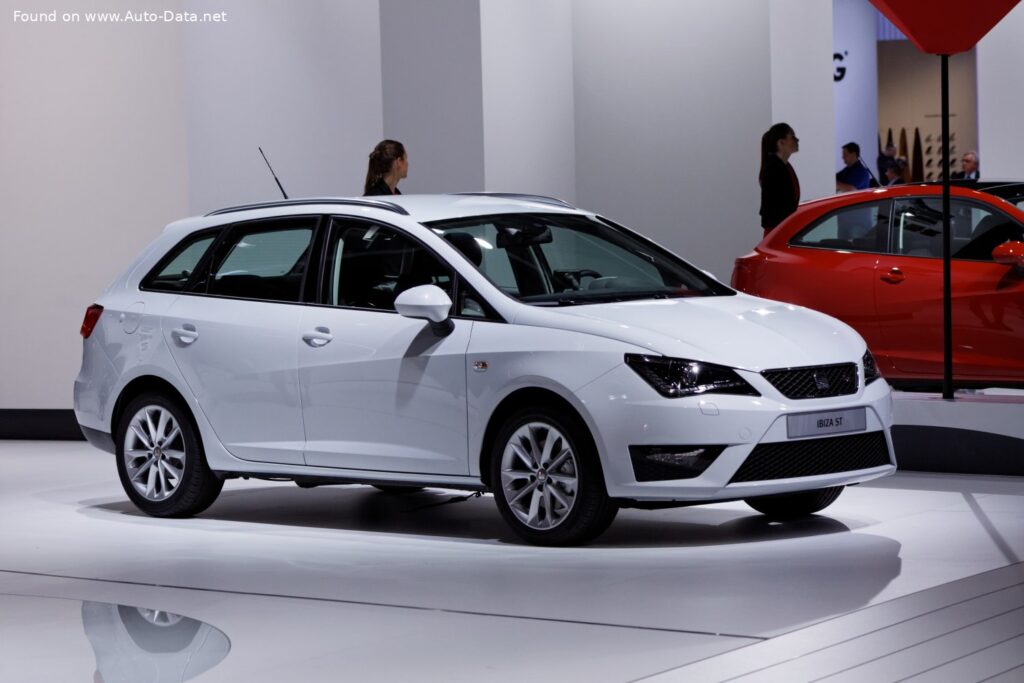
The Seat Ibiza IV ST (facelift 2012) adopted a practical five-door station wagon (estate) body style, a departure from the more common hatchback variants of the Ibiza. This design choice significantly enhanced its utility, offering a minimum trunk space of 15.19 cu. ft. (430 liters), making it a versatile option for small families or those requiring extra cargo capacity. The facelifted model introduced subtle styling revisions, including a refreshed front fascia with updated headlights and grille, giving it a sharper, more contemporary look in line with SEAT’s evolving design language.
Dimensionally, the Ibiza ST measured 166.77 inches (4236 mm) in length, 66.65 inches (1693 mm) in width, and 56.89 inches (1445 mm) in height, with a wheelbase of 97.2 inches (2469 mm). These compact dimensions contributed to its agility in urban environments, while the five-seat configuration ensured practical accommodation for passengers. The vehicle’s kerb weight stood at 2447.13 lbs. (1110 kg), allowing for a maximum payload of 1003.1 lbs. (455 kg) and a gross weight of 3450.23 lbs. (1565 kg).
In terms of chassis and safety, the Ibiza ST featured an independent McPherson strut front suspension with coil springs and an anti-roll bar, paired with a semi-independent rear suspension also utilizing coil springs. This setup provided a comfortable ride quality balanced with predictable handling. Braking duties were handled by ventilated discs at the front and traditional drum brakes at the rear, complemented by an Anti-lock Braking System (ABS) for enhanced stopping control. Steering was managed through a rack and pinion system. Various tire and wheel options were available, ranging from 175/70 R14 to 215/40 R17, allowing for customization based on trim level and desired aesthetics or performance characteristics.
Technical Specifications: Seat Ibiza IV ST (facelift 2012) 1.2 (60 Hp)
| Category | Specification | US Equivalent |
|---|---|---|
| Brand | Seat | |
| Model | Ibiza | |
| Generation | Ibiza IV ST (facelift 2012) | |
| Type (Engine) | 1.2 (60 Hp) | |
| Start of Production | 2012 year | |
| End of Production | 2015 year | |
| Powertrain Architecture | Internal Combustion engine | |
| Body type | Station wagon (estate) | |
| Seats | 5 | |
| Doors | 5 | |
| Fuel consumption (economy) – urban | 7.3 l/100 km | 32.2 US mpg |
| Fuel consumption (economy) – extra urban | 4.5 l/100 km | 52.3 US mpg |
| Fuel consumption (economy) – combined | 5.5 l/100 km | 42.8 US mpg |
| CO2 emissions | 128 g/km | |
| Fuel Type | Petrol (Gasoline) | |
| Acceleration 0 – 100 km/h | 16.7 sec | |
| Acceleration 0 – 62 mph | 16.7 sec | |
| Acceleration 0 – 60 mph (Calculated) | 15.9 sec | |
| Maximum speed | 155 km/h | 96.31 mph |
| Emission standard | Euro 5 | |
| Weight-to-power ratio | 18.5 kg/Hp | 54.1 Hp/tonne |
| Weight-to-torque ratio | 10.3 kg/Nm | 97.3 Nm/tonne |
| Power | 60 Hp @ 5200 rpm. | |
| Power per liter | 50.1 Hp/l | |
| Torque | 108 Nm @ 3000 rpm. | 79.66 lb.-ft. @ 3000 rpm. |
| Engine layout | Front, Transverse | |
| Engine Model/Code | CGPB | |
| Engine displacement | 1198 cm3 | 73.11 cu. in. |
| Number of cylinders | 3 | |
| Engine configuration | Inline | |
| Cylinder Bore | 76.5 mm | 3.01 in. |
| Piston Stroke | 86.9 mm | 3.42 in. |
| Compression ratio | 10.5:1 | |
| Number of valves per cylinder | 4 | |
| Fuel injection system | Multi-port manifold injection | |
| Engine aspiration | Naturally aspirated engine | |
| Engine oil capacity | 3 l | 3.17 US qt |
| Coolant | 5.6 l | 5.92 US qt |
| Kerb Weight | 1110 kg | 2447.13 lbs. |
| Max. weight | 1565 kg | 3450.23 lbs. |
| Max load | 455 kg | 1003.1 lbs. |
| Trunk (boot) space – minimum | 430 l | 15.19 cu. ft. |
| Fuel tank capacity | 45 l | 11.89 US gal |
| Length | 4236 mm | 166.77 in. |
| Width | 1693 mm | 66.65 in. |
| Height | 1445 mm | 56.89 in. |
| Wheelbase | 2469 mm | 97.2 in. |
| Front track | 1465 mm | 57.68 in. |
| Rear (Back) track | 1457 mm | 57.36 in. |
| Drivetrain Architecture | Front wheel drive | Internal Combustion engine drives the front wheels |
| Drive wheel | Front wheel drive | |
| Number of gears and type of gearbox | 5 gears, manual transmission | |
| Front suspension | Independent, type McPherson with coil spring and anti-roll bar | |
| Rear suspension | Semi-independent, coil spring | |
| Front brakes | Ventilated discs | |
| Rear brakes | Drum | |
| Assisting systems | ABS (Anti-lock braking system) | |
| Steering type | Steering rack and pinion | |
| Tires size | 175/70 R14; 185/60 R15; 215/45 R16; 215/40 R17 | |
| Wheel rims size | 5.0J x 14; 6.0J x 15; 7.0J x 16; 7.0J x 17 |
Legacy and Market Impact of the Seat Ibiza IV ST (facelift 2012)
The Seat Ibiza IV ST (facelift 2012), particularly in its 1.2-liter (60 Hp) guise, played a significant role in SEAT’s strategy within the European market. As a brand under the Volkswagen Group, SEAT is often positioned as the “sportier” and more design-conscious sibling to Skoda’s practicality and Volkswagen’s mainstream appeal. The Ibiza ST embodied this approach by offering a more visually engaging design than some of its direct rivals, while still delivering the core values of affordability, efficiency, and practicality.
In Europe, where compact dimensions, fuel economy, and lower vehicle taxation (often based on engine size and CO2 emissions) are crucial, the 1.2-liter engine was a logical and popular choice. While its 60 horsepower might seem modest by American standards, it was perfectly adequate for urban driving, suburban commutes, and even longer journeys on European highways, especially considering the car’s relatively light kerb weight. This powertrain was also attractive to younger drivers or those seeking minimal running costs.
The Ibiza ST competed in a crowded segment against formidable rivals such as its platform-mate, the Volkswagen Polo Estate (or Variant in some markets), the Ford Fiesta Estate, Renault Clio Estate, Peugeot 208 SW (if available), and the Skoda Fabia Estate. What set the Ibiza ST apart was its distinctive Spanish flair and a slightly more dynamic aesthetic, which appealed to buyers looking for a blend of utility and style without breaking the bank. Its competitive pricing and the backing of Volkswagen Group engineering ensured a reputation for reliability and solid build quality.
Historically, the Ibiza ST contributed to SEAT’s growing market share and brand recognition, showcasing the company’s ability to diversify beyond hatchbacks. It demonstrated that a compact estate could be both stylish and eminently practical, offering a compelling alternative to larger, more expensive vehicles for families who needed extra trunk space but preferred the smaller footprint and lower running costs of a B-segment car. Even today, the Ibiza IV ST remains a popular choice in the used car market across Europe, valued for its enduring practicality, fuel efficiency, and robust engineering, solidifying its legacy as a smart, economical family car.