The Seat Ibiza IV ST (facelift 2012): A Practical European Subcompact
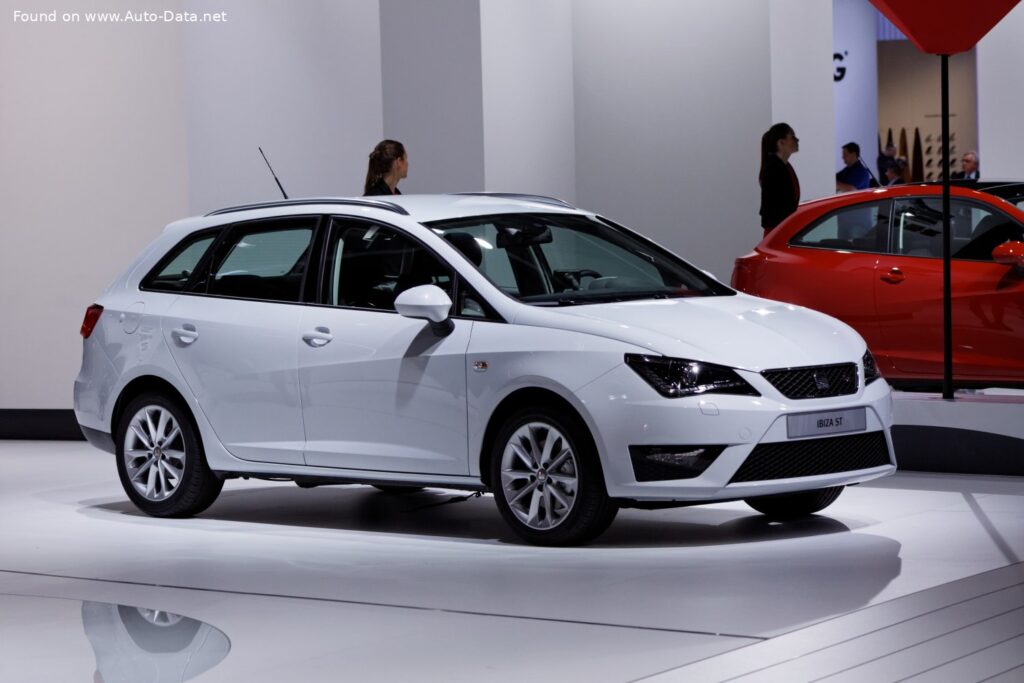
The Seat Ibiza IV ST (facelift 2012) represents a significant iteration in the lineage of Seat’s popular subcompact car, the Ibiza. As a brand within the Volkswagen Group, Seat primarily caters to European and select international markets, offering vehicles known for their sporty design and accessible price point. The fourth generation Ibiza, introduced in 2008, received a mid-cycle refresh in 2012, bringing updated styling and minor mechanical tweaks. This particular variant, the “ST” (Sport Tourer or Station Wagon), carved out a niche for itself by offering enhanced practicality and cargo space within the typically hatchback-dominated B-segment (subcompact class). Produced from 2012 to 2015, the Ibiza ST was a compelling choice for European families and individuals seeking the maneuverability of a small car combined with the versatility of a station wagon, embodying efficiency and functional design for its target demographic.
Engine and Performance of the Seat Ibiza IV ST (facelift 2012)
Powering the specific Seat Ibiza IV ST (facelift 2012) variant under review is a modest yet efficient 1.2-liter three-cylinder gasoline engine. This naturally aspirated unit, identified by engine codes CGPA or CJLB, was engineered for economy and reliability within urban and suburban environments. It delivers a peak output of 70 horsepower at 5400 revolutions per minute (rpm) and a maximum torque of 82.61 lb.-ft. (112 Nm) at a relatively low 3000 rpm. This torque characteristic contributes to its drivability in city traffic, allowing for decent low-end grunt despite its small displacement.
The powertrain architecture of the Ibiza ST is a conventional front-engine, front-wheel-drive setup, paired with a five-speed manual transmission. While not designed for outright speed, the 1.2-liter engine provides adequate performance for its segment. The vehicle can accelerate from 0 to 60 mph in a calculated 13.9 seconds, reaching a top speed of 101.28 mph (163 km/h). These figures underscore its role as a practical commuter rather than a performance-oriented vehicle.
Fuel efficiency was a key selling point for this model, especially in markets where fuel costs are a significant consideration. The combined fuel consumption is rated at an impressive 42.8 US mpg (5.5 l/100 km). In extra-urban driving, it could achieve up to 52.3 US mpg (4.5 l/100 km), while urban driving saw figures around 32.2 US mpg (7.3 l/100 km). With CO2 emissions of 128 g/km, the Ibiza ST 1.2 met the Euro 5 emission standard, reflecting its relatively clean operation for its time. The multi-port manifold injection system ensures precise fuel delivery, contributing to both efficiency and smooth operation.
Design and Features
The 2012 facelift brought subtle but effective aesthetic enhancements to the fourth-generation Ibiza, aligning its design more closely with Seat’s evolving corporate identity. The Seat Ibiza IV ST (facelift 2012) maintained its sharp, dynamic lines, a hallmark of Seat’s “auto emoción” design philosophy. As a five-door station wagon (often referred to as an “estate” in Europe), its primary differentiating feature was its extended rear section, providing significantly more cargo volume compared to its hatchback sibling. This body style was a direct response to consumer demand for more versatile and family-friendly compact vehicles without sacrificing the compact footprint.
Dimensionally, the Ibiza ST measured 166.77 inches (4236 mm) in length, 66.65 inches (1693 mm) in width, and 56.89 inches (1445 mm) in height, with a wheelbase of 97.2 inches (2469 mm). These compact dimensions made it highly maneuverable in congested European city streets, evidenced by its minimum turning circle of 34.38 feet (10.48 m). Despite its small exterior, the station wagon design allowed for a generous minimum trunk space of 15.19 cubic feet (430 liters), expandable by folding the rear seats, making it highly practical for carrying luggage, groceries, or even sports equipment. The vehicle comfortably seated five occupants.
Standard features for a vehicle of its class and era included essential safety systems such as an Anti-lock Braking System (ABS), which was crucial for maintaining control during hard braking. The front suspension featured an independent McPherson strut design with coil springs and an anti-roll bar, while the rear utilized a semi-independent setup with coil springs, providing a balanced ride and handling. Braking power was supplied by ventilated discs at the front and drum brakes at the rear. The car offered various tire and wheel size options, ranging from 175/70 R14 to more stylish 215/40 R17 configurations, allowing owners to customize their vehicle’s look and handling characteristics. The interior, while functional, focused on ergonomic design and durable materials, typical of Volkswagen Group products, ensuring a comfortable and intuitive driving experience.
Technical Specifications: Seat Ibiza IV ST (facelift 2012) 1.2 (70 Hp)
| Category | Specification | US Equivalent (where applicable) |
|---|---|---|
| General Information | ||
| Brand | Seat | |
| Model | Ibiza | |
| Generation | Ibiza IV ST (facelift 2012) | |
| Type (Engine) | 1.2 (70 Hp) | |
| Start of Production | 2012 year | |
| End of Production | 2015 year | |
| Powertrain Architecture | Internal Combustion engine | |
| Body type | Station wagon (estate) | |
| Seats | 5 | |
| Doors | 5 | |
| Performance Specs | ||
| Fuel consumption (economy) – urban | 7.3 l/100 km | 32.2 US mpg |
| Fuel consumption (economy) – extra urban | 4.5 l/100 km | 52.3 US mpg |
| Fuel consumption (economy) – combined | 5.5 l/100 km | 42.8 US mpg |
| CO2 emissions | 128 g/km | |
| Fuel Type | Petrol (Gasoline) | |
| Acceleration 0 – 60 mph | 13.9 sec | |
| Maximum speed | 163 km/h | 101.28 mph |
| Emission standard | Euro 5 | |
| Weight-to-power ratio | 15.9 kg/Hp | |
| Weight-to-torque ratio | 9.9 kg/Nm | |
| Engine Specs | ||
| Power | 70 Hp @ 5400 rpm | |
| Power per liter | 58.4 Hp/l | |
| Torque | 112 Nm @ 3000 rpm | 82.61 lb.-ft. @ 3000 rpm |
| Engine layout | Front, Transverse | |
| Engine Model/Code | CGPA, CJLB | |
| Engine displacement | 1198 cm3 | 1.2 liters (73.11 cu. in.) |
| Number of cylinders | 3 | |
| Engine configuration | Inline | |
| Cylinder Bore | 76.5 mm | 3.01 in. |
| Piston Stroke | 86.9 mm | 3.42 in. |
| Compression ratio | 10.5:1 | |
| Number of valves per cylinder | 4 | |
| Fuel injection system | Multi-port manifold injection | |
| Engine aspiration | Naturally aspirated engine | |
| Engine oil capacity | 3 l | 3.17 US qt |
| Coolant | 5.6 l | 5.92 US qt |
| Space, Volume and Weights | ||
| Kerb Weight | 1110 kg | 2447.13 lbs. |
| Max. weight | 1565 kg | 3450.23 lbs. |
| Max load | 455 kg | 1003.1 lbs. |
| Trunk (boot) space – minimum | 430 l | 15.19 cu. ft. |
| Fuel tank capacity | 45 l | 11.89 US gal |
| Dimensions | ||
| Length | 4236 mm | 166.77 in. |
| Width | 1693 mm | 66.65 in. |
| Height | 1445 mm | 56.89 in. |
| Wheelbase | 2469 mm | 97.2 in. |
| Front track | 1465 mm | 57.68 in. |
| Rear (Back) track | 1457 mm | 57.36 in. |
| Minimum turning circle (turning diameter) | 10.48 m | 34.38 ft. |
| Drivetrain, Brakes and Suspension Specs | ||
| Drivetrain Architecture | The Internal combustion engine (ICE) drives the front wheels of the vehicle. | |
| Drive wheel | Front wheel drive | |
| Number of gears and type of gearbox | 5 gears, manual transmission | |
| Front suspension | Independent, type McPherson with coil spring and anti-roll bar | |
| Rear suspension | Semi-independent, coil spring | |
| Front brakes | Ventilated discs | |
| Rear brakes | Drum | |
| Assisting systems | ABS (Anti-lock braking system) | |
| Steering type | Steering rack and pinion | |
| Tires size | 175/70 R14; 185/60 R15; 215/45 R16; 215/40 R17 | |
| Wheel rims size | 5.0J x 14; 6.0J x 15; 7.0J x 16; 7.0J x 17 |
Legacy and Market Impact
The Seat Ibiza, particularly its IV generation and the ST (Sport Tourer) variant, played a crucial role in Seat’s strategy within the highly competitive European subcompact segment. As a brand not sold in the United States, Seat’s market impact is entirely concentrated in Europe and other select international regions. The Seat Ibiza IV ST (facelift 2012) was positioned as a practical, stylish, and economical alternative to traditional hatchbacks, offering the added utility of a station wagon without significantly increasing the vehicle’s footprint or cost.
Its competitors in the European market were numerous and formidable, including the Skoda Fabia Combi, Renault Clio Estate, Peugeot 207 SW (and later 208 SW), and even its platform-mate, the Volkswagen Polo Variant (though the Polo Variant was less widely offered in all markets where the Ibiza ST excelled). What set the Ibiza ST apart was its distinctive Spanish flair and sportier design language, often perceived as more youthful and dynamic than some of its more conservative rivals, while still benefiting from the robust engineering of the Volkswagen Group.
The 1.2-liter engine variant specifically appealed to buyers prioritizing low running costs, fuel efficiency, and reduced emissions, especially in countries with tax structures that favor smaller, more economical engines. Its combination of a spacious trunk, five-door accessibility, and compact dimensions made it an ideal choice for young families or individuals requiring extra cargo capacity for hobbies, small businesses, or simply everyday life, without wanting to upgrade to a larger, more expensive vehicle.
The Ibiza ST contributed to Seat’s reputation as a brand capable of delivering practical and emotionally engaging vehicles. While the station wagon body style has seen a decline in popularity in recent years in favor of SUVs, the Ibiza ST remains a testament to a period when subcompact wagons offered a compelling blend of versatility and efficiency. Its legacy lies in demonstrating that even small cars could be highly functional and appealing, solidifying Seat’s position as a vibrant and relevant player in the European automotive landscape during its production run. It was a smart, sensible, and spirited option for those who valued practicality wrapped in a distinctively European package.