<h2>The Seat Ibiza IV ST (facelift 2012) 1.2 TDI (75 Hp) Start/Stop: A European Compact Estate</h2>
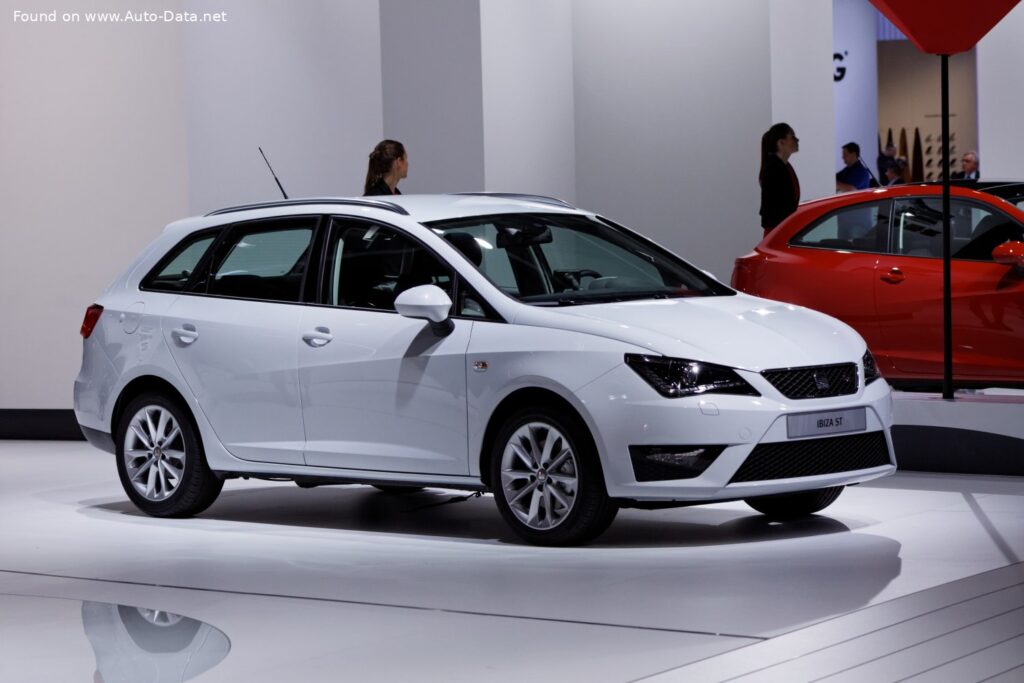
<p>The Seat Ibiza IV ST (facelift 2012) 1.2 TDI (75 Hp) Start/Stop represents a significant iteration of the popular Spanish automaker’s subcompact car, specifically tailored for the European market. As part of the fourth generation (6J/6P) of the Ibiza, this model, produced between 2012 and 2015, received a mid-cycle refresh that brought subtle styling updates and enhanced technological features. The “ST” designation, an acronym for “Sport Tourer” or “Station Wagon” in Seat’s nomenclature, signifies its practical estate body style, a less common offering in the compact segment but highly valued in many European countries for its blend of compact dimensions and increased cargo capacity. Unlike its hatchback siblings, the Ibiza ST was designed to cater to families or individuals requiring more versatility than a standard supermini, without stepping up to a larger, more expensive vehicle. This particular variant, equipped with the efficient 1.2-liter TDI diesel engine and a Start/Stop system, underscored Seat’s commitment to delivering economical and environmentally conscious transportation solutions, a crucial factor in the competitive European automotive landscape where fuel efficiency and low emissions are paramount.</p>
<p>While the Seat brand and the Ibiza model have never been officially sold in the United States, their impact across Europe, Latin America, and other global markets is substantial. Seat, a subsidiary of the Volkswagen Group, often leverages shared platforms and powertrains, positioning its vehicles with a distinctive “auto emoción” philosophy – a focus on dynamic styling and engaging driving characteristics. The Ibiza IV ST, therefore, provided a practical yet stylish option for consumers seeking the practicality of an estate car within the B-segment, competing effectively against other European compact wagons. Its relevance lies in its ability to offer Volkswagen Group engineering and reliability wrapped in a more expressive Spanish design, all while delivering impressive fuel economy figures that were particularly attractive during its production run.</p>
<h2>Engine & Performance of the Seat Ibiza IV ST (facelift 2012)</h2>
<p>At the heart of the <strong>Seat Ibiza IV ST (facelift 2012)</strong> 1.2 TDI (75 Hp) Start/Stop lies a highly efficient and compact diesel powertrain, designed with economy and low emissions as primary objectives. This particular engine, identified by the code CFWA, is an inline three-cylinder, 1.2-liter (1199 cm<sup>3</sup> or 73.17 cu. in.) unit. Despite its small displacement, the engine benefits from advanced diesel technology, including a common rail fuel injection system, a turbocharger, and an intercooler. These features are crucial for extracting maximum power and torque from such a compact unit while maintaining high fuel efficiency.</p>
<p>The 1.2 TDI engine generates a respectable 75 horsepower at 4200 rpm, translating to a power output of 62.6 horsepower per liter. More significantly for a diesel, it produces a robust 180 Nm (132.76 lb.-ft.) of torque, which peaks at a low 2000 rpm. This ample low-end torque is characteristic of diesel engines and contributes to the car’s tractable performance in city driving and during highway cruising, despite its modest horsepower rating. The engine’s layout is front, transverse, driving the front wheels through a 5-speed manual transmission, a common and reliable setup for compact vehicles.</p>
<p>Performance figures reflect the car’s focus on economy rather than outright speed. The Ibiza ST 1.2 TDI accelerates from 0 to 62 mph (0-100 km/h) in 14.6 seconds, with a slightly quicker calculated 0-60 mph time of 13.9 seconds. Its maximum speed is 107.5 mph (173 km/h). While these numbers won’t set any speed records, they are perfectly adequate for daily European driving conditions, including highway travel. The engine’s design, with a bore of 3.13 inches (79.5 mm) and a stroke of 3.17 inches (80.5 mm), along with a compression ratio of 16.5:1 and four valves per cylinder, optimizes combustion for efficiency. Crucially, the integration of a Start/Stop system and a particulate filter further enhances its environmental credentials, allowing it to meet Euro 5 emission standards with CO2 emissions ranging from 89-92 g/km, making it a very tax-friendly option in many European markets.</p>
<h3>Fuel Economy</h3>
<p>The true highlight of this powertrain is its exceptional fuel economy. The official figures are impressive:
<ul>
<li><strong>Urban:</strong> 4.1-4.2 l/100 km (57.4 – 56 US mpg)</li>
<li><strong>Extra Urban:</strong> 3.0-3.1 l/100 km (78.4 – 75.9 US mpg)</li>
<li><strong>Combined:</strong> 3.4-3.5 l/100 km (69.2 – 67.2 US mpg)</li>
</ul>
These figures underscore the Ibiza ST 1.2 TDI’s role as a highly economical choice, offering long driving ranges between fill-ups, which was a significant selling point in its target markets.</p>
<h2>Design & Features</h2>
<p>The Seat Ibiza IV ST (facelift 2012) maintains the core design language of the fourth-generation Ibiza, characterized by sharp lines, a distinctive “arrow design” front end, and a sporty stance. The 2012 facelift introduced subtle refinements, primarily focused on the front fascia with redesigned headlights featuring LED daytime running lights (where specified), a revised grille, and updated bumper styling. These changes aimed to keep the Ibiza fresh and competitive against its rivals.</p>
<p>As a station wagon (estate), the Ibiza ST differentiates itself from the hatchback models by its extended rear section, which significantly boosts its practicality. With a length of 166.77 inches (4236 mm), a width of 66.65 inches (1693 mm), and a height of 56.89 inches (1445 mm), it remains a compact vehicle, perfectly suited for navigating narrow European city streets and parking spaces. The wheelbase measures 97.2 inches (2469 mm), providing a stable ride and adequate interior space for five occupants across its five doors.</p>
<p>The primary advantage of the ST body type is its cargo capacity. The Ibiza ST offers a minimum trunk space of 430 liters (15.19 cu. ft.), which is a substantial increase over the hatchback models and highly competitive within its segment. This makes it a practical choice for small families, individuals with hobbies requiring extra gear, or those who simply appreciate the flexibility of a larger cargo area. The rear seats can typically be folded down to further expand this capacity, though specific maximum volume data is not provided.</p>
<p>In terms of chassis and suspension, the Ibiza ST features an independent McPherson strut setup with coil springs and an anti-roll bar at the front, providing a balance of comfort and responsive handling. The rear utilizes a semi-independent setup with coil springs, a common and cost-effective solution for compact cars that offers a good compromise between ride quality and packaging efficiency. Braking is handled by ventilated discs at the front and drum brakes at the rear, complemented by an Anti-lock Braking System (ABS) for enhanced safety. The steering system is a rack and pinion type, offering precise control. The vehicle rides on 185/60 R15 tires mounted on 6.0J x 15 wheel rims, a practical size that balances ride comfort, grip, and affordability.</p>
<p>Key features that highlight the car’s modern approach for its era include the Start & Stop System, which automatically shuts off the engine when the car is stationary to save fuel and reduce emissions, and a Particulate Filter, essential for diesel engines to meet stringent European emission standards. These technologies contribute to the car’s overall efficiency and lower environmental impact.</p>
<h2>Technical Specifications</h2>
<table border=”1″ style=”width:100%; border-collapse: collapse;”>
<thead>
<tr>
<th style=”padding: 8px; text-align: left; background-color: #f2f2f2;”>Category</th>
<th style=”padding: 8px; text-align: left; background-color: #f2f2f2;”>Specification</th>
</tr>
</thead>
<tbody>
<tr>
<td style=”padding: 8px; border: 1px solid #ddd;”><strong>General Information</strong></td>
<td style=”padding: 8px; border: 1px solid #ddd;”></td>
</tr>
<tr>
<td style=”padding: 8px; border: 1px solid #ddd;”>Brand</td>
<td style=”padding: 8px; border: 1px solid #ddd;”>Seat</td>
</tr>
<tr>
<td style=”padding: 8px; border: 1px solid #ddd;”>Model</td>
<td style=”padding: 8px; border: 1px solid #ddd;”>Ibiza</td>
</tr>
<tr>
<td style=”padding: 8px; border: 1px solid #ddd;”>Generation</td>
<td style=”padding: 8px; border: 1px solid #ddd;”>Ibiza IV ST (facelift 2012)</td>
</tr>
<tr>
<td style=”padding: 8px; border: 1px solid #ddd;”>Engine Type</td>
<td style=”padding: 8px; border: 1px solid #ddd;”>1.2 TDI (75 Hp) start/stop</td>
</tr>
<tr>
<td style=”padding: 8px; border: 1px solid #ddd;”>Start of Production</td>
<td style=”padding: 8px; border: 1px solid #ddd;”>2012 year</td>
</tr>
<tr>
<td style=”padding: 8px; border: 1px solid #ddd;”>End of Production</td>
<td style=”padding: 8px; border: 1px solid #ddd;”>2015 year</td>
</tr>
<tr>
<td style=”padding: 8px; border: 1px solid #ddd;”>Powertrain Architecture</td>
<td style=”padding: 8px; border: 1px solid #ddd;”>Internal Combustion engine</td>
</tr>
<tr>
<td style=”padding: 8px; border: 1px solid #ddd;”>Body Type</td>
<td style=”padding: 8px; border: 1px solid #ddd;”>Station wagon (estate)</td>
</tr>
<tr>
<td style=”padding: 8px; border: 1px solid #ddd;”>Seats</td>
<td style=”padding: 8px; border: 1px solid #ddd;”>5</td>
</tr>
<tr>
<td style=”padding: 8px; border: 1px solid #ddd;”>Doors</td>
<td style=”padding: 8px; border: 1px solid #ddd;”>5</td>
</tr>
<tr>
<td style=”padding: 8px; border: 1px solid #ddd;”><strong>Performance Specs</strong></td>
<td style=”padding: 8px; border: 1px solid #ddd;”></td>
</tr>
<tr>
<td style=”padding: 8px; border: 1px solid #ddd;”>Fuel Consumption (urban)</td>
<td style=”padding: 8px; border: 1px solid #ddd;”>4.1-4.2 l/100 km (57.4 – 56 US mpg)</td>
</tr>
<tr>
<td style=”padding: 8px; border: 1px solid #ddd;”>Fuel Consumption (extra urban)</td>
<td style=”padding: 8px; border: 1px solid #ddd;”>3.0-3.1 l/100 km (78.4 – 75.9 US mpg)</td>
</tr>
<tr>
<td style=”padding: 8px; border: 1px solid #ddd;”>Fuel Consumption (combined)</td>
<td style=”padding: 8px; border: 1px solid #ddd;”>3.4-3.5 l/100 km (69.2 – 67.2 US mpg)</td>
</tr>
<tr>
<td style=”padding: 8px; border: 1px solid #ddd;”>CO2 Emissions</td>
<td style=”padding: 8px; border: 1px solid #ddd;”>89-92 g/km</td>
</tr>
<tr>
<td style=”padding: 8px; border: 1px solid #ddd;”>Fuel Type</td>
<td style=”padding: 8px; border: 1px solid #ddd;”>Diesel</td>
</tr>
<tr>
<td style=”padding: 8px; border: 1px solid #ddd;”>Acceleration 0-60 mph</td>
<td style=”padding: 8px; border: 1px solid #ddd;”>13.9 sec</td>
</tr>
<tr>
<td style=”padding: 8px; border: 1px solid #ddd;”>Acceleration 0-62 mph (0-100 km/h)</td>
<td style=”padding: 8px; border: 1px solid #ddd;”>14.6 sec</td>
</tr>
<tr>
<td style=”padding: 8px; border: 1px solid #ddd;”>Maximum Speed</td>
<td style=”padding: 8px; border: 1px solid #ddd;”>107.5 mph (173 km/h)</td>
</tr>
<tr>
<td style=”padding: 8px; border: 1px solid #ddd;”>Emission Standard</td>
<td style=”padding: 8px; border: 1px solid #ddd;”>Euro 5</td>
</tr>
<tr>
<td style=”padding: 8px; border: 1px solid #ddd;”>Weight-to-Power Ratio</td>
<td style=”padding: 8px; border: 1px solid #ddd;”>16.1 kg/Hp, 62.2 Hp/tonne</td>
</tr>
<tr>
<td style=”padding: 8px; border: 1px solid #ddd;”>Weight-to-Torque Ratio</td>
<td style=”padding: 8px; border: 1px solid #ddd;”>6.7 kg/Nm, 149.4 Nm/tonne</td>
</tr>
<tr>
<td style=”padding: 8px; border: 1px solid #ddd;”><strong>Engine Specs</strong></td>
<td style=”padding: 8px; border: 1px solid #ddd;”></td>
</tr>
<tr>
<td style=”padding: 8px; border: 1px solid #ddd;”>Power</td>
<td style=”padding: 8px; border: 1px solid #ddd;”>75 Hp @ 4200 rpm</td>
</tr>
<tr>
<td style=”padding: 8px; border: 1px solid #ddd;”>Power per Liter</td>
<td style=”padding: 8px; border: 1px solid #ddd;”>62.6 Hp/l</td>
</tr>
<tr>
<td style=”padding: 8px; border: 1px solid #ddd;”>Torque</td>
<td style=”padding: 8px; border: 1px solid #ddd;”>132.76 lb.-ft. (180 Nm) @ 2000 rpm</td>
</tr>
<tr>
<td style=”padding: 8px; border: 1px solid #ddd;”>Engine Layout</td>
<td style=”padding: 8px; border: 1px solid #ddd;”>Front, Transverse</td>