Introduction to the Seat Ibiza V 1.0 TGI (90 Hp) CNG
The Seat Ibiza V 1.0 TGI (90 Hp) CNG represents a significant offering within the highly competitive European subcompact segment, showcasing SEAT’s commitment to both efficiency and alternative fuel solutions. Introduced as part of the fifth generation Ibiza, which debuted in 2017, this particular variant stands out for its bi-fuel capability, running on both gasoline and compressed natural gas (CNG). The Ibiza, a cornerstone of the Spanish automaker’s lineup since its inception in 1984, has consistently been a strong seller in Europe, recognized for its youthful design, engaging driving dynamics, and practical hatchback configuration. The fifth-generation model, built on the Volkswagen Group’s MQB A0 platform, brought substantial improvements in space, technology, and refinement, elevating its appeal in a segment dominated by formidable rivals.
The 1.0 TGI (90 Hp) CNG model, produced from 2017 to 2018, specifically targeted environmentally conscious consumers and those seeking lower running costs in markets where CNG infrastructure is prevalent. This specialized powertrain underscored SEAT’s strategic alignment with greener mobility initiatives, offering a compelling blend of everyday usability, respectable performance, and significantly reduced emissions compared to conventional gasoline-only counterparts. As an international automotive expert, it’s clear that while this model was not directly available in the United States, its innovative approach to fuel economy and environmental responsibility provides valuable insight into European market trends and the broader evolution of powertrain technology.
Engine and Performance of the Seat Ibiza V 1.0 TGI (90 Hp) CNG
At the heart of the Seat Ibiza V 1.0 TGI (90 Hp) CNG lies a sophisticated 1.0-liter (999 cm3), three-cylinder, inline engine, designated by the code DBYA. This powerplant is a prime example of modern engine downsizing, incorporating a turbocharger and direct fuel injection to deliver a balance of power and efficiency. The engine generates a respectable 90 horsepower (Hp) at a broad range of 4500-5800 rpm, providing ample thrust for urban commuting and highway cruising alike. Torque output is equally impressive for its displacement, peaking at 118.01 lb.-ft. (160 Nm) between 1900 and 3500 rpm. This wide torque band ensures responsive acceleration and reduces the need for frequent gear changes, contributing to a smoother driving experience.
What truly distinguishes this Ibiza variant is its bi-fuel capability. It operates primarily on compressed natural gas (CNG), with gasoline serving as a reserve fuel. This setup significantly reduces CO2 emissions to just 88 g/km when running on CNG, compared to 114 g/km on gasoline, meeting the stringent Euro 6 emission standard. The performance figures reflect its practical orientation: the Ibiza 1.0 TGI can accelerate from 0 to 60 mph in a calculated 11.2 seconds, with a top speed of 112.47 mph (181 km/h). These figures demonstrate that while its focus is on economy and emissions, it doesn’t compromise on adequate everyday performance.
Fuel economy is a major highlight. When operating on CNG, the combined consumption is a remarkable 3.3 kg/100 km. For gasoline, the combined figure stands at 5.0 l/100 km, translating to an impressive 47 US mpg. The urban consumption on CNG is 4.2 kg/100 km, and on gasoline, it’s 6.3 l/100 km (37.3 US mpg). These numbers underscore the economic benefits of the TGI system, offering substantial savings on fuel costs in regions where CNG is readily available and competitively priced. Power is delivered to the front wheels via a precise and engaging 5-speed manual transmission, a common and reliable choice for this segment, ensuring a direct connection between driver and road. The vehicle also incorporates a Start & Stop System, further enhancing fuel efficiency in city driving conditions.
Design and Features of the Seat Ibiza V
Exterior and Interior Styling
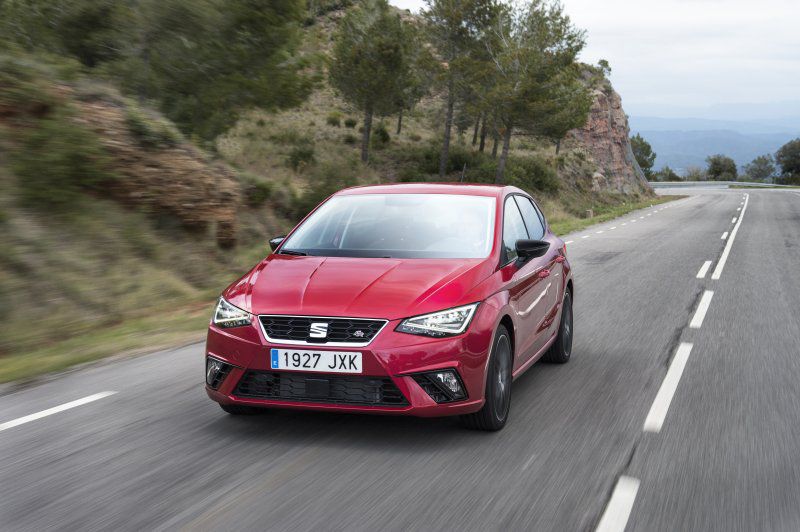
The fifth-generation Seat Ibiza V, including the 1.0 TGI (90 Hp) CNG model, boasts a dynamic and youthful design language, characteristic of the SEAT brand. Its five-door hatchback body type, measuring 159.8 inches (4059 mm) in length, 70.08 inches (1780 mm) in width (76.46 inches or 1942 mm including mirrors), and 56.85 inches (1444 mm) in height, presents a compact yet assertive stance. The sharp lines, prominent grille, and distinctive LED lighting (depending on trim) contribute to a sporty aesthetic that helps it stand out in the crowded subcompact segment. The design is not just about looks; the aerodynamic profile also contributes to its efficiency.
Inside, the Ibiza V offers a surprisingly spacious and well-appointed cabin for its class. Designed to accommodate five occupants, the interior benefits significantly from the MQB A0 platform, providing increased passenger room, particularly in the rear. The focus on ergonomics and modern connectivity is evident, with a driver-centric cockpit layout. While specific infotainment features are not detailed in the provided data, the era of its production (2017-2018) indicates the availability of touchscreen systems, smartphone integration, and advanced driver-assistance features in higher trims, though the TGI variant typically prioritized practicality and efficiency.
Practicality and Technology
Despite carrying a 13 kg CNG cylinder in addition to a 2.38 US gallon (9-liter) gasoline tank, the Ibiza TGI manages to retain reasonable cargo capacity. The trunk space ranges from a minimum of 9.25 cu. ft. (262 liters) to a maximum of 37.86 cu. ft. (1072 liters) with the rear seats folded down. While the CNG tank does impact the overall cargo volume compared to a gasoline-only model, the flexibility provided by the folding rear seats still makes it a practical choice for daily use.
The vehicle’s structure is robust, with a curb weight of 2566.18 lbs. (1164 kg) and a maximum gross weight of 3615.58 lbs. (1640 kg), allowing for a max load of 1049.4 lbs. (476 kg). Safety and handling are supported by a range of features. The drivetrain architecture is front-wheel drive, ensuring predictable handling. Braking is handled by ventilated discs at the front and disc brakes at the rear, complemented by an Anti-lock Braking System (ABS) for enhanced control during emergency stops. The steering system is a rack and pinion type with electric power steering, providing light and responsive feedback, ideal for urban maneuvering. The minimum turning circle of 34.78 ft. (10.6 m) further aids agility in tight spaces. Various tire and wheel options, ranging from 185/70 R14 to 215/45 R17, allow for customization in terms of ride comfort and handling characteristics.
Technical Specifications
| Category | Specification | Value |
|---|---|---|
| General Information | ||
| Brand | Seat | |
| Model | Ibiza | |
| Generation | Ibiza V | |
| Type (Engine) | 1.0 TGI (90 Hp) CNG | |
| Start of Production | 2017 year | |
| End of Production | 2018 year | |
| Powertrain Architecture | Internal Combustion engine | |
| Body Type | Hatchback | |
| Seats | 5 | |
| Doors | 5 | |
| Performance Specifications | ||
| Fuel Consumption (Economy) – Urban (Petrol) | 6.3 l/100 km (37.3 US mpg) | |
| Fuel Consumption (Economy) – Urban (CNG) | 4.2 kg/100 km | |
| Fuel Consumption (Economy) – Extra Urban (Petrol) | 4.3 l/100 km (54.7 US mpg) | |
| Fuel Consumption (Economy) – Extra Urban (CNG) | 2.7 kg/100 km | |
| Fuel Consumption (Economy) – Combined (Petrol) | 5.0 l/100 km (47 US mpg) | |
| Fuel Consumption (Economy) – Combined (CNG) | 3.3 kg/100 km | |
| CO2 Emissions (Petrol) | 114 g/km | |
| CO2 Emissions (CNG) | 88 g/km | |
| Fuel Type | Petrol / CNG | |
| Acceleration 0 – 60 mph (Calculated) | 11.2 sec | |
| Maximum Speed | 112.47 mph (181 km/h) | |
| Emission Standard | Euro 6 | |
| Weight-to-Power Ratio | 12.9 kg/Hp, 77.3 Hp/tonne | |
| Weight-to-Torque Ratio | 7.3 kg/Nm, 137.5 Nm/tonne | |
| Engine Specifications | ||
| Power | 90 Hp @ 4500-5800 rpm | |
| Power per Liter | 90.1 Hp/l | |
| Torque | 118.01 lb.-ft. (160 Nm) @ 1900-3500 rpm | |
| Engine Layout | Front, Transverse | |
| Engine Model/Code | DBYA | |
| Engine Displacement | 1.0 l (999 cm3, 60.96 cu. in.) | |
| Number of Cylinders | 3 | |
| Engine Configuration | Inline | |
| Cylinder Bore | 2.93 in. (74.5 mm) | |
| Piston Stroke | 3.01 in. (76.4 mm) | |
| Compression Ratio | 10.5:1 | |
| Number of Valves per Cylinder | 4 | |
| Fuel Injection System | Direct injection | |
| Engine Aspiration | Turbocharger | |
| Engine Oil Capacity | 4 l (4.23 US qt) | |
| Coolant Capacity | 10 l (10.57 US qt) | |
| Engine Systems | Start & Stop System | |
| Space, Volume and Weights | ||
| Kerb Weight | 2566.18 lbs. (1164 kg) | |
| Max. Weight | 3615.58 lbs. (1640 kg) | |
| Max Load | 1049.4 lbs. (476 kg) | |
| Trunk (boot) space – Minimum | 9.25 cu. ft. (262 l) | |
| Trunk (boot) space – Maximum | 37.86 cu. ft. (1072 l) | |
| Fuel Tank Capacity (Petrol) | 2.38 US gal (9 l) | |
| CNG Cylinder Capacity | 13 kg | |
| Dimensions | ||
| Length | 159.8 in. (4059 mm) | |
| Width | 70.08 in. (1780 mm) | |
| Width Including Mirrors | 76.46 in. (1942 mm) | |
| Height | 56.85 in. (1444 mm) | |
| Wheelbase | 100.94 in. (2564 mm) | |
| Front Track | 60.04 in. (1525 mm) | |
| Rear (Back) Track | 59.25 in. (1505 mm) | |
| Front Overhang | 31.34 in. (796 mm) | |
| Rear Overhang | 27.52 in. (699 mm) | |
| Minimum Turning Circle (Turning Diameter) | 34.78 ft. (10.6 m) | |
| Drivetrain, Brakes and Suspension Specifications | ||
| Drivetrain Architecture | Front wheel drive, Internal Combustion engine | |
| Drive Wheel | Front wheel drive | |
| Number of Gears and Type of Gearbox | 5 gears, manual transmission | |
| Front Brakes | Ventilated discs | |
| Rear Brakes | Disc | |
| Assisting Systems | ABS (Anti-lock braking system) | |
| Steering Type | Steering rack and pinion | |
| Power Steering | Electric Steering | |
| Tires Size | 185/70 R14; 185/65 R15; 195/55 R16; 215/45 R17 | |
| Wheel Rims Size | 5J x 14; 5.5J x 15; 6.5J x 16; 7J x 17; 7J x 18 | |
Legacy and Market Impact of the Seat Ibiza V 1.0 TGI (90 Hp) CNG
The Seat Ibiza V 1.0 TGI (90 Hp) CNG, while a niche offering, played a crucial role in SEAT’s strategy within the European automotive landscape. SEAT, as the Spanish arm of the Volkswagen Group, has long positioned itself as a brand with a youthful, sporty, and design-forward appeal. The Ibiza, particularly its fifth generation, is a core model that embodies these characteristics, consistently ranking among the best-selling subcompacts in several European markets. Its adoption of the versatile MQB A0 platform allowed it to compete effectively against segment stalwarts like the Volkswagen Polo, Ford Fiesta, Renault Clio, and Skoda Fabia, offering a distinct Spanish flair alongside robust German engineering.
The specific impact of the 1.0 TGI (90 Hp) CNG variant lies in its pioneering approach to alternative fuels. In Europe, where governments and consumers are increasingly focused on reducing emissions and fuel costs, CNG vehicles carved out a vital segment. This Ibiza model provided a compelling proposition for drivers in countries with established CNG refueling infrastructure, such as Italy, Germany, Spain, and parts of Eastern Europe. Its significantly lower CO2 emissions (88 g/km on CNG) and impressive fuel economy made it an attractive option for fleets, eco-conscious private buyers, and those seeking relief from fluctuating gasoline prices. The bi-fuel system offered peace of mind, with the small gasoline tank serving as a reliable backup, mitigating range anxiety often associated with single-fuel alternative vehicles.
The Ibiza TGI solidified SEAT’s image as an innovator within the Volkswagen Group, demonstrating that even a sporty subcompact could embrace sustainable mobility without sacrificing practicality or driving enjoyment. It highlighted SEAT’s ability to leverage the Group’s advanced powertrain technologies to meet specific market demands for greener transport. While the production run for this specific variant was relatively short (2017-2018), it laid the groundwork for future TGI models and reinforced SEAT’s commitment to offering diverse powertrain options, including those beyond conventional gasoline and diesel, moving towards a broader portfolio that now includes hybrid and electric vehicles. The legacy of the Ibiza TGI is one of pragmatic environmentalism, offering a real-world, accessible solution for reduced emissions and lower operating costs during a transitional period in the automotive industry. It served as a testament to the versatility of the Ibiza platform and SEAT’s responsiveness to evolving consumer and regulatory pressures in its primary markets.