<!DOCTYPE html>
<html lang=”en”>
<head>
<meta charset=”UTF-8″>
<meta name=”viewport” content=”width=device-width, initial-scale=1.0″>
<title>Seat Ibiza V 1.6 TDI (95 Hp) Start&Stop Expert Review</title>
</head>
<body>
<h2>The Seat Ibiza V 1.6 TDI (95 Hp) Start&Stop: A European Urban Dynamo</h2>
<p>The Seat Ibiza V 1.6 TDI (95 Hp) Start&Stop represents a significant iteration of Seat’s venerable subcompact hatchback, produced between 2019 and 2020. As the fifth generation of the Ibiza nameplate, this model continued the tradition of offering a compelling blend of youthful design, practical utility, and efficient powertrains, particularly catering to the discerning European market.</p>
<p>Seat, a Spanish automaker under the vast Volkswagen Group umbrella, positions itself as the more emotional and design-driven brand, often appealing to younger demographics with its sporty aesthetics and dynamic driving characteristics. The Ibiza, sharing its fundamental MQB A0 platform with siblings like the Volkswagen Polo and Skoda Fabia, is a cornerstone of Seat’s lineup, consistently ranking among the best-selling vehicles in its segment across Europe. The 1.6 TDI (95 Hp) Start&Stop variant specifically targeted buyers prioritizing exceptional fuel economy and lower running costs, a common preference in regions where diesel powertrains traditionally held a strong market share for their efficiency and torque delivery.</p>
<p>This specific model, with its 95 horsepower diesel engine and advanced Start&Stop system, was engineered for both urban agility and comfortable long-distance cruising, offering a compelling package for the everyday European driver. Its production period saw the automotive industry navigating increasingly stringent emissions regulations and a shifting public perception of diesel technology, yet the Ibiza TDI remained a relevant and competitive offering.</p>
<h2>Powertrain and Performance of the Seat Ibiza V 1.6 TDI (95 Hp) Start&Stop</h2>
<p>At the heart of the <strong>Seat Ibiza V 1.6 TDI (95 Hp) Start&Stop</strong> lies a highly optimized 1.6-liter (1598 cm<sup>3</sup> or 97.52 cu. in.) inline four-cylinder diesel engine. This unit, designated with the internal code DGTD, is a prime example of modern diesel engineering, featuring a common rail fuel injection system, a turbocharger, and an intercooler to maximize both power output and fuel efficiency. It generates a respectable 95 horsepower, delivered across a broad range from 2750 to 4600 revolutions per minute (rpm).</p>
<p>Crucially for a diesel, torque is abundant, with 250 Newton-meters (184.39 lb.-ft.) available from a low 1500 rpm and sustained up to 2600 rpm. This broad torque band is instrumental in the Ibiza’s responsive acceleration and flexible in-gear performance, making it feel livelier than its horsepower figure might suggest, especially in urban environments and when merging onto highways. Power is sent to the front wheels via a smooth-shifting 5-speed manual transmission, a common and cost-effective choice for vehicles in this segment.</p>
<p>Performance figures for the Ibiza V 1.6 TDI are well-suited to its class and intended use. The car accelerates from 0 to 60 miles per hour in a calculated 10.7 seconds (0-100 km/h in 11.3 seconds) and can reach a maximum speed of 113.09 mph (182 km/h). While not a performance hot hatch, these figures are more than adequate for daily driving and offer confident overtaking capabilities.</p>
<p>One of the standout attributes of this Ibiza variant is its exceptional fuel economy. The Start&Stop system, which automatically shuts off the engine when the vehicle is stationary and restarts it upon clutch engagement, plays a significant role in reducing fuel consumption and emissions, particularly in stop-and-go traffic. According to WLTP (Worldwide Harmonized Light Vehicles Test Procedure) standards, the combined fuel consumption ranges from 49 to 47 US miles per gallon (4.8-5.0 liters per 100 km). Under the older NEDC equivalent testing, the figures were even more impressive, with urban consumption at 52.3 US mpg (4.5 l/100 km), extra-urban at 65.3 US mpg (3.6 l/100 km), and a combined 60.3 US mpg (3.9 l/100 km). This makes the Ibiza V 1.6 TDI an incredibly economical choice for drivers covering significant mileage.</p>
<p>Environmental consciousness was also a key focus, with the engine meeting the stringent Euro 6 DG emission standard. CO2 emissions range from 127-132 g/km (WLTP) and 102 g/km (NEDC equivalent), further underscoring its efficiency. The inclusion of a particulate filter is standard, ensuring compliance with modern diesel emission requirements.</p>
<h3>Design and Features</h3>
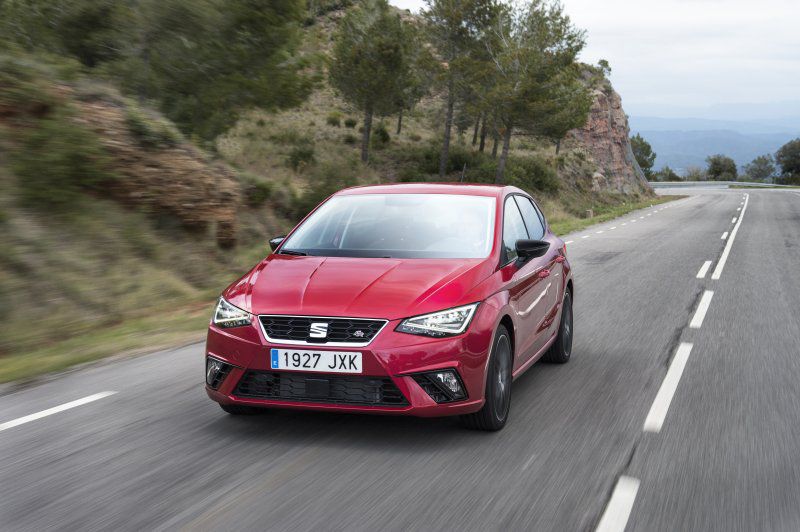
<p>The fifth-generation Seat Ibiza, launched in 2017, brought a more mature and angular design language compared to its predecessors, while retaining Seat’s signature sharp lines and dynamic profile. As a 5-door hatchback, it offered a practical and versatile body type, accommodating five occupants comfortably. Its dimensions – a length of 159.8 inches, a width of 70.08 inches (76.46 inches including mirrors), and a height of 56.85 inches – positioned it squarely in the subcompact segment, ideal for navigating tight European city streets while still providing sufficient interior space.</p>
<p>The Ibiza V’s design emphasized clean surfaces, pronounced character lines along the side, and a distinctive triangular LED daytime running light signature (depending on trim), giving it a sophisticated and modern appearance. The interior, while not explicitly detailed in the provided data, typically featured a driver-focused cockpit, high-quality materials for its class, and a contemporary infotainment system, reflecting the VW Group’s commitment to ergonomics and connectivity. Practicality was a strong suit, with a generous minimum trunk space of 12.54 cubic feet (355 liters), expandable to an impressive 41.14 cubic feet (1165 liters) with the rear seats folded down, making it highly adaptable for various cargo needs.</p>
<p>Underneath its stylish exterior, the Ibiza utilized a robust chassis setup. The front suspension employed an independent McPherson strut system with coil springs and an anti-roll bar, providing precise steering and good road holding. The rear featured a semi-independent setup with coil springs, a common and effective design for subcompacts, balancing ride comfort and handling dynamics. Braking duties were handled by ventilated discs at the front and solid discs at the rear, complemented by an Anti-lock Braking System (ABS) for enhanced safety during emergency stops. Electric power steering, a rack and pinion system, ensured light and responsive steering, particularly beneficial for urban maneuverability and parking. The car offered a range of tire sizes from 185/65 R15 up to 215/40 R18, allowing for various levels of grip and aesthetic appeal.</p>
<h3>Technical Specifications</h3>
<table border=”1″ style=”width:100%; border-collapse: collapse;”>
<thead>
<tr>
<th style=”padding: 8px; text-align: left; background-color: #f2f2f2;”>Category</th>
<th style=”padding: 8px; text-align: left; background-color: #f2f2f2;”>Specification</th>
</tr>
</thead>
<tbody>
<tr><td style=”padding: 8px; border: 1px solid #ddd;”>Brand</td><td style=”padding: 8px; border: 1px solid #ddd;”>Seat</td></tr>
<tr><td style=”padding: 8px; border: 1px solid #ddd;”>Model</td><td style=”padding: 8px; border: 1px solid #ddd;”>Ibiza V 1.6 TDI (95 Hp) Start&Stop</td></tr>
<tr><td style=”padding: 8px; border: 1px solid #ddd;”>Generation</td><td style=”padding: 8px; border: 1px solid #ddd;”>Ibiza V</td></tr>
<tr><td style=”padding: 8px; border: 1px solid #ddd;”>Production Start</td><td style=”padding: 8px; border: 1px solid #ddd;”>2019 year</td></tr>
<tr><td style=”padding: 8px; border: 1px solid #ddd;”>Production End</td><td style=”padding: 8px; border: 1px solid #ddd;”>2020 year</td></tr>
<tr><td style=”padding: 8px; border: 1px solid #ddd;”>Body Type</td><td style=”padding: 8px; border: 1px solid #ddd;”>Hatchback</td></tr>
<tr><td style=”padding: 8px; border: 1px solid #ddd;”>Doors / Seats</td><td style=”padding: 8px; border: 1px solid #ddd;”>5 / 5</td></tr>
<tr><td style=”padding: 8px; border: 1px solid #ddd;”>Fuel Type</td><td style=”padding: 8px; border: 1px solid #ddd;”>Diesel</td></tr>
<tr><td style=”padding: 8px; border: 1px solid #ddd;”>Engine Displacement</td><td style=”padding: 8px; border: 1px solid #ddd;”>1598 cm<sup>3</sup> (1.6 Liters / 97.52 cu. in.)</td></tr>
<tr><td style=”padding: 8px; border: 1px solid #ddd;”>Power</td><td style=”padding: 8px; border: 1px solid #ddd;”>95 Hp @ 2750-4600 rpm</td></tr>
<tr><td style=”padding: 8px; border: 1px solid #ddd;”>Torque</td><td style=”padding: 8px; border: 1px solid #ddd;”>250 Nm (184.39 lb.-ft.) @ 1500-2600 rpm</td></tr>
<tr><td style=”padding: 8px; border: 1px solid #ddd;”>Acceleration 0-60 mph</td><td style=”padding: 8px; border: 1px solid #ddd;”>10.7 seconds</td></tr>
<tr><td style=”padding: 8px; border: 1px solid #ddd;”>Maximum Speed</td><td style=”padding: 8px; border: 1px solid #ddd;”>113.09 mph (182 km/h)</td></tr>
<tr><td style=”padding: 8px; border: 1px solid #ddd;”>Fuel Economy (WLTP Combined)</td><td style=”padding: 8px; border: 1px solid #ddd;”>49 – 47 US mpg (4.8-5.0 l/100 km)</td></tr>
<tr><td style=”padding: 8px; border: 1px solid #ddd;”>Fuel Economy (Combined NEDC)</td><td style=”padding: 8px; border: 1px solid #ddd;”>60.3 US mpg (3.9 l/100 km)</td></tr>
<tr><td style=”padding: 8px; border: 1px solid #ddd;”>CO2 Emissions (WLTP)</td><td style=”padding: 8px; border: 1px solid #ddd;”>127-132 g/km</td></tr>
<tr><td style=”padding: 8px; border: 1px solid #ddd;”>Emission Standard</td><td style=”padding: 8px; border: 1px solid #ddd;”>Euro 6 DG</td></tr>
<tr><td style=”padding: 8px; border: 1px solid #ddd;”>Drivetrain</td><td style=”padding: 8px; border: 1px solid #ddd;”>Front-wheel drive</td></tr>
<tr><td style=”padding: 8px; border: 1px solid #ddd;”>Transmission</td><td style=”padding: 8px; border: 1px solid #ddd;”>5-speed Manual</td></tr>
<tr><td style=”padding: 8px; border: 1px solid #ddd;”>Kerb Weight</td><td style=”padding: 8px; border: 1px solid #ddd;”>2603.66 lbs (1181 kg)</td></tr>
<tr><td style=”padding: 8px; border: 1px solid #ddd;”>Max. Weight</td><td style=”padding: 8px; border: 1px solid #ddd;”>3858.09 lbs (1750 kg)</td></tr>
<tr><td style=”padding: 8px; border: 1px solid #ddd;”>Length</td><td style=”padding: 8px; border: 1px solid #ddd;”>159.8 inches (4059 mm)</td></tr>
<tr><td style=”padding: 8px; border: 1px solid #ddd;”>Width</td><td style=”padding: 8px; border: 1px solid #ddd;”>70.08 inches (1780 mm)</td></tr>
<tr><td style=”padding: 8px; border: 1px solid #ddd;”>Height</td><td style=”padding: 8px; border: