The Seat Ibiza V (facelift 2021) 1.0 TGI (90 Hp): A European Subcompact with Bi-Fuel Innovation
The Seat Ibiza V (facelift 2021) 1.0 TGI (90 Hp) represents a significant iteration of Seat’s long-standing subcompact hatchback, a model that has been a cornerstone of the Spanish automaker’s lineup since its inception in 1984. As part of the Volkswagen Group, Seat leverages shared platforms and engineering prowess, positioning the Ibiza as a more spirited and design-focused alternative to its siblings like the Volkswagen Polo and Skoda Fabia. This particular variant, produced from June 2021 to February 2023, is a facelift of the fifth generation, introduced in 2017. It solidifies the Ibiza’s role in the highly competitive European B-segment, catering to urban drivers and those seeking a practical yet engaging compact vehicle.
Crucially, the 1.0 TGI designation highlights a key technological differentiator: a bi-fuel powertrain capable of running on both Compressed Natural Gas (CNG) and gasoline. This innovative approach reflects a growing trend in European markets towards more environmentally conscious and cost-effective personal transportation, particularly in regions with established CNG refueling infrastructure. While the Seat brand and its Ibiza model are not officially sold in the United States, their impact on the global automotive landscape, especially in Europe and parts of Asia, is undeniable. The Ibiza consistently ranks among the top sellers in its class, celebrated for its dynamic styling, agile handling, and efficient powertrains. The 2021 facelift brought subtle yet impactful refinements, enhancing its appeal and keeping it competitive in a rapidly evolving market.
Engine and Performance of the Seat Ibiza V (facelift 2021) 1.0 TGI (90 Hp)
At the heart of the Seat Ibiza V (facelift 2021) 1.0 TGI (90 Hp) lies a sophisticated 1.0-liter (999 cm³, or 60.96 cubic inches) inline three-cylinder engine. This powertrain, designated with the code DBYA, is engineered for efficiency and low emissions, a hallmark of modern European subcompacts. The engine features direct fuel injection and a turbocharger, enabling it to punch above its weight in terms of power delivery despite its small displacement. It generates a respectable 90 horsepower (Hp) at a broad range of 4000-5500 rpm, delivering a power output of 90.1 Hp per liter.
Torque production is equally impressive for a three-cylinder unit, with 160 Newton-meters (Nm), or 118.01 lb.-ft., available from a low 1800 rpm and sustained up to 3800 rpm. This wide torque band contributes to the car’s responsive feel in city driving and allows for confident highway cruising. Power is sent to the front wheels via a smooth-shifting 6-speed manual transmission, offering drivers engaging control over the vehicle’s dynamics.
Performance figures for the Ibiza 1.0 TGI are well-suited for its urban and suburban mission. The car accelerates from 0 to 60 mph in a calculated 11.5 seconds (0-100 km/h in 12.1 seconds) and can reach a maximum speed of 112.47 mph (181 km/h). These figures demonstrate a balanced approach, prioritizing fuel economy and environmental friendliness without sacrificing essential drivability. The engine’s architecture includes a Start & Stop System and a particulate filter, further contributing to its Euro 6 AP emission standard compliance, a strict benchmark for environmental performance in Europe. The bi-fuel capability, primarily utilizing CNG, significantly reduces CO2 emissions to a range of 100-110 g/km (WLTP) and as low as 95 g/km (NEDC equivalent), making it an attractive option for eco-conscious buyers.
Design and Features
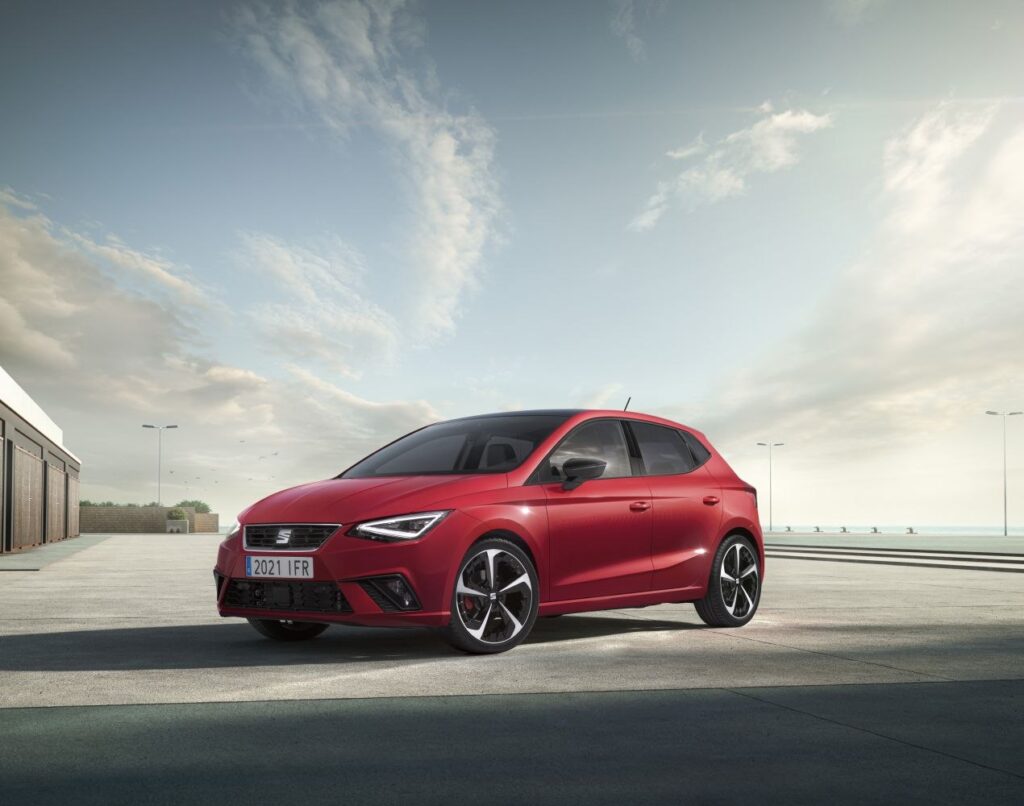
The Seat Ibiza V (facelift 2021) retains its youthful and dynamic design language, characterized by sharp lines, a sporty stance, and expressive lighting signatures. As a 5-door hatchback, it offers a practical and versatile body type, seating five occupants comfortably. The facelift introduced subtle but effective updates, including revised LED headlamps, a refreshed front grille, and new alloy wheel designs, keeping its aesthetic modern and appealing. The overall length of 159.8 inches (4059 mm) and width of 70.08 inches (1780 mm) make it maneuverable in tight urban environments, while the 100.94-inch (2564 mm) wheelbase contributes to a stable ride and generous interior space for its class.
Inside, the Ibiza’s cabin received notable upgrades with the 2021 facelift. Higher-quality materials, improved ergonomics, and advanced technology features were integrated. A prominent feature is the updated infotainment system, often featuring a larger touchscreen display with enhanced connectivity options, including smartphone integration through Apple CarPlay and Android Auto. While specific trim levels offer varying features, common amenities include electric power steering, a robust climate control system, and a suite of active and passive safety features.
Safety is a paramount concern for modern vehicles, and the Ibiza is equipped with standard features like ABS (Anti-lock Braking System). Given its production timeframe, it would typically include a comprehensive array of airbags, electronic stability control, and potentially advanced driver-assistance systems (ADAS) depending on the trim, such as lane-keeping assist and adaptive cruise control, though these are not explicitly listed in the provided data. The focus on meeting Euro 6 AP emission standards underscores a commitment not only to cleaner air but also to modern engineering practices that prioritize overall vehicle integrity. The trunk space is practical for a subcompact, offering 9.25 cubic feet (262 liters) with the rear seats up, expandable to a generous 37.86 cubic feet (1072 liters) when folded down, making it suitable for varying cargo needs.
Technical Specifications
| Category | Specification |
|---|---|
| Brand | Seat |
| Model | Ibiza |
| Generation | Ibiza V (facelift 2021) |
| Type (Engine) | 1.0 TGI (90 Hp) |
| Production Start | June, 2021 |
| Production End | February, 2023 |
| Powertrain Architecture | Internal Combustion Engine |
| Body Type | Hatchback |
| Seats | 5 |
| Doors | 5 |
| Performance Specs | |
| Combined Fuel Consumption (WLTP) (CNG) | 4.1-6.1 kg/100 km |
| CO2 Emissions (CNG) (WLTP) | 100-110 g/km |
| Fuel Consumption Urban (CNG) (NEDC equivalent) | 4.3 kg/100 km |
| Fuel Consumption Extra Urban (CNG) (NEDC equivalent) | 3 kg/100 km |
| Fuel Consumption Combined (CNG) (NEDC equivalent) | 3.5 kg/100 km |
| CO2 Emissions (CNG) (NEDC equivalent) | 95 g/km |
| Fuel Type | Petrol / CNG |
| Acceleration 0-60 mph | 11.5 sec |
| Acceleration 0-62 mph (0-100 km/h) | 12.1 sec |
| Maximum Speed | 112.47 mph (181 km/h) |
| Emission Standard | Euro 6 AP |
| Weight-to-Power Ratio | 13.1 kg/Hp, 76.1 Hp/tonne |
| Weight-to-Torque Ratio | 7.4 kg/Nm, 135.4 Nm/tonne |
| Engine Specs | |
| Power | 90 Hp @ 4000-5500 rpm |
| Power per Liter | 90.1 Hp/l |
| Torque | 118.01 lb.-ft. (160 Nm) @ 1800-3800 rpm |
| Engine Layout | Front, Transverse |
| Engine Model/Code | DBYA |
| Engine Displacement | 1.0 l (999 cm³, 60.96 cu. in.) |
| Number of Cylinders | 3 |
| Engine Configuration | Inline |
| Cylinder Bore | 2.93 in. (74.5 mm) |
| Piston Stroke | 3.01 in. (76.4 mm) |
| Compression Ratio | 10.5:1 |
| Valves per Cylinder | 4 |
| Fuel Injection System | Direct injection |
| Engine Aspiration | Turbocharger |
| Engine Oil Capacity | 4.23 US qt (4 l) |
| Engine Oil Specification | Not specified in data |
| Coolant Capacity | 10.57 US qt (10 l) |
| Engine Systems | Start & Stop System, Particulate filter |
| Space, Volume and Weights | |
| Kerb Weight | 2605.86 lbs. (1182 kg) |
| Max. Weight (GVWR) | 3725.81 lbs. (1690 kg) |
| Max Load | 1119.95 lbs. (508 kg) |
| Trunk (Boot) Space – Minimum | 9.25 cu. ft. (262 l) |
| Trunk (Boot) Space – Maximum | 37.86 cu. ft. (1072 l) |
| Fuel Tank Capacity (Petrol) | 2.38 US gal (9 l) |
| CNG Cylinder Capacity | 13.8 kg |
| Max. Roof Load | 165.35 lbs. (75 kg) |
| Dimensions | |
| Length | 159.8 in. (4059 mm) |
| Width | 70.08 in. (1780 mm) |
| Width including mirrors | 76.46 in. (1942 mm) |
| Height | 56.85 in. (1444 mm) |
| Wheelbase | 100.94 in. (2564 mm) |
| Front Track | 60.04 in. (1525 mm) |
| Rear (Back) Track | 59.25 in. (1505 mm) |
| Front Overhang | 31.34 in. (796 mm) |
| Rear Overhang | 27.52 in. (699 mm) |
| Minimum Turning Circle | 34.78 ft. (10.6 m) |
| Drivetrain, Brakes and Suspension Specs | |
| Drivetrain Architecture | Front-wheel drive, Internal Combustion Engine |
| Drive Wheel | Front wheel drive |
| Number of Gears & Gearbox Type | 6 gears, manual transmission |
| Front Suspension | Independent, McPherson strut with coil spring and anti-roll bar |
| Rear Suspension | Semi-independent, coil spring |
| Front Brakes | Ventilated discs, 10.08×0.87 in. (256×22 mm) |
| Rear Brakes | Drum, 8.98×1.65 in. (228×42 mm) |
| Assisting Systems | ABS (Anti-lock braking system) |
| Steering Type | Steering rack and pinion |
| Power Steering | Electric Steering |
| Tires Size | 185/65 R15 88H; 195/55 R16 91V XL; 215/45 R17 91W XL; 215/40 R18 91W XL |
| Wheel Rims Size | 5.5J x 15; 6.5J x 16; 7J x 17; 7J x 18 |
Legacy and Market Impact of the Seat Ibiza V (facelift 2021)
The Seat Ibiza has carved out a significant legacy over its multiple generations, establishing itself as a key player in the European supermini segment. It consistently competes with formidable rivals such as the Volkswagen Polo, Ford Fiesta, Renault Clio, and Peugeot 208. The Ibiza’s distinct advantage often lies in its more emotional and dynamic styling, combined with a youthful brand image that resonates strongly with a younger demographic and those seeking a sportier driving experience within a practical package.
The 2021 facelift of the fifth-generation Ibiza, particularly the 1.0 TGI variant, underscores Seat’s commitment to innovation and environmental responsibility. In markets where governments and consumers are increasingly focused on reducing carbon footprints and fuel costs, bi-fuel vehicles like the TGI offer a compelling alternative. While CNG infrastructure is not universally robust, its presence in key European nations has allowed models like the Ibiza TGI to provide a more sustainable option for daily commuting. The ability to switch seamlessly between CNG and gasoline provides drivers with flexibility and range assurance, mitigating concerns about finding CNG stations.
The Ibiza’s impact extends beyond just sales figures; it contributes to the perception of Seat as a brand that offers style, technology, and value. Its robust platform, shared with other successful VW Group models, ensures reliability and access to advanced safety and infotainment systems. The 1.0 TGI variant, with its emphasis on efficiency and lower emissions, plays a crucial role in Seat’s broader strategy to meet stringent European environmental regulations and appeal to an evolving customer base. Its relatively low CO2 emissions and competitive fuel consumption (in kg/100 km for CNG) position it as an economically sensible choice for many European consumers.
In summary, the Seat Ibiza V (facelift 2021) 1.0 TGI (90 Hp) is more than just a refreshed subcompact. It represents a blend of Spanish design flair, German engineering precision, and a forward-thinking approach to alternative fuels. Its legacy is one of consistent relevance in a tough segment, delivering a compelling package for those who prioritize efficiency, practicality, and a touch of Mediterranean vibrancy in their daily drive. Although not available in the US market, its technological advancements and market success in Europe provide valuable insights into global automotive trends and consumer preferences for efficient, compact vehicles.