
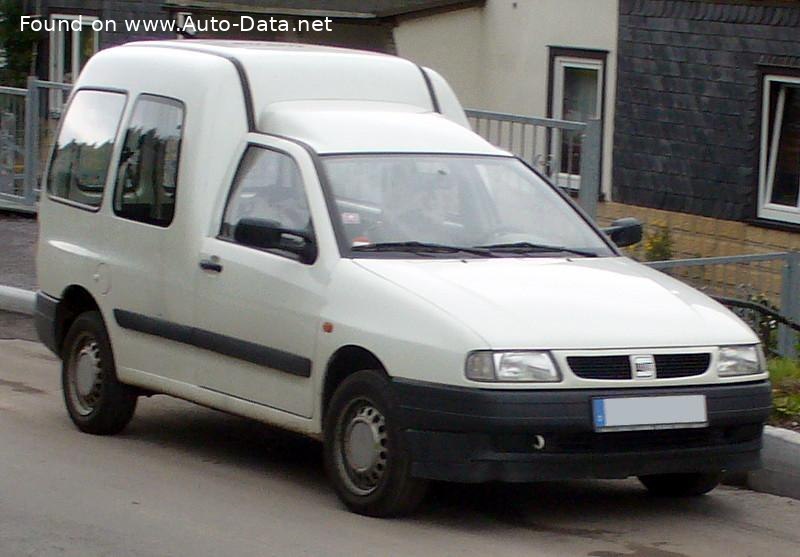
Introduction to the Seat Inca (9K) 1.4 MPi (60 Hp)
The Seat Inca (9K) represents a significant chapter in the history of the Spanish automotive manufacturer, Seat, particularly within the light commercial vehicle and compact MPV segments. Produced from May 2001 to October 2004, this specific variant, the Seat Inca (9K) 1.4 MPi (60 Hp), served as a practical and economical solution for both businesses and families in its primary European markets. As a rebadged version of the Volkswagen Caddy (Typ 9K), the Inca benefited from the robust engineering and reliability of its German counterpart, offering a blend of utility and affordability.
The Inca (9K) generation was part of a common platform strategy within the Volkswagen Group, allowing Seat to offer a versatile vehicle without extensive independent development costs. While the Seat brand was not officially sold in the United States, the Inca played a crucial role in Europe, competing in a fiercely contested segment dominated by vehicles designed for both cargo hauling and passenger transport. The 1.4 MPi (60 Hp) engine variant, though modest in power, was engineered for efficiency and durability, catering to the needs of urban delivery fleets and budget-conscious private owners seeking a multi-purpose vehicle. Its minivan body style, despite its compact dimensions, offered surprising interior space and flexibility, making it a popular choice for those requiring practical transport solutions.
Engine and Performance of the Seat Inca (9K) 1.4 MPi (60 Hp)
At the heart of the Seat Inca (9K) 1.4 MPi (60 Hp) lies a naturally aspirated, four-cylinder gasoline engine designed for reliability and economical operation. This 1.4-liter (1390 cm3 or 84.82 cubic inches) inline engine utilized a Multi-port manifold injection system and a Single Overhead Cam (SOHC) valvetrain with two valves per cylinder. While its output of 60 horsepower at 5000 rpm might appear modest by modern standards, it was perfectly adequate for the Inca’s intended purpose as a utility vehicle or a compact family hauler in urban and suburban environments.
The engine produced a peak torque of 117 Nm (86.29 lb.-ft.) at a relatively low 3500 rpm, providing decent pulling power for its size, especially when coupled with the standard 5-speed manual transmission. This front-wheel-drive powertrain architecture ensured predictable handling and efficient power delivery. The focus of this engine was clearly on fuel efficiency and low running costs rather than outright speed. The Inca (9K) 1.4 MPi achieved a combined fuel economy of approximately 8 liters per 100 kilometers (29.4 US mpg), an important factor for both commercial users and private owners. Its maximum speed of 142 km/h (88.23 mph) underscored its practical, rather than performance-oriented, nature. The engine’s modest power-to-weight ratio of 17.8 kg/Hp (56.3 Hp/tonne) reflected its utility-first design philosophy.
Engine maintenance was straightforward, with an oil capacity of 4.5 liters (4.76 US quarts) and a coolant capacity of 5.5 liters (5.81 US quarts), making it relatively simple and inexpensive to service. This emphasis on simplicity and robustness contributed to the Inca’s reputation as a reliable workhorse in its segment.
Design and Features
The Seat Inca (9K) adopted a practical and unpretentious design, characteristic of compact minivans and panel vans of its era. As a 5-seat, 3-door minivan, its body type prioritized interior volume and accessibility. The single sliding door on one side (typically the passenger side in left-hand-drive markets) was a key feature, greatly enhancing ease of access for rear passengers or cargo in tight urban spaces, a design element widely appreciated in Europe.
Measuring 4207 mm (165.63 inches) in length, 1696 mm (66.77 inches) in width, and 1836 mm (72.28 inches) in height, the Inca offered a compact footprint that made it maneuverable in city traffic, yet sufficiently spacious inside. The generous wheelbase of 2601 mm (102.4 inches) contributed to a stable ride and maximized interior room for both passengers and luggage. The relatively tall roofline was a defining characteristic, providing ample headroom and contributing to its utilitarian aesthetic.
Inside, the Inca (9K) was designed with durability and functionality in mind. While not boasting luxury features, the cabin was ergonomically laid out, with controls placed for ease of use. The seating arrangement, with five seats, made it a viable option for small families or as a crew cab for businesses. The rear seats could typically be folded or removed to expand cargo capacity, showcasing its versatility. Safety features, typical for early 2000s European vehicles in this segment, included basic ABS (Anti-lock Braking System) on some trims, front disc brakes, and rear drum brakes, alongside a robust chassis structure derived from the Volkswagen Caddy. The hydraulic power steering system, coupled with a steering rack and pinion, provided light and responsive steering, which was beneficial for city driving and parking maneuvers.
The suspension system featured an independent MacPherson strut setup with coil springs and an anti-roll bar at the front, providing a comfortable ride and stable handling. The rear utilized a rigid axle suspension with leaf springs, a common and durable setup for vehicles expected to carry varying loads, emphasizing its commercial vehicle roots and ability to handle up to a 625 kg (1377.89 lbs) maximum load.
Technical Specifications
| General Information | |
|---|---|
| Brand | Seat |
| Model | Inca |
| Generation | Inca (9K) |
| Type (Engine) | 1.4 MPi (60 Hp) |
| Start of Production | May, 2001 year |
| End of Production | October, 2004 year |
| Powertrain Architecture | Internal Combustion engine |
| Body type | Minivan |
| Seats | 5 |
| Doors | 3 |
| Performance Specifications | |
| Fuel Consumption (Economy) – Urban | 10.1 l/100 km (23.3 US mpg) |
| Fuel Consumption (Economy) – Extra Urban | 6.8 l/100 km (34.6 US mpg) |
| Fuel Consumption (Economy) – Combined | 8 l/100 km (29.4 US mpg) |
| Fuel Type | Petrol (Gasoline) |
| Maximum Speed | 142 km/h (88.23 mph) |
| Weight-to-Power Ratio | 17.8 kg/Hp (56.3 Hp/tonne) |
| Weight-to-Torque Ratio | 9.1 kg/Nm (109.9 Nm/tonne) |
| Engine Specifications | |
| Power | 60 Hp @ 5000 rpm |
| Power per Liter | 43.2 Hp/l |
| Torque | 117 Nm @ 3500 rpm (86.29 lb.-ft. @ 3500 rpm) |
| Engine Layout | Front, Transverse |
| Engine Displacement | 1390 cm3 (1.4 liters, 84.82 cu. in.) |
| Number of Cylinders | 4 |
| Engine Configuration | Inline |
| Cylinder Bore | 76.5 mm (3.01 in.) |
| Piston Stroke | 75.6 mm (2.98 in.) |
| Number of Valves per Cylinder | 2 |
| Fuel Injection System | Multi-port manifold injection |
| Engine Aspiration | Naturally aspirated engine |
| Valvetrain | SOHC |
| Engine Oil Capacity | 4.5 l (4.76 US qt) |
| Coolant Capacity | 5.5 l (5.81 US qt) |
| Space, Volume and Weights | |
| Kerb Weight | 1065 kg (2347.92 lbs) |
| Max. Weight | 1690 kg (3725.81 lbs) |
| Max Load | 625 kg (1377.89 lbs) |
| Fuel Tank Capacity | 54 l (14.27 US gal) |
| Dimensions | |
| Length | 4207 mm (165.63 in.) |
| Width | 1696 mm (66.77 in.) |
| Height | 1836 mm (72.28 in.) |
| Wheelbase | 2601 mm (102.4 in.) |
| Front Track | 1436 mm (56.54 in.) |
| Rear (Back) Track | 1452 mm (57.17 in.) |
| Front Overhang | 859 mm (33.82 in.) |
| Rear Overhang | 747 mm (29.41 in.) |
| Drivetrain, Brakes and Suspension Specifications | |
| Drivetrain Architecture | Front-wheel drive. Internal Combustion engine. |
| Drive Wheel | Front wheel drive |
| Number of Gears and Type of Gearbox | 5 gears, manual transmission |
| Front Suspension | Independent, type McPherson with coil spring and anti-roll bar |
| Rear Suspension | Rigid axle suspension, Leaf spring |
| Front Brakes | Disc |
| Rear Brakes | Drum |
| Steering Type | Steering rack and pinion |
| Power Steering | Hydraulic Steering |
Legacy and Market Impact
The Seat Inca (9K), and specifically the Seat Inca (9K) 1.4 MPi (60 Hp) minivan, carved out a distinct niche in the European automotive landscape during its production run. Positioned as an affordable and highly practical multi-purpose vehicle, it primarily competed with similar offerings from other European manufacturers, such as the Renault Kangoo, Citroën Berlingo, Peugeot Partner, and its direct sibling, the Volkswagen Caddy. Its strength lay in its robust Volkswagen Group underpinnings, offering a perceived reliability advantage and easier access to parts and servicing compared to some rivals.
For small businesses, the Inca served as an ideal light commercial vehicle, capable of hauling significant loads with its impressive 625 kg (1377.89 lbs) maximum payload capacity. Its compact dimensions and tight turning radius made it particularly suitable for urban deliveries and tradespeople navigating congested city streets. The option of a 5-seat minivan configuration, as detailed here, broadened its appeal to budget-conscious families who needed a versatile vehicle for daily commutes, school runs, and weekend excursions. The sliding rear door was a particularly valued feature for passenger access and cargo loading in tight parking spots.
The Inca’s reputation was built on its utilitarian nature, low running costs, and straightforward mechanics. While it didn’t offer groundbreaking technology or luxurious appointments, it delivered on its promise of dependable, no-frills transport. Its 1.4-liter engine, while not powerful, was known for its longevity and fuel efficiency, critical attributes for its target market. The manual transmission further contributed to its economical operation and driver engagement.
In terms of historical significance, the Inca (9K) represented Seat’s commitment to offering a comprehensive range of vehicles, leveraging its position within the VW Group to expand into segments beyond its core passenger car lineup. It demonstrated the effectiveness of platform sharing in creating market-specific vehicles that met diverse consumer needs. Though not a high-volume seller in the same league as some of its passenger car counterparts, the Inca was a steady performer, contributing to Seat’s overall market presence and brand image as a producer of practical, value-oriented vehicles in Europe. Its legacy is one of a dependable workhorse, a testament to practical engineering and functional design that served its owners faithfully.
