
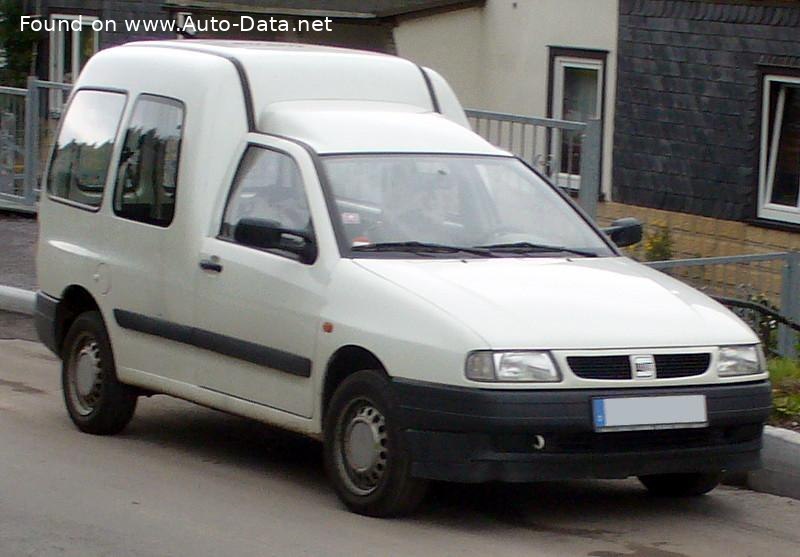
The Seat Inca (9K) 1.6 i (75 Hp): A European Utility Vehicle
The Seat Inca (9K) 1.6 i (75 Hp) represents a crucial period for the Spanish automaker, Seat, under the stewardship of the Volkswagen Group. Introduced in January 1996, the Inca (9K) was a light commercial vehicle, or LCV, that also offered a passenger-oriented minivan variant. This model was a rebadged version of the Volkswagen Caddy (Typ 9K), sharing its platform and many mechanical components with the contemporary Volkswagen Polo Mk3 (Typ 6N) and Seat Ibiza Mk2. While never officially sold in the United States, the Inca played a significant role in the European market, particularly in Spain and other parts of Southern Europe, as a versatile and economical solution for both businesses and families seeking practical transportation. Its production spanned from early 1996 until November 2000, establishing its presence as a robust and no-frills option in the compact utility segment.
Engine and Performance of the Seat Inca (9K) 1.6 i (75 Hp)
Under the hood, the Seat Inca (9K) 1.6 i (75 Hp) was equipped with a straightforward and reliable 1.6-liter naturally aspirated inline-four gasoline engine. This powerplant, mounted transversely at the front, was designed for durability and efficiency rather than outright speed. It delivered a modest 75 horsepower at 4600 rpm, which, while not groundbreaking, was perfectly adequate for the vehicle’s intended purpose of urban deliveries or family transport. Torque output stood at 135 Nm, or approximately 99.57 lb.-ft., peaking at a relatively low 2800 rpm, ensuring good low-end grunt for carrying loads or navigating city traffic.
The engine utilized a multi-port manifold injection system and a SOHC (Single Overhead Camshaft) valvetrain with two valves per cylinder, a configuration known for its simplicity and robustness. Power was channeled to the front wheels via a five-speed manual transmission, offering direct engagement and control. This drivetrain architecture, common across many Volkswagen Group vehicles of the era, contributed to the Inca’s predictable handling characteristics and ease of maintenance.
In terms of performance, the Inca (9K) 1.6 i achieved a maximum speed of 96.31 mph (155 km/h), reflecting its utilitarian focus. Fuel economy figures were respectable for its class and era: a combined average of 28 US mpg (8.4 l/100 km), with urban consumption at 21.6 US mpg (10.9 l/100 km) and extra-urban at 33.6 US mpg (7 l/100 km). These figures underscored its economical operation, a key selling point for a vehicle primarily targeting cost-conscious buyers in its European market.
Design and Features
The design of the Seat Inca (9K) was dictated by its functional requirements. Classified as a minivan body type, specifically a compact panel van with windows and rear seating, it featured three doors: two front doors and a large, often upward-swinging or barn-door style rear access. The passenger variant comfortably accommodated five occupants. Its exterior styling was distinctly unadorned, emphasizing practicality over aesthetic flair, a characteristic shared with its Volkswagen Caddy twin.
Dimensions were compact yet capacious enough for its segment. With a length of 165.63 inches (4207 mm), a width of 66.77 inches (1696 mm), and a height of 72.28 inches (1836 mm), the Inca offered a generous interior volume and a relatively high roofline, making it suitable for transporting goods or providing ample headroom for passengers. The wheelbase of 102.4 inches (2601 mm) contributed to a stable ride, while the front and rear track widths (56.54 inches and 57.17 inches, respectively) ensured a solid stance on the road.
Suspension-wise, the Inca adopted a robust setup designed for handling varying loads. The front featured an independent McPherson strut system with coil springs and an anti-roll bar, providing decent ride comfort and handling precision. The rear utilized a rigid axle suspension with leaf springs, a durable and load-bearing design commonly found in commercial vehicles, capable of enduring significant cargo weight. Braking was managed by disc brakes at the front and drum brakes at the rear, a standard configuration for vehicles of this segment during that period. Hydraulic power steering with a rack and pinion system made maneuvering the Inca, even when fully loaded, relatively easy and less fatiguing for the driver.
Technical Specifications: Seat Inca (9K) 1.6 i (75 Hp)
| General Information | |
|---|---|
| Brand | Seat |
| Model | Inca |
| Generation | Inca (9K) |
| Type (Engine) | 1.6 i (75 Hp) |
| Start of production | January, 1996 year |
| End of production | November, 2000 year |
| Powertrain Architecture | Internal Combustion engine |
| Body type | Minivan |
| Seats | 5 |
| Doors | 3 |
| Performance Specs | |
| Fuel consumption (economy) – urban | 10.9 l/100 km (21.6 US mpg) |
| Fuel consumption (economy) – extra urban | 7 l/100 km (33.6 US mpg) |
| Fuel consumption (economy) – combined | 8.4 l/100 km (28 US mpg) |
| Fuel Type | Petrol (Gasoline) |
| Maximum speed | 155 km/h (96.31 mph) |
| Weight-to-power ratio | 14.8 kg/Hp (67.6 Hp/tonne) |
| Weight-to-torque ratio | 8.2 kg/Nm (121.6 Nm/tonne) |
| Engine Specs | |
| Power | 75 Hp @ 4600 rpm |
| Power per liter | 46.9 Hp/l |
| Torque | 135 Nm @ 2800 rpm (99.57 lb.-ft. @ 2800 rpm) |
| Engine layout | Front, Transverse |
| Engine displacement | 1598 cm3 (97.52 cu. in.) |
| Number of cylinders | 4 |
| Engine configuration | Inline |
| Number of valves per cylinder | 2 |
| Fuel injection system | Multi-port manifold injection |
| Engine aspiration | Naturally aspirated engine |
| Valvetrain | SOHC |
| Engine oil capacity | 3.4 l (3.59 US qt) |
| Engine oil specification | Not specified in data |
| Coolant | 5.5 l (5.81 US qt) |
| Space, Volume and Weights | |
| Kerb Weight | 1110 kg (2447.13 lbs) |
| Max. weight | 1735 kg (3825.02 lbs) |
| Max load | 625 kg (1377.89 lbs) |
| Fuel tank capacity | 54 l (14.27 US gal) |
| Dimensions | |
| Length | 4207 mm (165.63 in.) |
| Width | 1696 mm (66.77 in.) |
| Height | 1836 mm (72.28 in.) |
| Wheelbase | 2601 mm (102.4 in.) |
| Front track | 1436 mm (56.54 in.) |
| Rear (Back) track | 1452 mm (57.17 in.) |
| Front overhang | 859 mm (33.82 in.) |
| Rear overhang | 747 mm (29.41 in.) |
| Drivetrain, Brakes and Suspension Specs | |
| Drivetrain Architecture | The Internal combustion engine (ICE) drives the front wheels of the vehicle. |
| Drive wheel | Front wheel drive |
| Number of gears and type of gearbox | 5 gears, manual transmission |
| Front suspension | Independent, type McPherson with coil spring and anti-roll bar |
| Rear suspension | Rigid axle suspension, Leaf spring |
| Front brakes | Disc |
| Rear brakes | Drum |
| Steering type | Steering rack and pinion |
| Power steering | Hydraulic Steering |
Legacy and Market Impact
The Seat Inca (9K) carved out a niche in the European compact utility vehicle segment, primarily competing against other versatile models like the Citroën Berlingo, Peugeot Partner, Renault Kangoo, and later, the Fiat Doblò. Its strength lay in its robust Volkswagen Group underpinnings, offering a reliable and cost-effective alternative to its slightly more premium Volkswagen Caddy sibling. For small businesses, the panel van variant provided an excellent platform for deliveries and light commercial duties due to its generous cargo capacity and economical running costs. For families, the passenger version offered a practical and affordable minivan alternative, especially for those who valued space and utility over lavish features or high performance.
While its design was utilitarian and its features basic by modern standards, the Inca’s simplicity contributed to its appeal. It was easy to maintain, parts were readily available across the vast Volkswagen Group network, and its straightforward mechanics meant fewer complex systems to go wrong. This made it a popular choice in markets where durability and low cost of ownership were paramount. The Inca’s role in Seat’s lineup was to broaden the brand’s appeal beyond conventional passenger cars, demonstrating its capability to produce workhorse vehicles that met specific market demands.
The Inca’s legacy is one of a dependable, unpretentious workhorse that fulfilled its mission effectively during its production run. It represented Seat’s contribution to a burgeoning segment of multi-purpose vehicles that blurred the lines between commercial vans and family cars. Although it never achieved iconic status, its consistent performance and utility cemented its place as a practical solution for European consumers, reflecting Seat’s commitment to offering diverse and accessible vehicles within the Volkswagen Group’s extensive portfolio. Its influence can still be seen in the continued popularity of compact vans and MPVs in Europe, a segment it helped to define during the late 20th century.
