
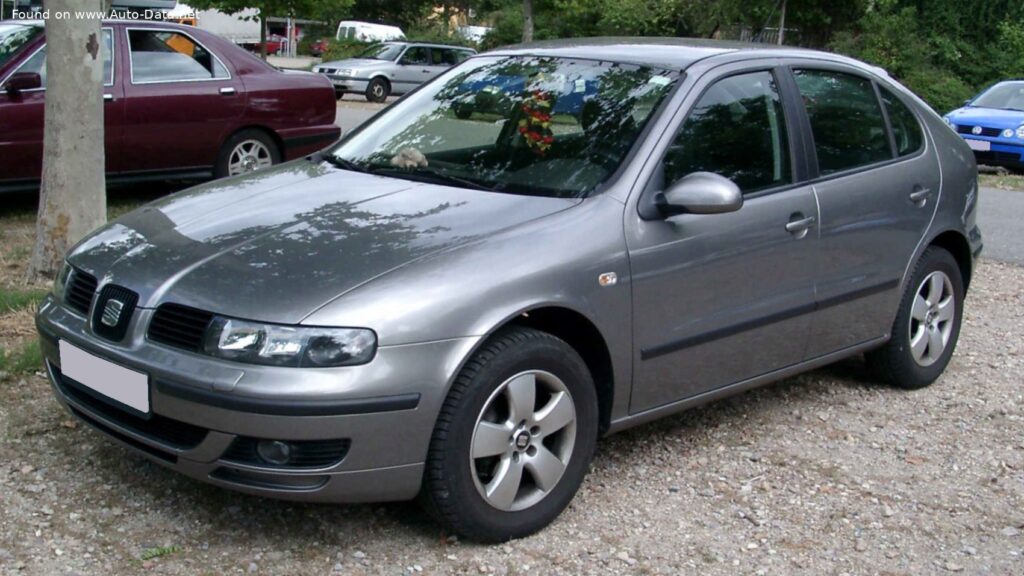
The Seat Leon I (1M): A European Compact with Sporting Ambition
The Seat Leon I (1M) represents the inaugural generation of Seat’s entry into the fiercely competitive European C-segment compact car market. Launched in August 1999 and produced until May 2005, this five-door hatchback quickly established itself as a more dynamically styled and sportier alternative to its Volkswagen Group stablemates, primarily the Volkswagen Golf Mk4 and Audi A3 (8L). Built on the robust A4 (PQ34) platform, shared across several successful models, the Leon I (1M) offered a compelling blend of Spanish flair and German engineering.
This article focuses on a popular and accessible variant, the 1.6-liter (100 Hp) model, which served as a workhorse in many European households. While never officially imported into the United States, the Seat Leon I (1M) played a pivotal role in shaping Seat’s brand identity, emphasizing youthful design, engaging driving dynamics, and everyday practicality for its primary European and other international markets.
Engine & Performance: The Heart of the Seat Leon I (1M) 1.6
Under the hood of the Seat Leon I (1M) 1.6 (100 Hp) lies a dependable 1.6-liter (1595 cm³ or 97.33 cu. in.) naturally aspirated inline-four gasoline engine. This powerplant, identified by engine codes AEH or AKL, was a well-proven unit within the Volkswagen Group, known for its reliability and adequate performance for daily commuting. It featured a Double Overhead Camshaft (DOHC) valvetrain with two valves per cylinder, a configuration that prioritized smooth power delivery and fuel efficiency over outright high-end performance.
The engine produced a respectable 100 horsepower at 5700 rpm, translating to 62.7 horsepower per liter, and delivered 109.16 lb-ft of torque at 4500 rpm. Power was sent to the front wheels via a slick-shifting 5-speed manual transmission, a common and effective setup for compact cars of this era. This powertrain architecture provided a balanced driving experience, allowing the Leon 1.6 to accelerate from 0 to 60 mph in a reasonable 10.6 seconds, with a top speed of 119.3 mph. The vehicle’s weight-to-power ratio stood at 12.2 kg/Hp (or 82 Hp/tonne), reflecting its status as a capable, yet not overtly sporty, family hatchback.
Fuel economy was a strong suit for the 1.6-liter engine, with a combined consumption rating of 33.1 US mpg (7.1 l/100 km), making it an economical choice for European drivers facing higher fuel prices. The engine’s multi-port manifold injection system ensured efficient fuel delivery, contributing to both performance and economy. With a 14.53 US gallon (55-liter) fuel tank, the Leon 1.6 offered a decent cruising range, suitable for both urban commutes and longer highway journeys.
Design & Features: A Distinctive European Hatchback
The design of the Seat Leon I (1M) was a significant departure from Seat’s previous conservative styling, largely influenced by the renowned designer Walter de Silva. The 5-door hatchback body type exuded a sporty and dynamic aesthetic, characterized by its sharp lines, distinctive headlight design, and a muscular stance that set it apart from its more subdued competitors. Despite its sporty appearance, the Leon I (1M) remained highly practical, offering seating for five occupants and a versatile cargo area.
The interior of the Leon I (1M) was well-appointed for its class, featuring a driver-focused cockpit with clear instrumentation. The use of quality materials, typical of Volkswagen Group vehicles, contributed to a durable and comfortable cabin environment. Practicality was further enhanced by a minimum trunk space of 12.01 cu. ft. (340 liters), which could be expanded to a generous 23.17 cu. ft. (656 liters) with the rear seats folded, making it suitable for a variety of cargo needs.
In terms of chassis and safety, the Leon I (1M) benefited from the robust PQ34 platform. It featured a wishbone front suspension and a coil spring rear suspension, providing a good balance between ride comfort and handling agility. Braking was handled by ventilated discs at the front and solid discs at the rear, complemented by an Anti-lock Braking System (ABS) as a standard safety feature, which was becoming increasingly common for European cars in the early 2000s. The steering system utilized a hydraulic rack and pinion setup, offering direct feedback to the driver, further enhancing the car’s engaging driving character. Standard tire size was 195/65 R15, a common fitment for compact cars, balancing grip with ride comfort and cost-effectiveness.
Technical Specifications
| Category | Specification |
|---|---|
| Brand | Seat |
| Model | Leon |
| Generation | Leon I (1M) |
| Type (Engine) | 1.6 (100 Hp) |
| Start of Production | August, 1999 |
| End of Production | May, 2005 |
| Powertrain Architecture | Internal Combustion engine |
| Body Type | Hatchback |
| Seats | 5 |
| Doors | 5 |
| Performance Specs | |
| Fuel Consumption (Combined) | 7.1 l/100 km (33.1 US mpg) |
| Fuel Type | Petrol (Gasoline) |
| Acceleration 0 – 60 mph | 10.6 seconds |
| Maximum Speed | 192 km/h (119.3 mph) |
| Weight-to-Power Ratio | 12.2 kg/Hp (82 Hp/tonne) |
| Weight-to-Torque Ratio | 8.2 kg/Nm (121.3 Nm/tonne) |
| Engine Specs | |
| Power | 100 Hp @ 5700 rpm |
| Power per liter | 62.7 Hp/l |
| Torque | 148 Nm (109.16 lb-ft) @ 4500 rpm |
| Engine Layout | Front, Transverse |
| Engine Model/Code | AEH, AKL |
| Engine Displacement | 1595 cm³ (97.33 cu. in.) |
| Number of Cylinders | 4 |
| Engine Configuration | Inline |
| Cylinder Bore | 76.5 mm (3.01 in.) |
| Piston Stroke | 86.9 mm (3.42 in.) |
| Compression Ratio | 11.5:1 |
| Number of Valves per Cylinder | 2 |
| Fuel Injection System | Multi-port manifold injection |
| Engine Aspiration | Naturally aspirated engine |
| Valvetrain | DOHC |
| Engine Oil Capacity | 4.5 l (4.76 US qt) |
| Engine Oil Specification | Not specified |
| Coolant Capacity | 5 l (5.28 US qt) |
| Space, Volume and Weights | |
| Kerb Weight | 1220 kg (2689.64 lbs) |
| Max. Weight | 1690 kg (3725.81 lbs) |
| Max Load | 470 kg (1036.17 lbs) |
| Trunk (Boot) Space – Minimum | 340 l (12.01 cu. ft.) |
| Trunk (Boot) Space – Maximum | 656 l (23.17 cu. ft.) |
| Fuel Tank Capacity | 55 l (14.53 US gal) |
| Dimensions | |
| Length | 4184 mm (164.72 in.) |
| Width | 1742 mm (68.58 in.) |
| Height | 1439 mm (56.65 in.) |
| Wheelbase | 2513 mm (98.94 in.) |
| Front Track | 1513 mm (59.57 in.) |
| Rear (Back) Track | 1492 mm (58.74 in.) |
| Drivetrain, Brakes and Suspension Specs | |
| Drivetrain Architecture | Front-wheel drive, Internal Combustion Engine |
| Drive Wheel | Front wheel drive |
| Number of Gears and Type of Gearbox | 5 gears, manual transmission |
| Front Suspension | Wishbone |
| Rear Suspension | Coil spring |
| Front Brakes | Ventilated discs |
| Rear Brakes | Disc |
| Assisting Systems | ABS (Anti-lock braking system) |
| Steering Type | Steering rack and pinion |
| Power Steering | Hydraulic Steering |
| Tires Size | 195/65 R15 |
Legacy & Market Impact of the Seat Leon I (1M)
The Seat Leon I (1M) made a significant impact on the European automotive landscape, particularly for the Spanish brand Seat. Positioned within the highly competitive C-segment, it faced formidable rivals such as the Ford Focus, Opel Astra, Renault Megane, Peugeot 307, and its own Volkswagen Golf sibling. However, the Leon carved out its niche by offering a distinct personality: a sportier, more passionate alternative within the VW Group’s generally conservative lineup.
Its robust underpinnings, shared with the critically acclaimed Golf Mk4, ensured a solid and reliable platform, but Seat’s unique tuning gave the Leon a more agile and engaging feel, especially in more powerful variants. The 1.6-liter model, while not a performance powerhouse, benefited from this inherent chassis competence, providing a comfortable yet competent driving experience for the everyday user. It was praised for its sharp styling, which helped attract a younger demographic, and its perceived value for money, often undercutting its Audi and VW cousins while offering similar levels of build quality.
As a brand, Seat had historically struggled to define its identity outside of its home market. The first-generation Leon, alongside models like the Ibiza, helped solidify Seat’s image as the “hot-blooded” or “sporty” brand of the Volkswagen Group. It demonstrated that Seat could produce vehicles that were not only practical and reliable but also emotionally appealing and fun to drive. The success of the Leon I (1M) paved the way for subsequent generations, each building on the foundation of dynamic styling and engaging performance.
Although the Seat brand never officially entered the North American market, the Leon I (1M) is a fascinating example of how European manufacturers adapted common platforms to create distinct brand identities. Its blend of accessible performance, practical design, and a touch of sporting flair made it a popular choice across Europe and contributed significantly to Seat’s growth and recognition as a key player in the compact car segment. Today, the Leon I (1M) remains a respected used car, appreciated for its enduring design and the solid engineering beneath its Spanish skin.
