
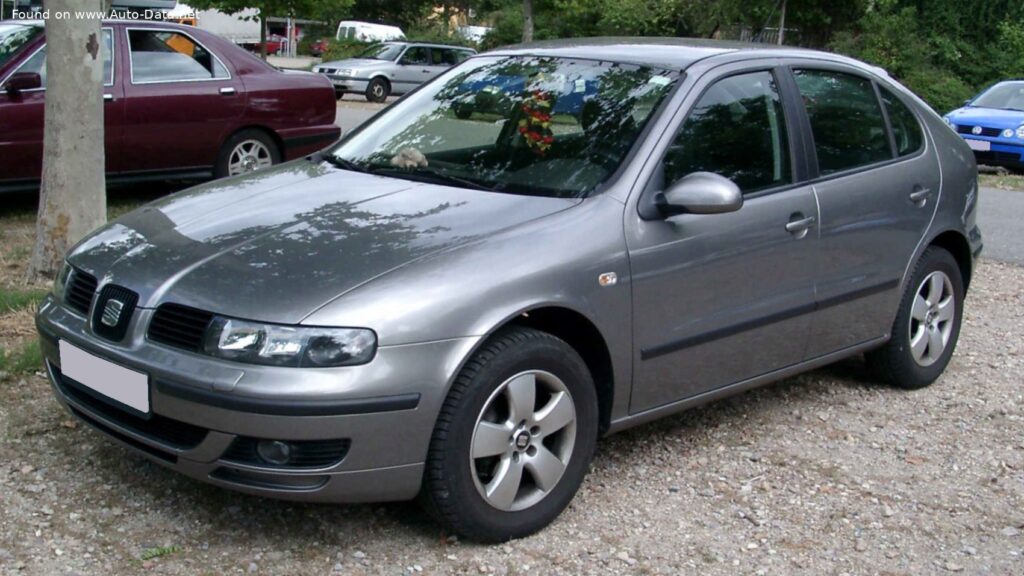
Introduction to the Seat Leon I (1M) 1.8 20V (125 Hp)
The Seat Leon I (1M) represents the inaugural generation of Seat’s popular compact family car, a vehicle that played a pivotal role in solidifying the Spanish automaker’s identity within the vast Volkswagen Group empire. Launched in November 1999, the Leon I (1M) was designed to carve out a niche in the highly competitive European C-segment, offering a sportier and more passionate alternative to its platform siblings, the Volkswagen Golf Mk4 and Audi A3 (8L). This particular variant, the 1.8 20V (125 Hp), stood as a well-balanced option within the range, providing a respectable blend of performance, efficiency, and everyday usability for its primary market.
While never officially sold in the United States, the Seat Leon I (1M) enjoyed considerable success across Europe and other international markets. It was conceived during a period when Seat was actively cultivating its “auto emocion” brand philosophy, emphasizing dynamic styling and engaging driving characteristics. The 1.8 20V model, with its naturally aspirated engine and five-door hatchback body style, was a popular choice for buyers seeking a practical yet spirited compact car. Its production ran until May 2005, making it a familiar sight on European roads and a significant chapter in Seat’s journey from a national Spanish brand to a globally recognized member of the Volkswagen Group.
The Seat Leon I (1M): Engineering and Performance
Engine and Powertrain
At the heart of the Seat Leon I (1M) 1.8 20V lies a robust and well-regarded 1.8-liter (1781 cm³ or 108.68 cu. in.) inline-four gasoline engine. This powerplant, known by internal codes such as AGN or APG, was a staple across various Volkswagen Group models of the era, celebrated for its smooth operation and reliability. What distinguished this engine was its advanced (for its time) 20-valve architecture, featuring five valves per cylinder (three intake, two exhaust), actuated by a Double Overhead Camshaft (DOHC) valvetrain. This design allowed for improved airflow into the combustion chambers, contributing to better high-RPM breathing and overall efficiency.
The naturally aspirated engine produced a healthy 125 horsepower (Hp) at 6000 rpm, delivering a power-per-liter figure of 70.2 Hp/l. Torque output stood at 125.39 lb.-ft. (170 Nm), peaking at 4200 rpm. This relatively broad powerband ensured that the Leon felt responsive in various driving conditions. Power was transmitted to the front wheels via a precise 5-speed manual transmission, a common and reliable setup for compact cars of this generation. The drivetrain architecture was a conventional front-engine, front-wheel-drive configuration, optimizing interior space and manufacturing simplicity.
Driving Dynamics and Efficiency
Performance figures for the Seat Leon I (1M) 1.8 20V were respectable for its class. The car could accelerate from 0 to 60 mph in an estimated 9.8 seconds (0-100 km/h in 10.3 seconds), and reach a maximum speed of 124.27 mph (200 km/h). These numbers placed it firmly in the mainstream compact segment, offering enough zest for daily commuting and occasional spirited driving without being overtly sporty. The vehicle’s curb weight of 2859.4 lbs (1297 kg) contributed to a weight-to-power ratio of 10.4 kg/Hp, or approximately 96.4 Hp/tonne, indicating a well-balanced power-to-weight relationship.
In terms of fuel economy, the Leon 1.8 20V offered competitive figures for a gasoline engine of its displacement and era. The combined fuel consumption was rated at 28 US mpg (8.4 l/100 km), with urban driving yielding approximately 19.9 US mpg (11.8 l/100 km) and extra-urban (highway) driving achieving 36.8 US mpg (6.4 l/100 km). This made it an economical choice for many European families and individuals. The 14.53 US gallon (55-liter) fuel tank provided a decent cruising range, enhancing its practicality for longer journeys. The hydraulic power steering, coupled with a steering rack and pinion system, offered good feedback and precision, contributing to the Leon’s reputation for engaging handling.
Design and Features of the Seat Leon I (1M)
Exterior and Interior Design
The design of the Seat Leon I (1M) was a significant departure from its predecessor, the Seat Toledo Mk1, and showcased a more aggressive and dynamic styling language under the guidance of then-design chief Walter de Silva. Its five-door hatchback body type was both practical and visually appealing, featuring flowing lines, a distinctive “arrow” nose, and pronounced wheel arches that gave it a muscular stance. While sharing its basic platform with the more conservative VW Golf Mk4, the Leon managed to project a unique, sportier character, aligning with Seat’s brand image. The overall dimensions, with a length of 164.72 inches (4184 mm), a width of 68.58 inches (1742 mm), and a height of 56.65 inches (1439 mm), made it a compact yet spacious vehicle for its segment.
Inside, the Seat Leon I (1M) continued the theme of functional sportiness. The cabin was well-appointed with quality materials, reflecting its Volkswagen Group parentage, albeit with a distinctly Spanish flair. The layout was driver-focused, with clear instrumentation and ergonomically placed controls. As a 5-seater, it offered ample space for four adults and a child, making it suitable for families. The trunk (boot) space was practical, ranging from a minimum of 12.01 cubic feet (340 liters) with the rear seats up, expandable to 23.17 cubic feet (656 liters) when the rear seats were folded down, providing versatility for cargo needs.
Comfort and Safety Features
For its time, the Seat Leon I (1M) 1.8 20V was equipped with a commendable array of features aimed at enhancing both comfort and safety. Standard safety equipment included an Anti-lock Braking System (ABS), which was becoming increasingly prevalent in European cars of this era, significantly improving braking performance and control in emergency situations. The braking system itself comprised ventilated discs at the front and solid discs at the rear, providing strong and consistent stopping power.
The suspension system was designed to blend comfort with Seat’s characteristic agile handling. It featured a wishbone setup at the front and a coil spring arrangement at the rear, offering a refined ride quality while maintaining stability through corners. The 195/65 R15 tires were a common size, providing a good balance of grip and ride comfort. While specific luxury features varied by trim level, the core mechanical and safety components ensured a competent and secure driving experience, positioning the Leon as a strong contender in the European compact market.
Technical Specifications
| Feature | Value |
|---|---|
| Brand | Seat |
| Model | Leon |
| Generation | Leon I (1M) |
| Type (Engine) | 1.8 20V (125 Hp) |
| Start of Production | November, 1999 year |
| End of Production | May, 2005 year |
| Powertrain Architecture | Internal Combustion engine |
| Body type | Hatchback |
| Seats | 5 |
| Doors | 5 |
| Fuel Consumption (Economy) – Urban | 11.8 l/100 km (19.9 US mpg) |
| Fuel Consumption (Economy) – Extra Urban | 6.4 l/100 km (36.8 US mpg) |
| Fuel Consumption (Economy) – Combined | 8.4 l/100 km (28 US mpg) |
| Fuel Type | Petrol (Gasoline) |
| Acceleration 0 – 60 mph | 9.8 sec |
| Acceleration 0 – 100 km/h | 10.3 sec |
| Maximum Speed | 200 km/h (124.27 mph) |
| Weight-to-Power Ratio | 10.4 kg/Hp (96.4 Hp/tonne) |
| Weight-to-Torque Ratio | 7.6 kg/Nm (131.1 Nm/tonne) |
| Power | 125 Hp @ 6000 rpm |
| Power per Liter | 70.2 Hp/l |
| Torque | 170 Nm @ 4200 rpm (125.39 lb.-ft. @ 4200 rpm) |
| Engine Layout | Front, Transverse |
| Engine Model/Code | AGN, APG |
| Engine Displacement | 1781 cm³ (1.8 l / 108.68 cu. in.) |
| Number of Cylinders | 4 |
| Engine Configuration | Inline |
| Cylinder Bore | 81 mm (3.19 in.) |
| Piston Stroke | 86.4 mm (3.4 in.) |
| Compression Ratio | 10.3:1 |
| Number of Valves per Cylinder | 5 |
| Fuel Injection System | Multi-port manifold injection |
| Engine Aspiration | Naturally aspirated engine |
| Valvetrain | DOHC |
| Engine Oil Capacity | 4.5 l (4.76 US qt) |
| Coolant Capacity | 5 l (5.28 US qt) |
| Kerb Weight | 1297 kg (2859.4 lbs) |
| Max. Weight | 1690 kg (3725.81 lbs) |
| Max Load | 393 kg (866.42 lbs) |
| Trunk (Boot) Space – Minimum | 340 l (12.01 cu. ft.) |
| Trunk (Boot) Space – Maximum | 656 l (23.17 cu. ft.) |
| Fuel Tank Capacity | 55 l (14.53 US gal) |
| Length | 4184 mm (164.72 in.) |
| Width | 1742 mm (68.58 in.) |
| Height | 1439 mm (56.65 in.) |
| Wheelbase | 2513 mm (98.94 in.) |
| Front Track | 1513 mm (59.57 in.) |
| Rear (Back) Track | 1492 mm (58.74 in.) |
| Drivetrain Architecture | Front-wheel drive (ICE drives front wheels) |
| Drive Wheel | Front wheel drive |
| Number of Gears and Type of Gearbox | 5 gears, manual transmission |
| Front Suspension | Wishbone |
| Rear Suspension | Coil spring |
| Front Brakes | Ventilated discs |
| Rear Brakes | Disc |
| Assisting Systems | ABS (Anti-lock braking system) |
| Steering Type | Steering rack and pinion |
| Power Steering | Hydraulic Steering |
| Tire Size | 195/65 R15 |
Legacy and Market Impact of the Seat Leon I (1M)
The Seat Leon I (1M), particularly variants like the 1.8 20V, left a significant mark on the European automotive landscape. It was a critical model for Seat, helping to establish its modern identity as a manufacturer of stylish, sporty, and value-oriented vehicles within the Volkswagen Group. Before the Leon, Seat was often perceived as a budget alternative to Volkswagen, but the Leon successfully injected a sense of “auto emocion” – automotive emotion – into the brand. Its sharp styling, engaging chassis, and reliable VW Group mechanicals resonated well with a younger, more dynamic customer base.
In its primary European market, the Leon I (1M) faced stiff competition from a plethora of well-established compact cars. Its main rivals included its platform siblings, the Volkswagen Golf Mk4 and Audi A3 (8L), which offered different takes on the same underlying engineering – the Golf being the sensible all-rounder, the A3 the premium choice, and the Leon the sporty option. Beyond the VW Group, it competed directly with best-sellers like the Ford Focus Mk1, Opel Astra G, Peugeot 307, Renault Mégane, and Honda Civic. The Leon distinguished itself with its more aggressive aesthetics and often a slightly more enthusiastic driving feel than some of its more anodyne competitors.
The reputation of the Seat Leon I (1M) was generally positive, known for its solid build quality, comfortable ride, and reliable powertrains. The 1.8 20V engine, in particular, was praised for its balance of performance and economy, proving durable over many miles. This generation also laid the groundwork for Seat’s foray into high-performance models, with the Cupra and Cupra R versions of the Leon I (1M) becoming cult classics among enthusiasts. These hot hatches cemented Seat’s performance credentials and showcased the potential of the Leon platform.
Today, the first-generation Leon remains a popular used car in Europe, valued for its affordability, robustness, and still-attractive design. Its historical significance lies in its role as a brand-builder for Seat, demonstrating that the Spanish marque could produce cars with distinct character and appeal, rather than merely rebadged Volkswagens. The success of the Seat Leon I (1M) paved the way for subsequent generations, which continued to build on its legacy of dynamic design and engaging driving, ensuring that the Leon nameplate remains a cornerstone of Seat’s product lineup.
