
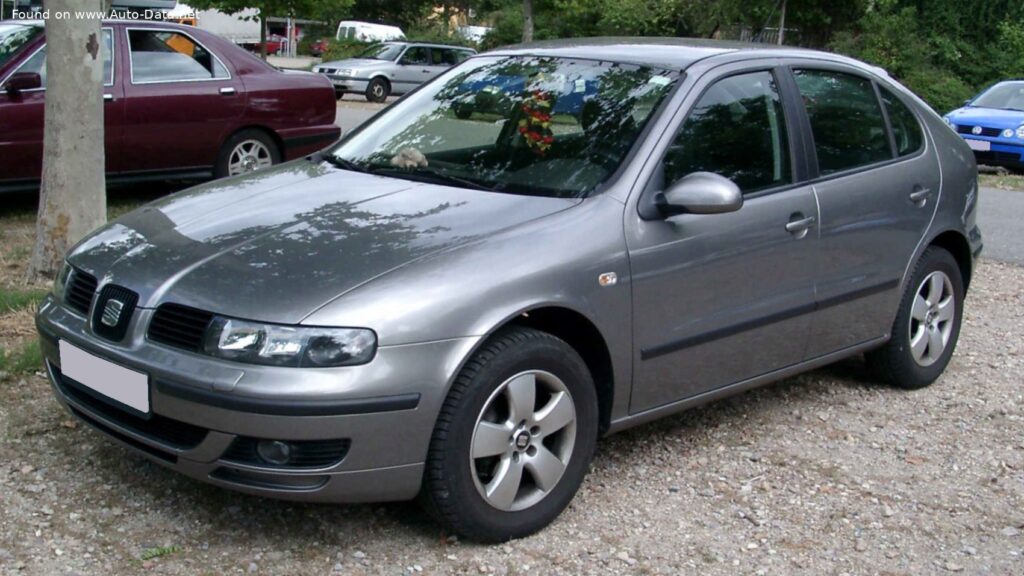
The Seat Leon I (1M) 1.9 SDI (68 Hp): A European Compact for the Economical Driver
The first-generation Seat Leon, internally designated 1M, marked a significant chapter for the Spanish automaker within the Volkswagen Group. Launched in 1999, the Seat Leon I (1M) was SEAT’s entry into the highly competitive European C-segment, a market dominated by stalwarts like the Volkswagen Golf, Opel Astra, and Ford Focus. This particular variant, the 1.9 SDI (68 Hp), produced from June 2000 to October 2003, represented the entry-level diesel offering, prioritizing exceptional fuel economy and rugged reliability over outright performance. While never officially sold in the United States, the Leon I (1M) carved out a niche in its primary European and select international markets as a practical, well-built, and stylish five-door hatchback, leveraging the robust and proven PQ34 platform shared with its Volkswagen Group siblings.
The Leon I (1M) was instrumental in shaping SEAT’s image as the “sporty” and “passionate” brand within the VW Group, a design philosophy that was evident even in its more modest powertrain configurations. Its distinctive styling, penned by Giorgetto Giugiaro and further refined by SEAT’s design team, offered a more dynamic aesthetic compared to some of its conservative platform mates. For the European consumer, the 1.9 SDI model was a pragmatic choice, offering low running costs, a comfortable ride, and ample interior space for a compact vehicle, making it a popular option for urban commuters and those seeking a dependable daily driver.
Engine and Performance: The Robust 1.9 SDI Powerplant
At the heart of this particular Seat Leon I (1M) model lies the venerable 1.9-liter SDI (Suction Diesel Injection) engine, designated by the code AQM. Unlike its turbocharged TDI (Turbocharged Direct Injection) counterparts, the SDI variant is naturally aspirated, meaning it relies solely on atmospheric pressure to draw air into the cylinders, foregoing a turbocharger. This design choice results in a power output of 68 horsepower at 4200 rpm and a peak torque of 98.1 lb.-ft. at a relatively low 2200 rpm. While these figures might seem modest by modern standards, they translate into a powertrain known for its exceptional longevity, simplicity, and remarkable fuel efficiency.
The 1.9 SDI engine’s naturally aspirated nature contributes to a linear and predictable power delivery, albeit one that requires patience. Acceleration from 0 to 60 mph is achieved in a measured 16.8 seconds, with a maximum speed of approximately 99.42 mph. These performance metrics clearly indicate that the 1.9 SDI was not engineered for spirited driving but rather for economical and reliable transportation. Its strength lies in its fuel economy, boasting a combined consumption figure of 45.2 US mpg. This impressive efficiency, coupled with a 14.53 US gallon fuel tank, provided a substantial cruising range, a highly desirable trait for European drivers facing higher fuel prices. The engine’s direct injection system, a hallmark of Volkswagen Group diesels, ensured efficient combustion and low emissions for its era. Paired with a smooth-shifting 5-speed manual transmission, the front-wheel-drive powertrain offered a direct and engaging driving experience, characteristic of the era’s compact cars.
Design and Features: Practicality Meets European Flair
The Seat Leon I (1M) adopted a five-door hatchback body style, a practical and popular choice in the European compact segment. Its exterior design was a departure from the more conservative lines of some of its platform mates, featuring a more aggressive front fascia, distinctive character lines, and a subtly sculpted profile that gave it a sportier stance. The overall dimensions, with a length of 164.72 inches, a width of 68.58 inches, and a height of 56.65 inches, positioned it squarely within the compact class, making it maneuverable in urban environments while still offering a respectable interior volume.
Inside, the Leon I (1M) provided seating for five occupants, with a focus on ergonomics and functionality. While the 1.9 SDI trim would have been more basic, standard features for the generation typically included power steering (hydraulic in this case, offering good road feel), and essential safety systems like ABS (Anti-lock Braking System) were becoming increasingly common, as indicated in the specifications. The trunk space offered a practical 12.01 cubic feet with the rear seats up, expanding to a generous 23.17 cubic feet when folded, making it versatile for carrying luggage or larger items. The suspension setup, featuring wishbones at the front and coil springs at the rear, provided a comfortable yet composed ride, typical of the well-engineered PQ34 platform. Ventilated discs at the front and disc brakes at the rear ensured adequate stopping power for the vehicle’s modest performance.
Technical Specifications: Seat Leon I (1M) 1.9 SDI (68 Hp)
| Category | Specification | Value |
|---|---|---|
| General Information | Brand | Seat |
| Model | Leon | |
| Generation | Leon I (1M) | |
| Engine Type | 1.9 SDI (68 Hp) | |
| Production Start | June, 2000 | |
| Production End | October, 2003 | |
| Powertrain Architecture | Internal Combustion Engine | |
| Body Type | Hatchback | |
| Seats | 5 | |
| Doors | 5 | |
| Performance Specs | Fuel Consumption (Combined) | 45.2 US mpg (5.2 l/100 km) |
| Fuel Type | Diesel | |
| Acceleration 0 – 60 mph | 16.8 sec | |
| Maximum Speed | 99.42 mph (160 km/h) | |
| Weight-to-Power Ratio | 18.7 kg/Hp (53.5 Hp/tonne) | |
| Weight-to-Torque Ratio | 9.5 kg/Nm (104.7 Nm/tonne) | |
| Engine Specs | Power | 68 Hp @ 4200 rpm |
| Power per Liter | 35.9 Hp/l | |
| Torque | 98.1 lb.-ft. @ 2200 rpm (133 Nm) | |
| Engine Layout | Front, Transverse | |
| Engine Model/Code | AQM | |
| Engine Displacement | 1.9 Liters (1896 cm3 / 115.7 cu. in.) | |
| Number of Cylinders | 4 | |
| Engine Configuration | Inline | |
| Cylinder Bore | 3.13 in. (79.5 mm) | |
| Piston Stroke | 3.76 in. (95.5 mm) | |
| Compression Ratio | 19.5:1 | |
| Valves per Cylinder | 2 | |
| Fuel Injection System | Direct injection | |
| Engine Aspiration | Naturally aspirated engine | |
| Valvetrain | OHC | |
| Engine Oil Capacity | 4.76 US qt (4.5 l) | |
| Coolant Capacity | 6.34 US qt (6 l) | |
| Space, Volume & Weights | Kerb Weight | 2799.87 lbs. (1270 kg) |
| Maximum Weight | 3836.04 lbs. (1740 kg) | |
| Maximum Load | 1036.17 lbs. (470 kg) | |
| Trunk (Boot) Space – Minimum | 12.01 cu. ft. (340 l) | |
| Trunk (Boot) Space – Maximum | 23.17 cu. ft. (656 l) | |
| Fuel Tank Capacity | 14.53 US gal (55 l) | |
| Dimensions | Length | 164.72 in. (4184 mm) |
| Width | 68.58 in. (1742 mm) | |
| Height | 56.65 in. (1439 mm) | |
| Wheelbase | 98.94 in. (2513 mm) | |
| Front Track | 59.57 in. (1513 mm) | |
| Rear Track | 58.74 in. (1492 mm) | |
| Drivetrain, Brakes & Suspension | Drivetrain Architecture | Front-wheel drive (ICE drives front wheels) |
| Drive Wheel | Front wheel drive | |
| Gearbox Type | 5 gears, manual transmission | |
| Front Suspension | Wishbone | |
| Rear Suspension | Coil spring | |
| Front Brakes | Ventilated discs | |
| Rear Brakes | Disc | |
| Assisting Systems | ABS (Anti-lock braking system) | |
| Steering Type | Steering rack and pinion | |
| Power Steering | Hydraulic Steering | |
| Tires Size | 175/80 R14 |
Legacy and Market Impact of the Seat Leon I (1M)
The Seat Leon I (1M), particularly in its economical 1.9 SDI guise, played a crucial role in establishing SEAT’s identity and market position within Europe during the early 2000s. While not a performance icon, the 1.9 SDI variant was a workhorse, embodying the practicality and cost-effectiveness that many European buyers sought in the compact segment. Its direct competitors included the entry-level diesel versions of the Volkswagen Golf IV, Skoda Octavia, Ford Focus, Opel Astra, and Peugeot 307. In this crowded field, the Leon stood out with its distinctive styling and a perceived sportier character, even when equipped with the most basic engine.
The SDI engine, despite its modest horsepower, developed a reputation for being incredibly robust and durable. Its lack of a turbocharger meant fewer complex components, often leading to lower maintenance costs and greater reliability over its turbocharged siblings. This made it a particularly attractive option for fleet operators, driving schools, and private individuals who prioritized long-term running costs and dependability. The excellent fuel economy, a consistent strong suit of the 1.9 SDI, was a significant selling point in markets where diesel fuel was prevalent and often more affordable than gasoline.
The first-generation Leon’s success helped SEAT solidify its image as a youthful and dynamic brand, distinct from Volkswagen’s more conservative appeal and Skoda’s value-oriented approach. It demonstrated that SEAT could produce a car that was not only practical and economical but also engaging to look at and drive, thanks to its well-tuned chassis and responsive hydraulic steering. The Seat Leon I (1M) laid the groundwork for future generations of the Leon, which continued to build on its foundations of attractive design, strong performance (in other variants), and everyday usability. Even today, the 1M Leon, especially the SDI models, can be found diligently serving drivers across Europe, a testament to its enduring build quality and the inherent reliability of its powertrain. Its legacy is one of quiet competence and steadfast efficiency, contributing significantly to SEAT’s growth and recognition in the global automotive landscape.
