
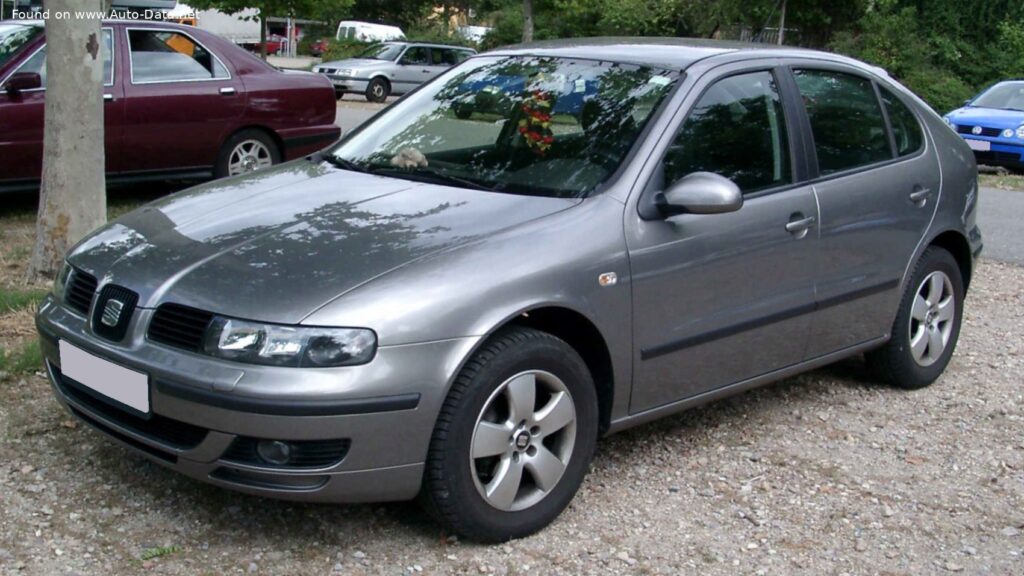
Introduction to the Seat Leon I (1M) 1.9 TDI (110 Hp)
The Seat Leon I (1M) 1.9 TDI (110 Hp) represents a significant chapter in the history of SEAT, the Spanish automotive manufacturer known for its vibrant and sporty offerings within the Volkswagen Group. Launched in November 1999, the first-generation Leon, internally designated 1M, quickly established itself as a compelling contender in the highly competitive European C-segment compact car market. Produced until October 2005, this iteration of the Leon was built on the Volkswagen Group A4 (PQ34) platform, sharing its robust underpinnings with esteemed siblings such as the Volkswagen Golf Mk4, Audi A3 (8L), and Skoda Octavia Mk1.
The 1.9 TDI (110 Hp) variant was particularly pivotal for the Leon’s success, embodying the era’s growing demand for fuel-efficient yet capable diesel powertrains. As a five-door hatchback, it offered a practical and versatile package, appealing to a broad spectrum of European buyers who valued a blend of everyday usability, spirited driving dynamics, and economical operation. While never officially sold in the United States, the Leon 1M carved out a strong niche in its primary European markets, showcasing SEAT’s ambition to provide a more emotionally charged alternative to its German counterparts, often at a more accessible price point. This article delves into the specifics of this particular model, highlighting its engineering, design, and lasting impact.
Engine and Performance of the Seat Leon I (1M)
At the heart of the Seat Leon I (1M) 1.9 TDI (110 Hp) was a venerable 1.9-liter turbocharged direct injection (TDI) diesel engine, an powerplant renowned across the Volkswagen Group for its durability and impressive efficiency. This inline-four cylinder engine, identified by codes such as AHF or ASV, delivered a robust 110 horsepower at 4150 revolutions per minute (rpm). More significantly for real-world driving, it produced a substantial 173.33 lb.-ft. of torque at a low 1900 rpm. This low-end torque was a hallmark of the TDI engines, providing strong pulling power and excellent responsiveness, making it particularly well-suited for both city driving and highway cruising.
The powertrain architecture featured a front, transverse engine layout, driving the front wheels through a precise 5-speed manual transmission. This setup contributed to the car’s agile handling and direct driver engagement. Despite its focus on economy, the Leon 1.9 TDI (110 Hp) offered respectable performance for its class. It could accelerate from 0 to 60 mph in a swift 10.6 seconds and reach a maximum speed of nearly 120 mph (119.92 mph, to be exact). For its time, these figures underscored a harmonious balance between performance and the inherent fuel-saving benefits of a diesel engine.
Fuel economy was a major selling point. The combined fuel consumption was an impressive 47 US mpg (5 liters per 100 km), with extra-urban figures soaring to 57.4 US mpg (4.1 liters per 100 km). This made the Leon 1.9 TDI an exceptionally economical choice for drivers covering long distances, a crucial factor in many European markets where fuel prices are higher than in the U.S. The engine’s aspiration system, comprising a turbocharger and intercooler, was key to extracting both power and efficiency from its relatively small displacement of 115.7 cubic inches (1896 cm3). With a high compression ratio of 19.5:1 and an OHC valvetrain with two valves per cylinder, the engine was engineered for reliability and consistent performance.
Design and Features
The design of the Seat Leon I (1M) was penned by the renowned Italian designer Giorgetto Giugiaro, giving it a distinctive yet understated aesthetic that blended seamlessly with its Volkswagen Group stablemates while retaining a unique SEAT identity. Its five-door hatchback body type exuded a sporty yet practical appeal, a common configuration in the European compact segment. The overall dimensions—164.72 inches in length, 68.58 inches in width, and 56.65 inches in height—contributed to a compact footprint that was ideal for navigating narrow European city streets while still offering a surprisingly spacious interior.
Inside, the Leon offered seating for five occupants, making it a viable option for small families or individuals needing versatile cargo space. The trunk (boot) space ranged from 12.01 cubic feet (340 liters) with the rear seats up, expanding to a generous 23.17 cubic feet (656 liters) when the rear seats were folded down. This flexibility further enhanced its appeal as a practical everyday vehicle.
For its era, the Leon 1M incorporated a range of features aimed at enhancing safety and driving comfort. Standard assisting systems included an Anti-lock Braking System (ABS), a crucial safety feature for maintaining steering control during hard braking. The car utilized a steering rack and pinion system with hydraulic power steering, providing a tactile and engaging steering feel that enthusiasts appreciated. The suspension setup featured wishbones at the front and coil springs at the rear, a proven configuration for balancing ride comfort with dynamic handling. Braking power was supplied by ventilated discs at the front and solid discs at the rear, ensuring confident stopping performance. The vehicle rode on 195/65 R15 tires, a common size that offered a good blend of grip, comfort, and affordability.
Technical Specifications
| Category | Specification | US/Imperial Equivalent |
|---|---|---|
| Brand | Seat | |
| Model | Leon I (1M) | |
| Type (Engine) | 1.9 TDI (110 Hp) | |
| Production Start | November, 1999 | |
| Production End | October, 2005 | |
| Body Type | Hatchback | |
| Seats | 5 | |
| Doors | 5 | |
| Performance Specifications | ||
| Fuel Consumption (Urban) | 6.6 l/100 km | 35.6 US mpg |
| Fuel Consumption (Extra Urban) | 4.1 l/100 km | 57.4 US mpg |
| Fuel Consumption (Combined) | 5 l/100 km | 47 US mpg |
| Fuel Type | Diesel | |
| Acceleration 0-60 mph | 10.6 sec | |
| Maximum Speed | 193 km/h | 119.92 mph |
| Weight-to-power ratio | 11.9 kg/Hp | 83.7 Hp/tonne |
| Weight-to-torque ratio | 5.6 kg/Nm | 178.8 Nm/tonne |
| Engine Specifications | ||
| Power | 110 Hp @ 4150 rpm | |
| Torque | 235 Nm @ 1900 rpm | 173.33 lb.-ft. @ 1900 rpm |
| Engine Layout | Front, Transverse | |
| Engine Model/Code | AHF, ASV | |
| Engine Displacement | 1896 cm3 | 115.7 cu. in. |
| Number of Cylinders | 4 | |
| Engine Configuration | Inline | |
| Cylinder Bore | 79.5 mm | 3.13 in. |
| Piston Stroke | 95.5 mm | 3.76 in. |
| Compression Ratio | 19.5:1 | |
| Valves per Cylinder | 2 | |
| Fuel Injection System | Direct injection | |
| Engine Aspiration | Turbocharger, Intercooler | |
| Valvetrain | OHC | |
| Engine Oil Capacity | 4.5 l | 4.76 US qt |
| Coolant Capacity | 6 l | 6.34 US qt |
| Dimensions, Volume, and Weights | ||
| Kerb Weight | 1314 kg | 2896.87 lbs. |
| Maximum Weight | 1780 kg | 3924.23 lbs. |
| Maximum Load | 466 kg | 1027.35 lbs. |
| Trunk Space (Min) | 340 l | 12.01 cu. ft. |
| Trunk Space (Max) | 656 l | 23.17 cu. ft. |
| Fuel Tank Capacity | 55 l | 14.53 US gal |
| Length | 4184 mm | 164.72 in. |
| Width | 1742 mm | 68.58 in. |
| Height | 1439 mm | 56.65 in. |
| Wheelbase | 2513 mm | 98.94 in. |
| Front Track | 1513 mm | 59.57 in. |
| Rear Track | 1492 mm | 58.74 in. |
| Drivetrain, Brakes, and Suspension | ||
| Drivetrain Architecture | Internal Combustion engine (ICE) drives the front wheels. | |
| Drive Wheel | Front wheel drive | |
| Gearbox | 5 gears, manual transmission | |
| Front Suspension | Wishbone | |
| Rear Suspension | Coil spring | |
| Front Brakes | Ventilated discs | |
| Rear Brakes | Disc | |
| Assisting Systems | ABS (Anti-lock braking system) | |
| Steering Type | Steering rack and pinion | |
| Power Steering | Hydraulic Steering | |
| Tire Size | 195/65 R15 | |
Legacy and Market Impact of the Seat Leon I (1M)
The Seat Leon I (1M), particularly in its 1.9 TDI (110 Hp) guise, left an indelible mark on the European automotive landscape. As SEAT’s entry into the fiercely competitive C-segment, it played a crucial role in solidifying the brand’s image as the sporty and youthful arm of the Volkswagen Group. Unlike its more conservative siblings, the Golf and Octavia, the Leon aimed for a more dynamic aesthetic and driving experience, often appealing to younger buyers or those who simply desired a bit more flair from their compact hatchback.
Its primary competitors in the European market were formidable, including the aforementioned Volkswagen Golf Mk4, Audi A3 (8L), and Skoda Octavia Mk1, all sharing the same robust platform. Beyond the VW Group, it squared off against popular models like the Ford Focus Mk1, Opel Astra G, Peugeot 307, and Renault Megane. What set the Leon 1.9 TDI apart was its compelling combination of Volkswagen Group engineering reliability, SEAT’s distinct styling, and the legendary efficiency of the TDI engine. This diesel powertrain was a major draw, offering a blend of performance and economy that was hard to beat, especially in countries with high diesel fuel consumption and tax incentives. The 110 HP version was particularly well-regarded for its sweet spot of power and fuel frugality, making it a favorite among company car fleets and private owners alike.
The Leon 1M’s reputation for robust build quality, derived from its VW Group foundations, combined with its engaging chassis and responsive steering, contributed to its strong sales performance across Southern Europe, particularly in Spain, Italy, and Portugal. It was often perceived as a more affordable, yet equally capable, alternative to an Audi A3, offering similar mechanical sophistication without the premium price tag. The car’s success helped SEAT expand its market share and establish a clearer brand identity within the crowded European market.
Even years after its production ceased, the first-generation Leon 1.9 TDI (110 Hp) remains a popular used car in many European countries, a testament to its enduring reliability and low running costs. Its legacy paved the way for subsequent generations of the Leon, each building upon the foundation of sportiness, practicality, and value established by the original. The 1M Leon, especially with its potent and economical TDI engine, is remembered as a car that perfectly captured the spirit of European compact motoring at the turn of the millennium.
