
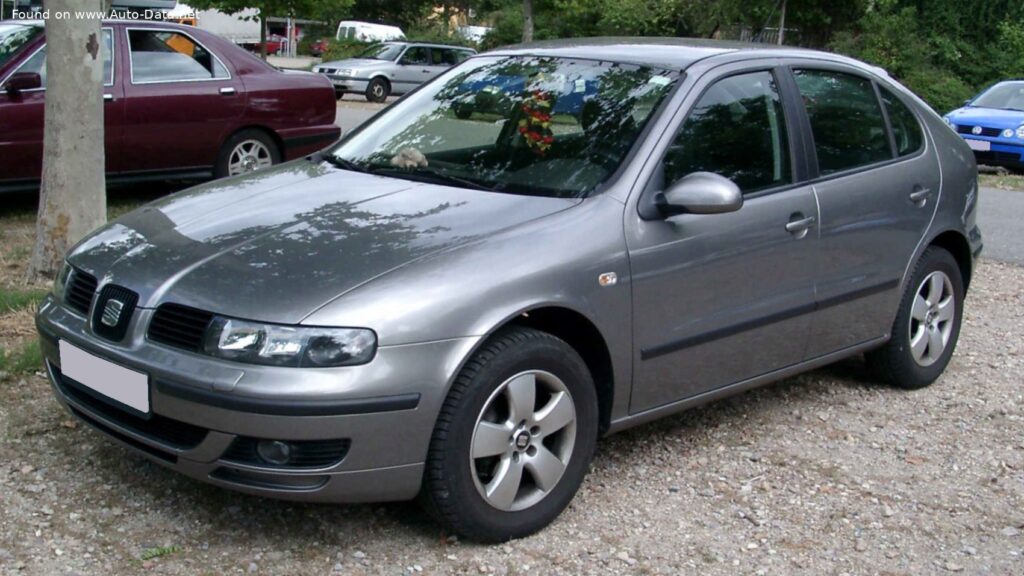
Seat Leon I (1M) 1.9 TDI (150 Hp): A European Performance Diesel Icon
The Seat Leon I (1M) 1.9 TDI (150 Hp) represents a significant chapter in the history of compact European hatchbacks, particularly for its blend of spirited performance and exceptional fuel economy delivered by its advanced turbodiesel engine. Produced from September 2000 to May 2005, this first-generation Leon, internally designated 1M, was Seat’s entry into the highly competitive C-segment, a market segment dominated by vehicles like the Volkswagen Golf and Ford Focus. As a product of the Volkswagen Group, the Leon I (1M) shared its robust A4 (PQ34) platform with contemporaries such as the Audi A3 8L, Skoda Octavia I, and the Volkswagen Golf IV, inheriting a reputation for solid engineering and driving dynamics. While never officially sold in the United States, the Leon I (1M) 1.9 TDI (150 Hp) carved out a niche in Europe as a compelling “warm hatch” option, offering a distinctly sportier aesthetic and driving experience than its VW Group stablemates, all while leveraging the efficiency benefits of diesel power.
Engine and Performance of the Seat Leon I (1M)
At the heart of the formidable Seat Leon I (1M) 1.9 TDI (150 Hp) was a highly regarded powertrain: the ARL-code 1.9-liter (1896 cm³) inline-four turbodiesel engine. This direct-injection unit was a benchmark for diesel performance in its era, renowned for its strong torque delivery and impressive fuel efficiency. It employed a sophisticated pump-nozzle (unit injector) fuel injection system, which allowed for precise fuel atomization and combustion, contributing to both its power output and relatively low emissions for a diesel of its time. Coupled with a turbocharger and intercooler, the engine generated a robust 150 horsepower at 4000 rpm. More importantly, it produced a substantial 236.02 lb.-ft. of torque at a low 1900 rpm, providing excellent mid-range acceleration and responsiveness.
This potent diesel engine was exclusively paired with a slick-shifting 6-speed manual transmission, driving the front wheels. The combination allowed the Leon I (1M) 1.9 TDI to achieve a 0-60 mph acceleration time of a swift 8.6 seconds (0-100 km/h in 9.1 seconds) and reach a top speed of 131.11 mph (211 km/h). These figures were particularly impressive for a diesel-powered compact car in the early 2000s, enabling it to compete effectively with many gasoline-powered counterparts. The engine’s high compression ratio of 18.5:1 further optimized combustion efficiency. With a weight-to-power ratio of 9 kg per horsepower and a weight-to-torque ratio of 4.2 kg per Nm, the vehicle offered a dynamic driving experience, especially on European roads where its torque-rich nature made overtaking effortless and highway cruising highly economical.
Fuel economy was a major selling point for the 1.9 TDI (150 Hp). Its combined fuel consumption was rated at an impressive 43.6 US mpg (5.4 liters per 100 km), with extra-urban figures reaching an outstanding 53.5 US mpg (4.4 liters per 100 km). Even in urban driving, it managed a respectable 32.7 US mpg (7.2 liters per 100 km), showcasing the efficiency benefits of diesel technology that were highly valued in its primary markets.
Design and Features
The Seat Leon I (1M) was designed by the renowned Italian automotive designer Giorgetto Giugiaro, giving it a distinctive and sporty appearance that set it apart from its more conservative VW Group siblings. It featured a 5-door hatchback body type, a practical choice for a family car, accommodating five occupants comfortably. The design emphasized sharp lines, a bold grille, and swept-back headlights, projecting an image of agility and performance. The standard tire size of 205/55 R16 further underscored its sporty intentions, providing a good balance of grip and ride comfort.
Inside, the Leon I (1M) offered a driver-focused cockpit, characterized by quality materials and a logical layout, typical of Volkswagen Group vehicles of the era. While not overtly luxurious, the interior was functional and ergonomic. The hatchback design provided practical cargo solutions, with a minimum trunk space of 12.01 cubic feet (340 liters), which could expand to a generous 23.17 cubic feet (656 liters) with the rear seats folded, making it versatile for both daily commuting and longer trips.
In terms of safety and driving dynamics, the Leon I (1M) was equipped with a robust chassis featuring a wishbone front suspension and a multi-link rear suspension system, providing a refined ride and confident handling. Braking was handled by ventilated discs at the front and solid discs at the rear, complemented by an Anti-lock Braking System (ABS) for enhanced stopping power and control. Power steering, a hydraulic rack-and-pinion system, offered good feedback to the driver, contributing to the car’s engaging driving character.
Technical Specifications
| General Information | |
|---|---|
| Brand | Seat |
| Model | Leon |
| Generation | Leon I (1M) |
| Engine Type | 1.9 TDI (150 Hp) |
| Production Start | September 2000 |
| Production End | May 2005 |
| Powertrain Architecture | Internal Combustion Engine |
| Body Type | Hatchback |
| Seats | 5 |
| Doors | 5 |
| Performance Specifications | |
| Fuel Consumption (Urban) | 7.2 l/100 km (32.7 US mpg) |
| Fuel Consumption (Extra Urban) | 4.4 l/100 km (53.5 US mpg) |
| Fuel Consumption (Combined) | 5.4 l/100 km (43.6 US mpg) |
| Fuel Type | Diesel |
| Acceleration 0-60 mph | 8.6 seconds |
| Acceleration 0-100 km/h | 9.1 seconds |
| Maximum Speed | 211 km/h (131.11 mph) |
| Weight-to-Power Ratio | 9 kg/Hp (110.6 Hp/tonne) |
| Weight-to-Torque Ratio | 4.2 kg/Nm (236 Nm/tonne) |
| Engine Specifications | |
| Power | 150 Hp @ 4000 rpm |
| Power per Liter | 79.1 Hp/l |
| Torque | 320 Nm @ 1900 rpm (236.02 lb.-ft. @ 1900 rpm) |
| Engine Layout | Front, Transverse |
| Engine Model/Code | ARL |
| Engine Displacement | 1896 cm³ (115.7 cu. in.) |
| Number of Cylinders | 4 |
| Engine Configuration | Inline |
| Cylinder Bore | 79.5 mm (3.13 in.) |
| Piston Stroke | 95.5 mm (3.76 in.) |
| Compression Ratio | 18.5:1 |
| Valves per Cylinder | 2 |
| Fuel Injection System | Pump-nozzle (Unit Injector) |
| Engine Aspiration | Turbocharger, Intercooler |
| Valvetrain | OHC |
| Engine Oil Capacity | 4.5 l (4.76 US qt) |
| Coolant Capacity | 6 l (6.34 US qt) |
| Dimensions, Volume, and Weights | |
| Kerb Weight | 1356 kg (2989.47 lbs) |
| Max. Weight | 1811 kg (3992.57 lbs) |
| Max Load | 455 kg (1003.1 lbs) |
| Trunk Space (Minimum) | 340 l (12.01 cu. ft.) |
| Trunk Space (Maximum) | 656 l (23.17 cu. ft.) |
| Fuel Tank Capacity | 55 l (14.53 US gal) |
| Length | 4183 mm (164.69 in.) |
| Width | 1742 mm (68.58 in.) |
| Height | 1439 mm (56.65 in.) |
| Wheelbase | 2513 mm (98.94 in.) |
| Front Track | 1513 mm (59.57 in.) |
| Rear Track | 1494 mm (58.82 in.) |
| Drivetrain, Brakes, and Suspension | |
| Drivetrain Architecture | Front-wheel drive, Internal Combustion Engine |
| Drive Wheel | Front-wheel drive |
| Gearbox Type | 6-speed manual transmission |
| Front Suspension | Wishbone |
| Rear Suspension | Several levers and rods |
| Front Brakes | Ventilated discs |
| Rear Brakes | Disc |
| Assisting Systems | ABS (Anti-lock braking system) |
| Steering Type | Steering rack and pinion |
| Power Steering | Hydraulic Steering |
| Tires Size | 205/55 R16 |
Legacy and Market Impact
The Seat Leon I (1M) 1.9 TDI (150 Hp) holds a distinct place in European automotive history as one of the quintessential performance diesel hatchbacks of its era. Seat, positioned as the sporty and youthful brand within the Volkswagen Group, successfully leveraged the robust engineering of its parent company while infusing its own passionate “auto emoción” philosophy into the Leon. This particular 150 horsepower TDI variant quickly gained a reputation as a “hot diesel hatch,” offering a compelling alternative to traditional gasoline-powered performance cars.
In its primary European markets, the Leon 1M 1.9 TDI (150 Hp) competed fiercely with a range of rivals. Its main competitors included the Volkswagen Golf IV GT TDI, which shared its engine and platform but offered a more subdued aesthetic, as well as models like the Ford Focus ST170 (though gasoline-powered), Opel Astra G, and Peugeot 307. What set the Leon apart was its more aggressive styling and its perceived value for money, often offering a sportier package at a more accessible price point than some of its platform mates.
The 1.9 TDI engine itself, particularly in its 150 Hp ARL guise, became legendary for its robust construction, tuning potential, and exceptional longevity when properly maintained. It allowed the Leon to offer the best of both worlds: exhilarating performance for spirited driving and remarkable fuel efficiency for long-distance cruising. This duality made it incredibly popular with drivers who sought both excitement and economy. The car’s strong performance, coupled with its practical hatchback body, made it a versatile choice for young families, commuters, and performance enthusiasts alike.
Even after production ceased in 2005, the Seat Leon I (1M) 1.9 TDI (150 Hp) maintained a strong following in the used car market, particularly among enthusiasts. Its mechanical durability, widespread availability of parts due to platform sharing, and the engine’s legendary tunability ensured its continued relevance. The car’s legacy is that of a pioneering performance diesel, demonstrating that diesel engines could offer not just efficiency but also genuine driving pleasure and a sporty character, effectively shaping the perception of diesel technology in the European compact car segment for years to come.
