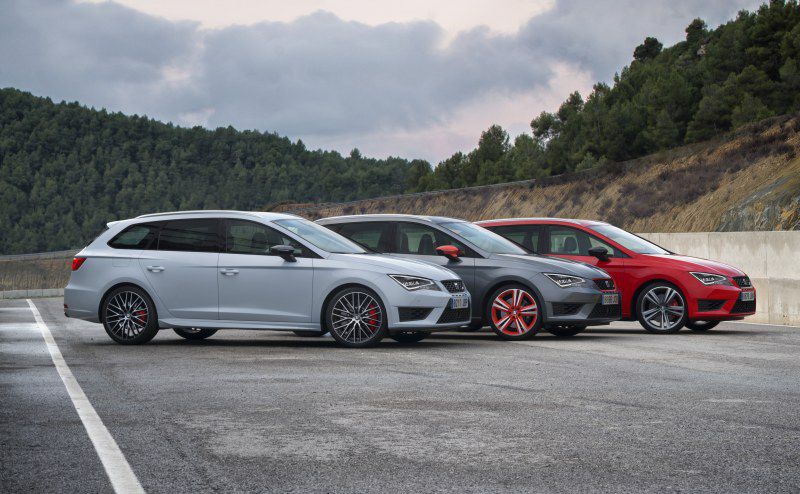
The Seat Leon III ST 1.2 TSI (86 Hp) represents a compelling entry in the European compact wagon segment, produced by the Spanish automaker Seat, a subsidiary of the Volkswagen Group. Launched in July 2014 and continuing production through 2016, this third-generation Leon, specifically in its Sport Tourer (ST) estate body style, was engineered to offer a blend of practicality, efficiency, and contemporary design to a discerning European audience. While Seat vehicles are not officially sold in the United States, understanding models like the Leon ST provides insight into the diverse automotive landscape and the specific demands of markets beyond North America, where compact, fuel-efficient wagons play a crucial role for families and individuals seeking versatility without excessive size or running costs. The 1.2 TSI variant, with its modest yet capable 86 horsepower, was positioned as an accessible and economical option within the broader Leon lineup, catering to buyers prioritizing low operating expenses and everyday usability.
The Seat Leon III ST 1.2 TSI (86 Hp): A European Compact Wagon
The Seat Leon III ST, an iteration of the popular Leon compact car, adopted the “Sport Tourer” designation to emphasize its dynamic styling alongside its enhanced utility. Built on the Volkswagen Group’s highly versatile MQB platform, shared with numerous other successful models, the Leon ST benefited from advanced engineering that allowed for a lightweight yet rigid structure, contributing to both driving dynamics and fuel efficiency. This particular 1.2 TSI (86 Hp) model was a foundational offering, designed to be the entry point for those seeking the practicality of a station wagon without the higher costs associated with more powerful engines. Its role in the European market was significant, providing a family-friendly vehicle that could navigate urban environments with ease while offering ample cargo space for longer journeys, all while adhering to stringent European emission standards. The car’s production window from 2014 to 2016 highlights its relevance during a period where automakers were increasingly focused on downsized, turbocharged engines to meet evolving fuel economy and emissions targets.
Engineering for Efficiency: The 1.2 TSI Powertrain
At the heart of the Seat Leon III ST 1.2 TSI (86 Hp) lies a sophisticated, downsized gasoline engine that exemplifies modern European powertrain philosophy. This 1.2-liter (1197 cm3 or 73.05 cu. in.) inline-four cylinder engine, designated by codes such as CJZB or CYVA, features direct fuel injection and forced induction via a turbocharger and intercooler. This configuration allows the relatively small displacement engine to produce a respectable 86 horsepower, delivered across a broad range from 4300 to 5300 rpm. More importantly for everyday driving, it generates a robust 118.01 lb.-ft. of torque (160 Nm) available from a remarkably low 1400 rpm and sustained up to 3500 rpm. This wide torque band is crucial for responsive acceleration in city traffic and relaxed cruising on highways, mitigating the typical lag associated with smaller engines.
Power is efficiently transferred to the front wheels through a 5-speed manual transmission, a common and reliable setup for vehicles in this segment. Despite its modest power output, the Leon ST 1.2 TSI achieves a 0-60 mph acceleration time of 11.5 seconds, with a top speed of 110.6 mph (178 km/h). While not designed for outright speed, these figures underscore its capability for daily commuting and family travel. A core strength of this powertrain is its exceptional fuel economy. The combined cycle rating stands at an impressive 45.2 US mpg (5.2 l/100 km), with extra-urban driving yielding up to 53.5 US mpg (4.4 l/100 km). This efficiency is complemented by low CO2 emissions of 119 g/km, allowing it to meet the stringent Euro 6 emission standard, a key selling point in environmentally conscious European markets. The engine’s design, including a 10.5:1 compression ratio and four valves per cylinder, optimizes combustion for both power and efficiency, requiring 4 liters (4.23 US qt) of engine oil and 8 liters (8.45 US qt) of coolant for optimal operation.
Design, Practicality, and Features
The Seat Leon III ST distinguishes itself with a sleek, athletic design that belies its station wagon practicality. Its “Sport Tourer” moniker is earned through sharp lines, a dynamic profile, and a cohesive aesthetic that integrates the extended rear section seamlessly. Measuring 178.54 inches (4535 mm) in length, 71.5 inches (1816 mm) in width, and 57.13 inches (1451 mm) in height, with a wheelbase of 103.78 inches (2636 mm), the Leon ST strikes an excellent balance between exterior compactness and interior spaciousness. The five-door, five-seat configuration provides easy access and comfortable accommodation for occupants, making it an ideal family vehicle.
The true highlight of the station wagon body type is its cargo capacity. The Leon ST offers a substantial minimum trunk space of 20.73 cu. ft. (587 liters), which expands dramatically to an impressive 51.91 cu. ft. (1470 liters) with the rear seats folded down. This cavernous load area makes it highly versatile for everything from grocery runs to transporting luggage for vacations or sports equipment. The vehicle’s kerb weight of 2718.3 lbs (1233 kg) and a maximum load capacity of 1250.02 lbs (567 kg) further underscore its utility. In terms of safety and driving aids, the Leon ST 1.2 TSI (86 Hp) comes equipped with essential systems such as ABS (Anti-lock braking system), providing critical stability during braking. The steering system utilizes a precise rack and pinion setup, contributing to responsive handling and a confident driving experience, characteristic of vehicles built on the MQB platform. The design ethos of the Leon ST successfully marries aesthetic appeal with functional requirements, making it a highly competitive offering in its segment.
Driving Dynamics and Market Position
The driving experience of the Seat Leon III ST 1.2 TSI (86 Hp) is characterized by a balanced approach to comfort and agility, typical of its Volkswagen Group underpinnings. The front-wheel-drive architecture, combined with well-tuned suspension (front track 60.98 in, rear track 59.84 in), provides stable and predictable handling. While the 86 HP engine prioritizes efficiency over outright performance, the vehicle’s relatively low weight-to-power ratio of 14.3 kg/Hp (69.7 Hp/tonne) and weight-to-torque ratio of 7.7 kg/Nm (129.8 Nm/tonne) ensure it feels adequately spirited for daily driving tasks. The manual transmission offers an engaging driving experience, allowing the driver to maximize the engine’s power band.
In the highly competitive European compact segment, the Leon ST 1.2 TSI carved out a distinct niche. It appealed to buyers who appreciated Seat’s more youthful and sporty brand image compared to its Volkswagen siblings, while still benefiting from the robust engineering and reliability of the VW Group. Its combination of stylish wagon aesthetics, impressive fuel economy, practical cargo space, and competitive pricing made it a strong contender against rivals. For families, small businesses, or individuals requiring versatility without the bulk or expense of larger vehicles, the Leon III ST 1.2 TSI (86 Hp) presented a compelling package, embodying the modern European ideal of a practical, efficient, and enjoyable compact station wagon.
Technical Specifications: Seat Leon III ST 1.2 TSI (86 Hp)
| Brand | Seat |
| Model | Leon |
| Generation | Leon III ST |
| Type (Engine) | 1.2 TSI (86 Hp) |
| Start of production | July, 2014 year |
| End of production | 2016 year |
| Powertrain Architecture | Internal Combustion engine |
| Body type | Station wagon (estate) |
| Seats | 5 |
| Doors | 5 |
| Fuel consumption (economy) – urban | 6.5 l/100 km (36.2 US mpg) |
| Fuel consumption (economy) – extra urban | 4.4 l/100 km (53.5 US mpg) |
| Fuel consumption (economy) – combined | 5.2 l/100 km (45.2 US mpg) |
| CO2 emissions | 119 g/km |
| Fuel Type | Petrol (Gasoline) |
| Acceleration 0 – 60 mph | 11.5 sec |
| Acceleration 0 – 100 km/h | 12.1 sec |
| Maximum speed | 178 km/h (110.6 mph) |
| Emission standard | Euro 6 |
| Weight-to-power ratio | 14.3 kg/Hp (69.7 Hp/tonne) |
| Weight-to-torque ratio | 7.7 kg/Nm (129.8 Nm/tonne) |
| Power | 86 Hp @ 4300-5300 rpm |
| Power per litre | 71.8 Hp/l |
| Torque | 160 Nm @ 1400-3500 rpm (118.01 lb.-ft.) |
| Engine layout | Front, Transverse |
| Engine Model/Code | CJZB, CYVA |
| Engine displacement | 1197 cm3 (73.05 cu. in.) |
| Number of cylinders | 4 |
| Engine configuration | Inline |
| Cylinder Bore | 71 mm (2.8 in.) |
| Piston Stroke | 75.6 mm (2.98 in.) |
| Compression ratio | 10.5:1 |
| Number of valves per cylinder | 4 |
| Fuel injection system | Direct injection |
| Engine aspiration | Turbocharger, Intercooler |
| Engine oil capacity | 4 l (4.23 US qt) |
| Coolant | 8 l (8.45 US qt) |
| Kerb Weight | 1233 kg (2718.3 lbs.) |
| Max. weight | 1800 kg (3968.32 lbs.) |
| Max load | 567 kg (1250.02 lbs.) |
| Trunk (boot) space – minimum | 587 l (20.73 cu. ft.) |
| Trunk (boot) space – maximum | 1470 l (51.91 cu. ft.) |
| Length | 4535 mm (178.54 in.) |
| Width | 1816 mm (71.5 in.) |
| Height | 1451 mm (57.13 in.) |
| Wheelbase | 2636 mm (103.78 in.) |
| Front track | 1549 mm (60.98 in.) |
| Rear (Back) track | 1520 mm (59.84 in.) |
| Drivetrain Architecture | The Internal combustion engine (ICE) drives the front wheels of the vehicle. |
| Drive wheel | Front wheel drive |
| Number of gears and type of gearbox | 5 gears, manual transmission |
| Assisting systems | ABS (Anti-lock braking system) |
| Steering type | Steering rack and pinion |