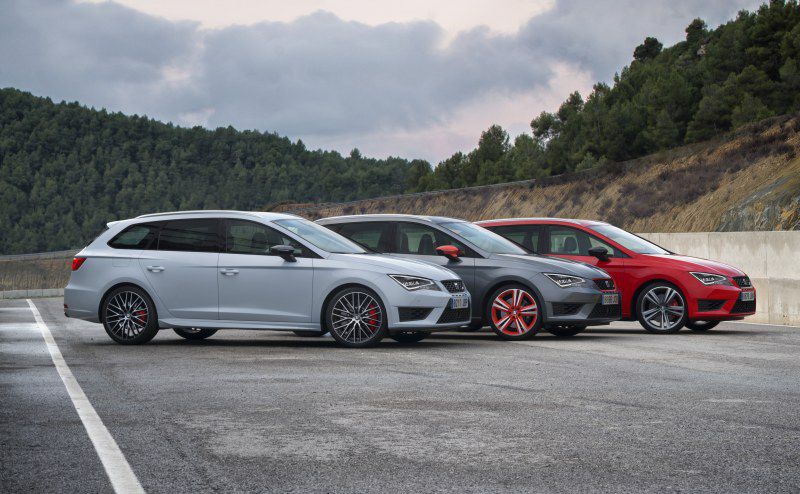
The Seat Leon III ST Cupra 2.0 TSI (290 Hp) start/stop, produced between 2015 and 2016, represents a compelling blend of high-performance driving dynamics and practical utility within the European compact segment. As a product of SEAT, a Spanish automaker under the Volkswagen Group umbrella, this vehicle was primarily marketed in Europe, where it carved out a niche as a potent “hot wagon” or “performance estate.” Unlike its American counterparts, SEAT vehicles are not officially sold in the United States, making the Leon Cupra a distinctive European offering. The third generation Leon, particularly in its Sport Tourer (ST) guise with the formidable Cupra engine, showcased SEAT’s commitment to delivering an engaging driving experience without sacrificing everyday usability. It combined the sharp styling and agile handling characteristic of the Leon range with a powerful turbocharged engine, making it a highly desirable option for enthusiasts seeking both thrills and ample cargo space.
The Seat Leon III ST Cupra 2.0 TSI (290 Hp) start/stop: A European Performance Icon
The “Cupra” designation has long been synonymous with SEAT’s highest-performing models, akin to Volkswagen’s GTI or R lines. The Leon III ST Cupra 2.0 TSI (290 Hp) start/stop continued this tradition, offering a potent powertrain and a performance-tuned chassis within a practical station wagon body. This specific variant, produced for a brief but impactful period from 2015 to 2016, refined the already impressive third-generation Leon Cupra by offering a slight power bump to 290 horsepower. Its role in the European market was significant, providing a more affordable yet equally thrilling alternative to premium German performance wagons. The “ST” suffix, denoting Sport Tourer, highlighted its versatility, making it suitable for families or individuals needing substantial cargo capacity without compromising on driving excitement. The vehicle’s design language, characterized by sharp lines and an athletic stance, further emphasized its sporty credentials, differentiating it from more mundane compact station wagons.
Powertrain and Dynamic Performance
Engine Architecture and Output
At the heart of the 2015-2016 Seat Leon III ST Cupra 2.0 TSI (290 Hp) start/stop was a highly acclaimed 2.0-liter turbocharged inline-four engine, designated EA888 / CJXH. This powerplant, renowned for its robust design and tunability, featured a sophisticated DOHC (Double Overhead Camshaft) valvetrain with four valves per cylinder, totaling 16 valves. Its advanced fuel injection system combined both direct injection and multi-port manifold injection, optimizing fuel delivery across various engine loads for enhanced power and efficiency. A single turbocharger, complemented by an intercooler, ensured a consistent supply of dense air to the engine, contributing to its impressive output. The engine delivered a formidable 290 horsepower, peaking across a broad range from 5900 to 6400 rpm. Equally impressive was its torque output of 258.15 lb.-ft., available from a remarkably low 1700 rpm and sustained up to 5800 rpm. This wide torque band provided exceptional responsiveness and strong acceleration across the rev range. With an engine displacement of 121.07 cubic inches (1984 cm3) and a compression ratio of 9.3:1, the engine achieved a power per liter figure of 146.2 Hp/l, showcasing its high specific output. The inclusion of a Start & Stop System further contributed to fuel efficiency by automatically shutting off the engine during brief stops, restarting seamlessly when the driver is ready to proceed. The engine oil capacity stood at 6.02 US quarts, with a coolant capacity of 10.57 US quarts.
Acceleration and Fuel Economy
The performance figures for the Seat Leon III ST Cupra 2.0 TSI (290 Hp) start/stop underscore its “hot wagon” credentials. It could sprint from 0 to 60 mph in a swift 5.7 seconds, with the 0 to 100 km/h (0-62 mph) benchmark achieved in 6 seconds. The top speed was electronically limited to 155.34 mph (250 km/h), a common practice for performance vehicles in Europe. Despite its impressive performance, the vehicle also demonstrated commendable fuel economy, particularly for its power level. Utilizing gasoline (petrol) as its fuel type, the combined NEDC fuel consumption was rated at 34.6 US mpg (6.8 l/100 km). Urban driving yielded 26.4 US mpg (8.9 l/100 km), while extra-urban cruising improved to 42 US mpg (5.6 l/100 km). Carbon dioxide emissions were 158 g/km, adhering to the stringent Euro 6 emission standard, reflecting SEAT’s commitment to environmental considerations alongside performance. The vehicle’s weight-to-power ratio of 4.7 kg/Hp (212.5 Hp/tonne) and weight-to-torque ratio of 3.9 kg/Nm (256.4 Nm/tonne) further illustrate its favorable power-to-weight distribution, enabling its brisk acceleration and dynamic capabilities.
Design, Ergonomics, and Practicality
Exterior Design and Dimensions
The Seat Leon III ST Cupra 2.0 TSI (290 Hp) start/stop presented a sleek and athletic aesthetic, characteristic of SEAT’s design language during this period. As a station wagon (estate) with five doors and seating for five occupants, it balanced sporting intent with family-friendly practicality. Its dimensions were well-proportioned for the compact segment: a length of 178.86 inches (4543 mm), a width of 71.5 inches (1816 mm), and a height of 56.34 inches (1431 mm). The wheelbase measured 103.58 inches (2631 mm), contributing to both interior space and stable handling. The front track was 60.47 inches (1536 mm), and the rear track was 59.45 inches (1510 mm). The Cupra trim added distinctive styling cues, including larger air intakes, specific bumpers, and unique alloy wheel designs, available in sizes 7.5J x 18 with 225/40 R18 tires or 8J x 19 with 235/35 R19 tires, enhancing both its visual appeal and road presence. The overall design was purposeful, conveying both speed and functionality.
Interior and Cargo Versatility
The interior of the Leon III ST Cupra was designed to be both driver-focused and passenger-friendly. While specific interior features are not detailed in the provided data, SEAT typically equipped its Cupra models with sport seats, a flat-bottom steering wheel, and premium materials to enhance the driving experience. The true highlight of the ST body style, however, was its exceptional cargo versatility. The trunk (boot) space offered a generous minimum of 20.73 cubic feet (587 liters), which could be expanded dramatically to a maximum of 51.91 cubic feet (1470 liters) with the rear seats folded down. This expansive load area made the Cupra ST a highly practical vehicle for hauling luggage, sports equipment, or groceries, effectively combining the performance of a hot hatch with the utility of a larger family car. The kerb weight of the vehicle was 3009.31 lbs. (1365 kg), with a maximum permissible weight of 4343.11 lbs. (1970 kg), allowing for a maximum load of 1333.8 lbs. (605 kg). The fuel tank capacity was 13.21 US gallons (50 liters), providing a decent range between fill-ups, while a maximum roof load of 165.35 lbs. (75 kg) added further versatility for carrying additional gear.
Chassis, Handling, and Safety
Suspension and Braking Systems
The driving dynamics of the Seat Leon III ST Cupra 2.0 TSI (290 Hp) start/stop were significantly enhanced by its well-engineered chassis and suspension setup. The powertrain architecture featured an internal combustion engine driving the front wheels, making it a front-wheel-drive vehicle. Power was transmitted through a precise 6-speed manual transmission, offering an engaging and direct connection between driver and machine. The suspension system was fully independent, a crucial factor for superior ride comfort and handling. At the front, it utilized a McPherson strut design with coil springs and an anti-roll bar, providing excellent body control and steering response. The rear featured an independent multi-link spring suspension, also equipped with a stabilizer bar, which is superior to simpler torsion beam setups often found in compact cars, especially for maintaining wheel alignment and grip during cornering. Braking performance was equally robust, with ventilated discs at both the front and rear axles, ensuring strong, fade-resistant stopping power crucial for a performance vehicle. An Anti-lock Braking System (ABS) was standard, enhancing safety by preventing wheel lock-up during hard braking. The steering system was a rack and pinion type, complemented by electric power steering, which offered precise control and variable assistance, adapting to different driving speeds for optimal feel.
Driving Dynamics
The combination of a powerful engine, a sophisticated independent suspension system, and a precise manual gearbox made the Seat Leon III ST Cupra 2.0 TSI (290 Hp) start/stop a highly engaging vehicle to drive. Its front-wheel-drive layout, coupled with an advanced chassis, allowed for agile handling and responsive cornering, making it a favorite among enthusiasts. The minimum turning circle of 34.45 feet (10.5 meters) indicated good maneuverability for its size, an advantage in urban environments. The Cupra’s dynamic capabilities were further refined by SEAT’s attention to detail in suspension tuning, which provided a firm yet compliant ride, capable of absorbing road imperfections while maintaining composure during spirited driving. This balance of performance and comfort, combined with the practicality of a station wagon body, cemented its reputation as a versatile and exciting choice in the European performance car market.
Technical Specifications
| Brand | Seat |
| Model | Leon |
| Generation | Leon III ST |
| Type (Engine) | Cupra 2.0 TSI (290 Hp) start/stop |
| Start of production | 2015 year |
| End of production | 2016 year |
| Powertrain Architecture | Internal Combustion engine |
| Body type | Station wagon (estate) |
| Seats | 5 |
| Doors | 5 |
| Fuel consumption (economy) – urban (NEDC) | 8.9 l/100 km (26.4 US mpg) |
| Fuel consumption (economy) – extra urban (NEDC) | 5.6 l/100 km (42 US mpg) |
| Fuel consumption (economy) – combined (NEDC) | 6.8 l/100 km (34.6 US mpg) |
| CO2 emissions (NEDC) | 158 g/km |
| Fuel Type | Petrol (Gasoline) |
| Acceleration 0 – 60 mph | 5.7 sec |
| Acceleration 0 – 100 km/h | 6 sec |
| Maximum speed | 250 km/h (155.34 mph), Electronically limited |
| Emission standard | Euro 6 |
| Weight-to-power ratio | 4.7 kg/Hp (212.5 Hp/tonne) |
| Weight-to-torque ratio | 3.9 kg/Nm (256.4 Nm/tonne) |
| Power | 290 Hp @ 5900-6400 rpm |
| Power per liter | 146.2 Hp/l |
| Torque | 350 Nm (258.15 lb.-ft.) @ 1700-5800 rpm |
| Engine layout | Front, Transverse |
| Engine Model/Code | EA888 / CJXH |
| Engine displacement | 1984 cm3 (121.07 cu. in.) |
| Number of cylinders | 4 |
| Engine configuration | Inline |
| Cylinder Bore | 82.5 mm (3.25 in.) |
| Piston Stroke | 92.8 mm (3.65 in.) |
| Compression ratio | 9.3:1 |
| Number of valves per cylinder | 4 |
| Fuel injection system | Direct injection and Multi-port manifold injection |
| Engine aspiration | Turbocharger, Intercooler |
| Valvetrain | DOHC |
| Engine oil capacity | 5.7 l (6.02 US qt) |
| Coolant | 10 l (10.57 US qt) |
| Engine systems | Start & Stop System |
| Kerb Weight | 1365 kg (3009.31 lbs.) |
| Max. weight | 1970 kg (4343.11 lbs.) |
| Max load | 605 kg (1333.8 lbs.) |
| Trunk (boot) space – minimum | 587 l (20.73 cu. ft.) |
| Trunk (boot) space – maximum | 1470 l (51.91 cu. ft.) |
| Fuel tank capacity | 50 l (13.21 US gal) |
| Max. roof load | 75 kg (165.35 lbs.) |
| Length | 4543 mm (178.86 in.) |
| Width | 1816 mm (71.5 in.) |
| Width including mirrors | 1975 mm (77.76 in.) |
| Height | 1431 mm (56.34 in.) |
| Wheelbase | 2631 mm (103.58 in.) |
| Front track | 1536 mm (60.47 in.) |
| Rear (Back) track | 1510 mm (59.45 in.) |
| Minimum turning circle (turning diameter) | 10.5 m (34.45 ft.) |
| Drivetrain Architecture | Internal combustion engine drives front wheels |
| Drive wheel | Front wheel drive |
| Number of gears and type of gearbox | 6 gears, manual transmission |
| Front suspension | Independent, type McPherson with coil spring and anti-roll bar |
| Rear suspension | Independent multi-link spring suspension with stabilizer |
| Front brakes | Ventilated discs |
| Rear brakes | Ventilated discs |
| Assisting systems | ABS (Anti-lock braking system) |
| Steering type | Steering rack and pinion |
| Power steering | Electric Steering |
| Tires size | 225/40 R18; 235/35 R19 |
| Wheel rims size | 7.5J x 18; 8J x 19 |