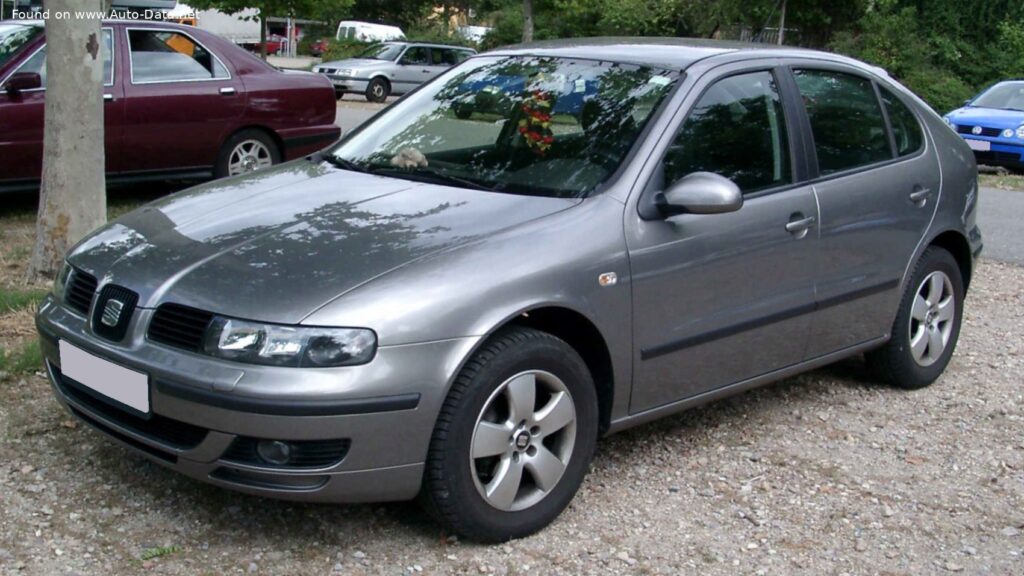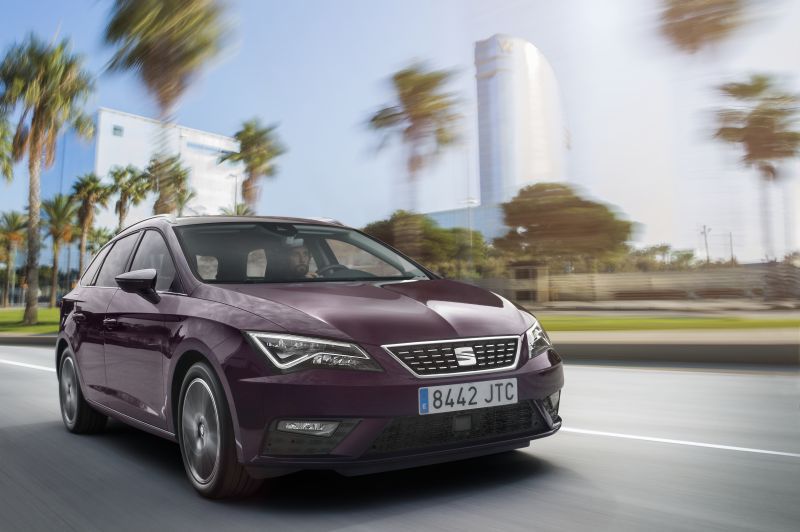
The Seat Leon III ST (facelift 2016) 1.4 TGI (110 Hp) CNG represents a compelling blend of practicality, efficiency, and contemporary design within the European compact segment. As a product of the Spanish automotive brand SEAT, a member of the Volkswagen Group, this particular variant of the third-generation Leon Sport Tourer (ST) received a significant refresh in 2016, enhancing its appeal in a highly competitive market. Unlike many vehicles prominently featured in the North American market, SEAT models, including the Leon, are primarily targeted at European and other international markets, where they are known for their sporty character, modern aesthetics, and value proposition. This specific model, with its TGI designation, stands out due to its innovative dual-fuel powertrain, capable of running on both gasoline and Compressed Natural Gas (CNG), catering to a growing demand for environmentally conscious and cost-effective transportation solutions.
The Seat Leon III ST (facelift 2016) 1.4 TGI (110 Hp) CNG: A European Eco-Wagon
First introduced in 2012, the third generation of the SEAT Leon built upon the success of its predecessors, offering a more refined driving experience and a sharper design language. The 2016 facelift brought subtle yet impactful updates, including revised styling cues, enhanced interior materials, and updated technology features, keeping the Leon fresh against rivals. The Sport Tourer (ST) body style, a station wagon or estate as it’s known in Europe, underscores the vehicle’s commitment to versatility and family utility. With five doors and seating for five occupants, it provides ample space for passengers and cargo, making it a popular choice for those requiring more capacity than a traditional hatchback without the larger footprint of an SUV. The 1.4 TGI variant, produced from 2016 to 2018, was a strategic offering designed to capitalize on the increasing interest in alternative fuels, particularly CNG, which often boasts lower emissions and reduced running costs compared to conventional gasoline or diesel.
Engine and Performance Characteristics
At the heart of the Seat Leon III ST (facelift 2016) 1.4 TGI (110 Hp) CNG lies a sophisticated 1.4-liter (1395 cm3 or 85.13 cu. in.) inline-four engine, a prime example of modern powertrain engineering from the Volkswagen Group. This engine, with codes like CPWA or CZBA, features a front, transverse layout and is equipped with a turbocharger and direct injection fuel system, ensuring efficient combustion and robust performance. It delivers a respectable 110 horsepower, available across a broad rev range from 4800 to 6000 rpm, providing flexible power delivery suitable for both city driving and highway cruising. Torque output is equally impressive for its displacement, generating 200 Newton-meters (147.51 lb.-ft.) between 1500 and 3500 rpm. This wide torque band contributes significantly to the vehicle’s drivability, allowing for strong acceleration from low speeds and minimizing the need for frequent gear changes.
The dual-fuel capability is a defining characteristic of the TGI engine. While it can run on conventional gasoline, its primary design intent is optimized for Compressed Natural Gas (CNG). This allows drivers to switch between fuels, offering flexibility depending on availability and cost. Performance figures reflect a balanced approach: the Leon 1.4 TGI accelerates from 0 to 60 miles per hour in approximately 10.5 seconds, with a top speed of 120.55 mph (194 km/h). These figures position it as a capable, rather than overtly sporty, performer, perfectly aligned with its role as a practical family vehicle. Fuel economy is a strong suit, particularly when operating on CNG, which records CO2 emissions as low as 96 g/km, meeting the stringent Euro 6 emission standard. On gasoline, combined fuel consumption is rated at 44.4 US mpg (5.3 l/100 km), while on CNG, it consumes 5.4 kg/100 km, highlighting the efficiency benefits of natural gas. The powertrain architecture is front-wheel drive, paired with a smooth-shifting 6-speed manual transmission, providing an engaging driving experience typical of European compacts.
Design, Features, and Practicality
The design of the Seat Leon III ST (facelift 2016) 1.4 TGI (110 Hp) CNG is characterized by SEAT’s distinctive “dynamic line” philosophy, blending sharp creases, taut surfaces, and a purposeful stance. The facelift in 2016 refined these elements, introducing subtle changes to the grille, bumpers, and lighting signatures, giving the car a more modern and assertive look. As a station wagon, its dimensions are optimized for practicality: measuring 179.09 inches (4549 mm) in length, 71.5 inches (1816 mm) in width, and 57.24 inches (1454 mm) in height, with a wheelbase of 103.78 inches (2636 mm). These proportions contribute to a spacious cabin and a substantial cargo area. The minimum trunk space stands at 17.02 cubic feet (482 liters), which is highly competitive for its class, offering ample room for luggage, groceries, or sports equipment. The vehicle’s kerb weight is 2910.1 lbs (1320 kg), with a maximum permissible weight of 4122.64 lbs (1870 kg), allowing for a maximum load of 1212.54 lbs (550 kg).
Underneath, the Leon ST employs a robust chassis designed for comfort and confident handling. The front suspension features an independent McPherson strut setup with coil springs and an anti-roll bar, while the rear utilizes a semi-independent coil spring system, striking a balance between ride comfort and dynamic stability. Braking is handled by ventilated discs at the front and solid discs at the rear, complemented by an Anti-lock Braking System (ABS) for enhanced safety and control during emergency stops. The electric power steering system, with a rack and pinion setup, provides precise feedback and light effort at low speeds, aiding maneuverability, especially in urban environments, as evidenced by its tight turning circle of 33.79 feet (10.3 meters). Various tire and wheel size options, ranging from 15-inch to 18-inch, allow for customization in terms of aesthetics and driving dynamics. The fuel tank capacity for gasoline is 13.21 US gallons (50 liters), supplemented by a 15 kg CNG cylinder, ensuring a substantial combined range for long journeys. The ability to tow a braked trailer up to 3086.47 lbs (1400 kg) further underscores its utility, making the Leon ST TGI a versatile and highly capable vehicle for the European market.
Technical Specifications: Seat Leon III ST (facelift 2016) 1.4 TGI (110 Hp) CNG
| Brand | Seat |
| Model | Leon |
| Generation | Leon III ST (facelift 2016) |
| Type (Engine) | 1.4 TGI (110 Hp) CNG |
| Start of production | 2016 year |
| End of production | 2018 year |
| Powertrain Architecture | Internal Combustion engine |
| Body type | Station wagon (estate) |
| Seats | 5 |
| Doors | 5 |
| Fuel consumption (economy) – combined (Petrol) | 5.3 l/100 km (44.4 US mpg / 53.3 UK mpg) |
| Fuel consumption (economy) – combined (CNG) | 5.4 kg/100 km |
| CO2 emissions (Petrol) | 124 g/km |
| CO2 emissions (CNG) | 96 g/km |
| Fuel Type | Petrol / CNG |
| Acceleration 0 – 60 mph | 10.5 sec |
| Maximum speed | 120.55 mph (194 km/h) |
| Emission standard | Euro 6 |
| Weight-to-power ratio | 12 kg/Hp, 83.3 Hp/tonne |
| Weight-to-torque ratio | 6.6 kg/Nm, 151.5 Nm/tonne |
| Power | 110 Hp @ 4800-6000 rpm |
| Power per liter | 78.9 Hp/l |
| Torque | 200 Nm (147.51 lb.-ft.) @ 1500-3500 rpm |
| Engine layout | Front, Transverse |
| Engine Model/Code | CPWA, CZBA |
| Engine displacement | 1395 cm3 (85.13 cu. in.) |
| Number of cylinders | 4 |
| Engine configuration | Inline |
| Cylinder Bore | 74.5 mm (2.93 in.) |
| Piston Stroke | 80 mm (3.15 in.) |
| Compression ratio | 10.5:1 |
| Number of valves per cylinder | 4 |
| Fuel injection system | Direct injection |
| Engine aspiration | Turbocharger |
| Engine oil capacity | 4 l (4.23 US qt / 3.52 UK qt) |
| Coolant | 8 l (8.45 US qt / 7.04 UK qt) |
| Kerb Weight | 1320 kg (2910.1 lbs) |
| Max. weight | 1870 kg (4122.64 lbs) |
| Max load | 550 kg (1212.54 lbs) |
| Trunk (boot) space – minimum | 482 l (17.02 cu. ft.) |
| Fuel tank capacity (Petrol) | 50 l (13.21 US gal / 11 UK gal) |
| CNG cylinder capacity | 15 kg |
| Permitted trailer load with brakes (12%) | 1400 kg (3086.47 lbs) |
| Length | 4549 mm (179.09 in.) |
| Width | 1816 mm (71.5 in.) |
| Height | 1454 mm (57.24 in.) |
| Wheelbase | 2636 mm (103.78 in.) |
| Front track | 1534-1549 mm (60.39 – 60.98 in.) |
| Rear (Back) track | 1508-1520 mm (59.37 – 59.84 in.) |
| Minimum turning circle (turning diameter) | 10.3 m (33.79 ft.) |
| Drivetrain Architecture | The Internal combustion engine (ICE) drives the front wheels of the vehicle. |
| Drive wheel | Front wheel drive |
| Number of gears and type of gearbox | 6 gears, manual transmission |
| Front suspension | Independent, type McPherson with coil spring and anti-roll bar |
| Rear suspension | Semi-independent, coil spring |
| Front brakes | Ventilated discs |
| Rear brakes | Disc |
| Assisting systems | ABS (Anti-lock braking system) |
| Steering type | Steering rack and pinion |
| Power steering | Electric Steering |
| Tires size | 195/65 R15; 205/55 R16; 225/45 R17; 225/40 R18 |
| Wheel rims size | 15; 16; 17; 18 |