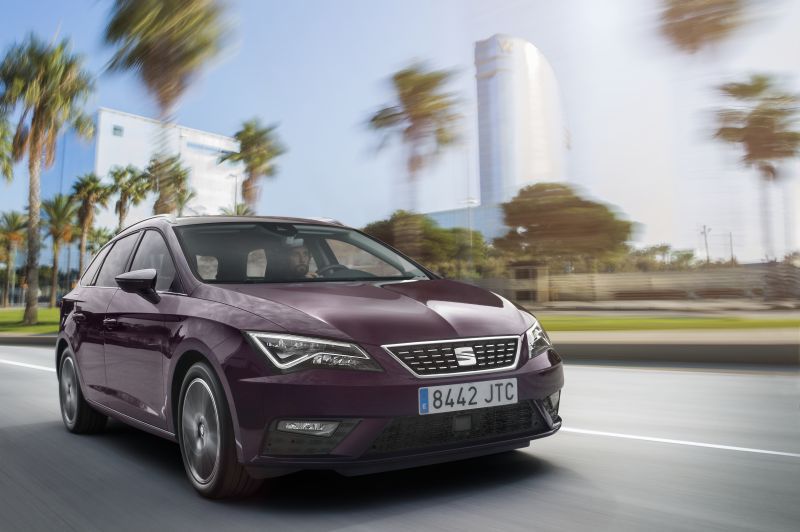
The Seat Leon III ST (facelift 2016) 1.5 EcoTSI (130 Hp) represents a compelling blend of practicality, efficiency, and dynamic styling within the highly competitive European compact segment. As a product of SEAT, the Spanish automotive manufacturer under the Volkswagen Group, the Leon is a cornerstone of the brand’s offerings, particularly popular in its home continent. This third-generation Leon, specifically the Station Wagon (Sport Tourer or ST) variant, received a significant facelift in 2016, introducing updated aesthetics, enhanced technology, and refined powertrains. The 1.5 EcoTSI engine, launched in 2018 as part of this refreshed lineup, epitomizes the modern trend towards smaller displacement, turbocharged gasoline engines designed to deliver robust performance while adhering to stringent emission standards and offering impressive fuel economy. This particular model, produced from 2018 to 2020, was engineered to cater to families and individuals seeking a versatile daily driver with ample cargo space and a spirited driving experience, a testament to SEAT’s commitment to delivering accessible yet engaging vehicles.
Engine and Performance Characteristics of the Seat Leon III ST (facelift 2016) 1.5 EcoTSI (130 Hp)
At the heart of the Seat Leon III ST (facelift 2016) 1.5 EcoTSI (130 Hp) lies a sophisticated 1.5-liter (1498 cm3 or 91.41 cu. in.) inline four-cylinder gasoline engine, designated by model codes DACA or DPBA. This powertrain exemplifies modern engine design, featuring direct fuel injection, a turbocharger, and an intercooler to optimize combustion efficiency and power delivery across a broad RPM range. The “EcoTSI” designation highlights its focus on ecological efficiency and robust performance, a balance critical for today’s automotive market. It generates a respectable 130 horsepower at 5000-6000 rpm, translating to a power-per-liter output of 86.8 horsepower, indicating a highly tuned and efficient powerplant for its size. Torque is equally impressive, peaking at 200 Nm (147.51 lb.-ft.) between a wide band of 1400-4000 rpm. This broad torque curve ensures strong acceleration and flexible driving characteristics, minimizing the need for frequent downshifts in everyday driving scenarios.
Performance figures for this front-wheel-drive station wagon are competitive for its class. The Leon ST can accelerate from 0 to 60 mph in approximately 9 seconds, with a 0 to 100 km/h sprint completed in 9.5 seconds. Its maximum speed reaches 128.62 mph (207 km/h), making it capable of comfortable highway cruising. Power is delivered to the front wheels via a precise 6-speed manual transmission, offering an engaging driving experience for those who prefer manual control. The engine’s layout is front, transverse, a common configuration for compact front-wheel-drive vehicles, optimizing packaging and weight distribution. With a compression ratio of 12.5:1 and four valves per cylinder, the engine is designed for optimal fuel atomization and combustion, further contributing to its efficiency and responsiveness.
Fuel economy is a standout feature of the 1.5 EcoTSI engine. In combined driving, the Leon ST achieves an impressive 48-46.1 US mpg (4.9-5.1 l/100 km). Urban driving sees figures of 37.3-36.2 US mpg (6.3-6.5 l/100 km), while extra-urban (highway) consumption is even more frugal at 57.4-54.7 US mpg (4.1-4.3 l/100 km). These figures underscore the engine’s advanced design, enabling drivers to cover significant distances with fewer refueling stops. Furthermore, the vehicle adheres to the stringent Euro 6 AG emission standard, with CO2 emissions ranging from 111-116 g/km, reflecting SEAT’s commitment to environmental responsibility. The inclusion of a particulate filter in the engine systems further reduces harmful emissions, aligning with modern European regulations for gasoline engines.
Design, Practicality, and Advanced Features
The Seat Leon III ST (facelift 2016) presents a modern and dynamic aesthetic, characteristic of SEAT’s design language, which often emphasizes sharp lines and a sporty stance. As a station wagon, or “estate” in European terminology, its primary appeal lies in its enhanced practicality and versatility compared to the standard hatchback. The body type features five doors and comfortable seating for five occupants, making it an ideal choice for families or individuals requiring significant cargo capacity. With a length of 179.06 inches (4548 mm), a width of 71.5 inches (1816 mm), and a height of 56.65 inches (1439 mm), the Leon ST strikes a balance between maneuverability in urban environments and stability on the open road. The wheelbase of 103.7 inches (2634 mm) contributes to a stable ride and generous interior space.
One of the most compelling aspects of the Leon ST is its cargo utility. The trunk (boot) space offers a substantial minimum of 20.73 cu. ft. (587 liters) with all seats in place, easily accommodating luggage, groceries, or sports equipment. For larger items, folding down the rear seats expands the cargo volume to an impressive 51.91 cu. ft. (1470 liters), transforming the vehicle into a highly capable hauler. This flexibility is a key differentiator for station wagons and a major advantage for the Leon ST in its segment. The kerb weight of 2654.37 lbs. (1204 kg) combined with a maximum permissible weight of 4078.55 lbs. (1850 kg) indicates a robust yet lightweight construction, contributing to both performance and efficiency. The vehicle also boasts a permitted trailer load of 1388.91 lbs. (630 kg) without brakes, adding to its utility.
The driving dynamics are further refined by a well-engineered chassis and suspension system. The front suspension utilizes an independent McPherson strut setup, known for its precise handling and comfortable ride, while the rear features a semi-independent, coil spring arrangement. This combination provides a compliant yet engaging driving experience. Braking performance is handled by ventilated discs measuring 276 mm at the front and solid discs of 253 mm at the rear, complemented by an Anti-lock Braking System (ABS) for enhanced safety and control during emergency stops. The electric power steering system, with a steering rack and pinion setup, offers precise feedback and easy maneuverability, reflected in its minimum turning circle of 33.79 feet (10.3 meters). The vehicle rides on 225/40 R18 92Y tires mounted on 7.5J x 18-inch wheel rims, providing ample grip and a sporty aesthetic.
While specific interior technology features are not detailed in the raw data, the “facelift 2016” designation suggests that this model would have incorporated contemporary infotainment systems, connectivity options, and driver-assistance technologies prevalent in its era. Modern cars of this generation typically include features such as touchscreens, smartphone integration (Apple CarPlay/Android Auto), and advanced safety systems beyond just ABS, though ABS is explicitly mentioned as an assisting system. The overall design and engineering of the Seat Leon III ST (facelift 2016) 1.5 EcoTSI (130 Hp) position it as a well-rounded and highly practical vehicle, designed to meet the demands of European consumers seeking efficiency, versatility, and a dynamic driving character.
Technical Specifications: Seat Leon III ST (facelift 2016) 1.5 EcoTSI (130 Hp)
| General information | |
| Brand | Seat |
| Model | Leon |
| Generation | Leon III ST (facelift 2016) |
| Type (Engine) | 1.5 EcoTSI (130 Hp) |
| Start of production | 2018 year |
| End of production | 2020 year |
| Powertrain Architecture | Internal Combustion engine |
| Body type | Station wagon (estate) |
| Seats | 5 |
| Doors | 5 |
| Performance specs | |
| Fuel consumption (economy) – urban | 6.3-6.5 l/100 km (37.3 – 36.2 US mpg) |
| Fuel consumption (economy) – extra urban | 4.1-4.3 l/100 km (57.4 – 54.7 US mpg) |
| Fuel consumption (economy) – combined | 4.9-5.1 l/100 km (48 – 46.1 US mpg) |
| CO2 emissions | 111-116 g/km |
| Fuel Type | Petrol (Gasoline) |
| Acceleration 0 – 100 km/h | 9.5 sec |
| Acceleration 0 – 62 mph | 9.5 sec |
| Acceleration 0 – 60 mph (Calculated) | 9 sec |
| Maximum speed | 207 km/h (128.62 mph) |
| Emission standard | Euro 6 AG |
| Weight-to-power ratio | 9.3 kg/Hp (108 Hp/tonne) |
| Weight-to-torque ratio | 6 kg/Nm (166.1 Nm/tonne) |
| Engine specs | |
| Power | 130 Hp @ 5000-6000 rpm |
| Power per litre | 86.8 Hp/l |
| Torque | 200 Nm @ 1400-4000 rpm (147.51 lb.-ft.) |
| Engine layout | Front, Transverse |
| Engine Model/Code | DACA, DPBA |
| Engine displacement | 1498 cm3 (91.41 cu. in.) |
| Number of cylinders | 4 |
| Engine configuration | Inline |
| Cylinder Bore | 74.5 mm (2.93 in.) |
| Piston Stroke | 85.9 mm (3.38 in.) |
| Compression ratio | 12.5:1 |
| Number of valves per cylinder | 4 |
| Fuel injection system | Direct injection |
| Engine aspiration | Turbocharger, Intercooler |
| Engine oil capacity | 4.3 l (4.54 US qt) |
| Coolant | 8 l (8.45 US qt) |
| Engine systems | Particulate filter |
| Space, Volume and weights | |
| Kerb Weight | 1204 kg (2654.37 lbs.) |
| Max. weight | 1850 kg (4078.55 lbs.) |
| Max load | 646 kg (1424.19 lbs.) |
| Trunk (boot) space – minimum | 587 l (20.73 cu. ft.) |
| Trunk (boot) space – maximum | 1470 l (51.91 cu. ft.) |
| Fuel tank capacity | 50 l (13.21 US gal) |
| Permitted trailer load without brakes | 630 kg (1388.91 lbs.) |
| Dimensions | |
| Length | 4548 mm (179.06 in.) |
| Width | 1816 mm (71.5 in.) |
| Width including mirrors | 1975 mm (77.76 in.) |
| Height | 1439 mm (56.65 in.) |
| Wheelbase | 2634 mm (103.7 in.) |
| Front track | 1549 mm (60.98 in.) |
| Rear (Back) track | 1520 mm (59.84 in.) |
| Minimum turning circle (turning diameter) | 10.3 m (33.79 ft.) |
| Drivetrain, brakes and suspension specs | |
| Drivetrain Architecture | The Internal combustion engine (ICE) drives the front wheels of the vehicle. |
| Drive wheel | Front wheel drive |
| Number of gears and type of gearbox | 6 gears, manual transmission |
| Front suspension | Independent type McPherson |
| Rear suspension | Semi-independent, coil spring |
| Front brakes | Ventilated discs, 276 mm |
| Rear brakes | Disc, 253 mm |
| Assisting systems | ABS (Anti-lock braking system) |
| Steering type | Steering rack and pinion |
| Power steering | Electric Steering |
| Tires size | 225/40 R18 92Y |
| Wheel rims size | 7.5J x 18 |