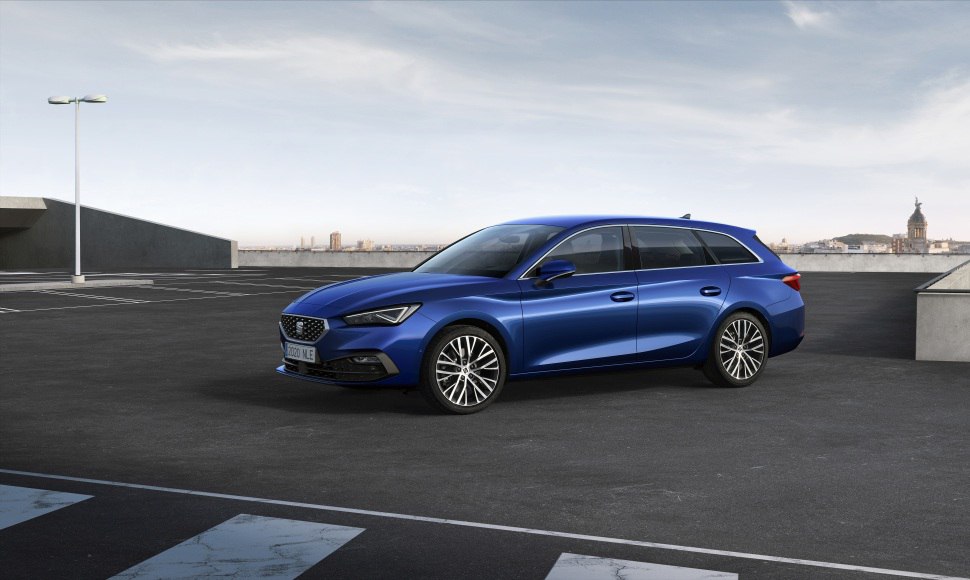
The Seat Leon IV Sportstourer 1.4 e-Hybrid is a plug-in hybrid estate car produced by the Spanish manufacturer SEAT from October 2020 to July 2024. Part of the fourth generation of the Leon, the Sportstourer body style offers increased practicality compared to the hatchback version. While SEAT vehicles are not officially sold in the United States, the Leon is a popular model in Europe, competing with vehicles like the Volkswagen Golf Estate, Skoda Octavia Combi, and Ford Focus Wagon. The 1.4 e-Hybrid variant specifically targets environmentally conscious buyers seeking a blend of fuel efficiency and performance, leveraging a combined petrol and electric powertrain.
Seat Leon IV Sportstourer 1.4 e-Hybrid: Overview
The Leon IV Sportstourer represents SEAT’s commitment to electrification and modern automotive design. The Sportstourer version expands upon the Leon’s already successful formula by providing a larger cargo area and enhanced versatility. The 1.4 e-Hybrid model is a key component of SEAT’s strategy to offer a range of electrified options, catering to increasingly stringent emissions regulations and growing consumer demand for sustainable transportation. It combines a turbocharged petrol engine with an electric motor and battery pack, allowing for both all-electric driving and extended range when needed.
Engine & Performance
The Seat Leon IV Sportstourer 1.4 e-Hybrid utilizes a 1.4-liter turbocharged inline-four cylinder petrol engine paired with an electric motor. The petrol engine produces 150 horsepower at 5000-6000 rpm and 250 Nm (184.39 lb-ft) of torque between 1550-3500 rpm. The electric motor contributes an additional 116 horsepower and 330 Nm (243.4 lb-ft) of torque. Combined, the system delivers a total output of 204 horsepower and 350 Nm (258.15 lb-ft) of torque. This power is delivered to the front wheels via a six-speed dual-clutch transmission (DSG), enabling a 0-100 km/h (0-62 mph) acceleration time of 7.7 seconds and a 0-60 mph time of 7.3 seconds. The maximum speed is electronically limited to 220 km/h (136.7 mph). The powertrain architecture is a parallel hybrid, meaning both the engine and motor can drive the wheels independently or in conjunction.
Design & Features
The Seat Leon IV Sportstourer is a five-door, five-seat station wagon (estate). Its exterior design features a sleek and modern aesthetic, characterized by sharp lines, a distinctive front grille, and full LED lighting. The Sportstourer body style provides a significantly larger cargo capacity compared to the hatchback, offering 470 liters (16.6 cu. ft.) with the rear seats up and expanding to 1600 liters (56.5 cu. ft.) with the seats folded down. The interior is designed with a focus on technology and comfort, featuring a digital cockpit with a customizable instrument cluster and a central infotainment touchscreen. Safety features include ABS, multiple airbags, and advanced driver-assistance systems (ADAS) such as lane keeping assist and adaptive cruise control, reflecting modern safety standards. The battery pack is located under the floor, beneath the rear seats, minimizing intrusion into the passenger or cargo space.
Technical Specifications
| General Information | Specifications |
| Brand | Seat |
| Model | Leon |
| Generation | Leon IV Sportstourer |
| Type (Engine) | 1.4 e-Hybrid (204 Hp) DSG |
| Start of production | October, 2020 |
| End of production | July, 2024 |
| Powertrain Architecture | PHEV (Plug-in Hybrid Electric Vehicle) |
| Body type | Station wagon (estate) |
| Seats | 5 |
| Doors | 5 |
| Performance Specs | |
| Combined fuel consumption (WLTP) | 1.1-1.2 l/100 km (213.8 – 196 US mpg, 256.8 – 235.4 UK mpg, 90.9 – 83.3 km/l) |
| CO2 emissions (WLTP) | 26-28 g/km |
| Fuel consumption (economy) – combined (NEDC) | 1.4 l/100 km (168 US mpg, 201.8 UK mpg, 71.4 km/l) |
| CO2 emissions (NEDC) | 32 g/km |
| Fuel Type | Petrol / electricity |
| Acceleration 0 – 100 km/h | 7.7 sec |
| Acceleration 0 – 62 mph | 7.7 sec |
| Acceleration 0 – 60 mph | 7.3 sec |
| Maximum speed | 220 km/h (136.7 mph) |
| Emission standard | Euro 6d-ISC-FCM |
| Weight-to-power ratio | 7.8 kg/Hp, 128.9 Hp/tonne |
| Weight-to-torque ratio | 4.5 kg/Nm, 221.1 Nm/tonne |
| Electric/Hybrid Specs | |
| Gross battery capacity | 12.8 kWh |
| Net (usable) battery capacity | 10.4 kWh |
| Battery technology | Lithium-ion (Li-Ion) |
| Battery weight | 130 kg (286.6 lbs.) |
| Battery location | Below the floor, under the rear seats |
| All-electric range (WLTP) | 58-63 km (36.04 – 39.15 mi) |
| All-electric range (NEDC) | 72 km (44.74 mi) |
| Average Energy consumption (WLTP) | 15-15.5 kWh/100 km (24.14 – 24.94 kWh/100 mi, 140 – 135 MPGe, 6.7 – 6.5 km/kWh, 4.1 – 4 mi/kWh) |
| Average Energy consumption (NEDC) | 12.3 kWh/100 km (19.79 kWh/100 mi, 170 MPGe, 8.1 km/kWh, 5.1 mi/kWh) |
| Electric motor power | 116 Hp |
| Electric motor Torque | 330 Nm (243.4 lb.-ft.) |
| Electric motor location | Between the combustion engine and the transmission |
| System power | 204 Hp |
| System torque | 350 Nm (258.15 lb.-ft.) |
| Internal Combustion Engine Specs | |
| Power | 150 Hp @ 5000-6000 rpm |
| Power per litre | 107.5 Hp/l |
| Torque | 250 Nm @ 1550-3500 rpm (184.39 lb.-ft. @ 1550-3500 rpm) |
| Engine layout | Front, Transverse |
| Engine Model/Code | DGEA |
| Engine displacement | 1395 cm3 (85.13 cu. in.) |
| Number of cylinders | 4 |
| Engine configuration | Inline |
| Cylinder Bore | 74.5 mm (2.93 in.) |
| Piston Stroke | 80 mm (3.15 in.) |
| Compression ratio | 10:1 |
| Number of valves per cylinder | 4 |
| Fuel injection system | Direct injection |
| Engine aspiration | Turbocharger, Intercooler |
| Valvetrain | DOHC |
| Space, Volume and Weights | |
| Kerb Weight | 1583 kg (3489.92 lbs.) |
| Max. weight | 2080 kg (4585.62 lbs.) |
| Max load | 497 kg (1095.7 lbs.) |
| Trunk (boot) space – minimum | 470 l (16.6 cu. ft.) |
| Trunk (boot) space – maximum | 1600 l (56.5 cu. ft.) |
| Fuel tank capacity | 40 l (10.57 US gal | 8.8 UK gal) |
| Max. roof load | 75 kg (165.35 lbs.) |
| Permitted trailer load with brakes (8%) | 1700 kg (3747.86 lbs.) |
| Permitted trailer load with brakes (12%) | 1500 kg (3306.93 lbs.) |
| Permitted trailer load without brakes | 750 kg (1653.47 lbs.) |
| Permitted towbar download | 80 kg (176.37 lbs.) |
| Dimensions | |
| Length | 4642 mm (182.76 in.) |
| Width | 1799 mm (70.83 in.) |
| Width including mirrors | 1991 mm (78.39 in.) |
| Height | 1448 mm (57.01 in.) |
| Wheelbase | 2686 mm (105.75 in.) |
| Front track | 1545 mm (60.83 in.) |
| Rear (Back) track | 1516 mm (59.69 in.) |
| Front overhang | 888 mm (34.96 in.) |
| Rear overhang | 1068 mm (42.05 in.) |
| Minimum turning circle (turning diameter) | 11.2 m (36.75 ft.) |
| Drivetrain, Brakes and Suspension | |
| Drivetrain Architecture | The Internal combustion engine (ICE) and electric motor drive the front wheels of the car with the ability to work in full electric or mixed mode. |
| Drive wheel | Front wheel drive |
| Number of gears and type of gearbox | 6 gears, automatic transmission DSG |
| Front suspension | Independent type McPherson |
| Rear suspension | Independent multi-link suspension |
| Front brakes | Ventilated discs, 312×25 mm |
| Rear brakes | Disc, 272×10 mm |