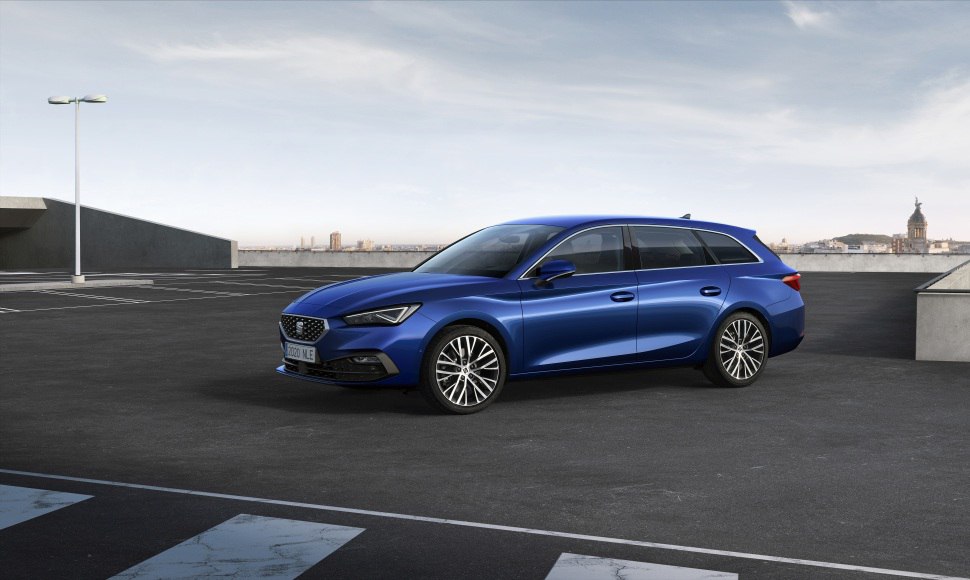
The SEAT Leon IV Sportstourer 1.5 TGI (130 Hp) DSG is a compact estate car produced by the Spanish automobile manufacturer SEAT from March 2021 to January 2023. As part of the fourth generation of the Leon, the Sportstourer body style offers increased practicality compared to the five-door hatchback, targeting families and individuals requiring additional cargo space. Notably, the “TGI” designation indicates a bi-fuel powertrain capable of running on both gasoline and Compressed Natural Gas (CNG), a feature particularly popular in European markets due to environmental incentives and established CNG infrastructure. While not officially sold in the United States, the Leon is a significant model in Europe, competing with vehicles like the Volkswagen Golf Estate, Skoda Octavia Combi, and Ford Focus Estate.
SEAT Leon IV Sportstourer 1.5 TGI: Overview
The Leon IV Sportstourer represents SEAT’s commitment to offering versatile and efficient vehicles. The 1.5 TGI variant specifically caters to environmentally conscious buyers seeking lower running costs and reduced emissions. The use of CNG allows for significantly lower CO2 output compared to traditional gasoline engines, making it an attractive option in regions with stringent emissions regulations and CNG fueling stations. The Sportstourer’s design blends practicality with a modern aesthetic, appealing to a broad demographic.
Engine & Performance
The SEAT Leon IV Sportstourer 1.5 TGI is powered by a 1.5-liter inline-four cylinder turbocharged engine. This engine produces 130 horsepower (Hp) at 5000-6000 rpm and 200 Newton-meters (147.51 lb.-ft.) of torque between 1400 and 4000 rpm. The engine features direct fuel injection and a turbocharger, optimizing both power delivery and fuel efficiency. The “TGI” system allows the vehicle to switch between gasoline and CNG, with the engine automatically managing the fuel source. This bi-fuel capability results in a combined fuel consumption of 4.1-4.3 kg/100 km (CNG) and CO2 emissions of 110-115 g/km (CNG) under WLTP testing. Acceleration from 0 to 100 km/h (0-62 mph) takes 9.9 seconds, while 0-60 mph is achieved in approximately 9.4 seconds. The vehicle has a maximum speed of 203 km/h (126.14 mph). The engine is transversely mounted at the front of the vehicle and is paired with a 7-speed Dual Clutch Gearbox (DSG) automatic transmission, providing smooth and efficient gear changes.
Design & Features
The SEAT Leon IV Sportstourer is a five-door, five-seat station wagon (estate). Its exterior design is characterized by sharp lines, a sloping roofline, and a distinctive rear light bar that extends across the width of the vehicle. The Sportstourer offers a generous 480 liters (16.95 cu. ft.) of trunk space with the rear seats up, expanding to 1460 liters (51.56 cu. ft.) when the seats are folded down. The interior features a modern dashboard layout with a digital instrument cluster and a central touchscreen infotainment system. Safety features include ABS (Anti-lock Braking System), and a comprehensive suite of driver-assistance systems, depending on the trim level. The vehicle’s suspension consists of an independent McPherson strut setup at the front and a coil spring elastic beam arrangement at the rear, providing a balance between comfort and handling. The steering utilizes an electric power steering system for ease of use and efficiency.
Technical Specifications
| Brand | Seat |
| Model | Leon |
| Generation | Leon IV Sportstourer |
| Type (Engine) | 1.5 TGI (130 Hp) DSG |
| Start of production | March, 2021 |
| End of production | January, 2023 |
| Powertrain Architecture | Internal Combustion engine |
| Body type | Station wagon (estate) |
| Seats | 5 |
| Doors | 5 |
| Combined fuel consumption (WLTP) (CNG) | 4.1-4.3 kg/100 km |
| CO2 emissions (CNG) (WLTP) | 110-115 g/km |
| Fuel consumption (economy) – urban (CNG) (NEDC, WLTP equivalent) | 4.5 kg/100 km |
| Fuel consumption (economy) – extra urban (CNG) (NEDC, WLTP equivalent) | 3.1 kg/100 km |
| Fuel consumption (economy) – combined (CNG) (NEDC, WLTP equivalent) | 3.7 kg/100 km |
| CO2 emissions (CNG) (NEDC, WLTP equivalent) | 98 g/km |
| Fuel Type | Petrol / CNG |
| Acceleration 0 – 100 km/h | 9.9 sec |
| Acceleration 0 – 62 mph | 9.9 sec |
| Acceleration 0 – 60 mph | 9.4 sec |
| Maximum speed | 203 km/h / 126.14 mph |
| Emission standard | Euro 6 AP |
| Weight-to-power ratio | 10.6 kg/Hp, 94.1 Hp/tonne |
| Weight-to-torque ratio | 6.9 kg/Nm, 144.7 Nm/tonne |
| Power | 130 Hp @ 5000-6000 rpm |
| Power per litre | 86.8 Hp/l |
| Torque | 200 Nm @ 1400-4000 rpm / 147.51 lb.-ft. @ 1400-4000 rpm |
| Engine layout | Front, Transverse |
| Engine Model/Code | DHF |
| Engine displacement | 1498 cm3 / 91.41 cu. in. |
| Number of cylinders | 4 |
| Engine configuration | Inline |
| Cylinder Bore | 74.5 mm / 2.93 in. |
| Piston Stroke | 85.9 mm / 3.38 in. |
| Compression ratio | 12.5:1 |
| Number of valves per cylinder | 4 |
| Fuel injection system | Direct injection |
| Engine aspiration | Turbocharger |
| Engine oil capacity | 4.3 l / 4.54 US qt | 3.78 UK qt |
| Coolant | 8 l / 8.45 US qt | 7.04 UK qt |
| Kerb Weight | 1382 kg / 3046.79 lbs |
| Max. weight | 1990 kg / 4387.2 lbs |
| Max load | 608 kg / 1340.41 lbs |
| Trunk (boot) space – minimum | 480 l / 16.95 cu. ft. |
| Trunk (boot) space – maximum | 1460 l / 51.56 cu. ft. |
| Fuel tank capacity | 9 l / 2.38 US gal | 1.98 UK gal |
| CNG cylinder capacity | 17.3 kg |
| Max. roof load | 75 kg / 165.35 lbs |
| Length | 4642 mm / 182.76 in. |
| Width | 1799 mm / 70.83 in. |
| Width including mirrors | 1991 mm / 78.39 in. |
| Height | 1437-1448 mm / 56.57 – 57.01 in. |
| Wheelbase | 2686 mm / 105.75 in. |
| Front overhang | 888 mm / 34.96 in. |
| Rear overhang | 1068 mm / 42.05 in. |
| Minimum turning circle (turning diameter) | 10.5 m / 34.45 ft |
| Drivetrain Architecture | The Internal combustion engine (ICE) drives the front wheels of the vehicle. |
| Drive wheel | Front wheel drive |
| Number of gears and type of gearbox | 7 gears, automatic transmission DSG |
| Front suspension | Independent type McPherson |
| Rear suspension | Coil spring, Elastic beam |
| Front brakes | Ventilated discs |
| Rear brakes | Disc |
| Assisting systems | ABS (Anti-lock braking system) |
| Steering type | Steering rack and pinion |
| Power steering | Electric Steering |
| Tires size | 205/55 R16; 225/45 R17; 225/40 R18 |
The SEAT Leon IV Sportstourer 1.5 TGI (130 Hp) DSG represents a practical and efficient option for buyers seeking a versatile estate car with reduced environmental impact, particularly within markets that support and incentivize CNG vehicle ownership.