
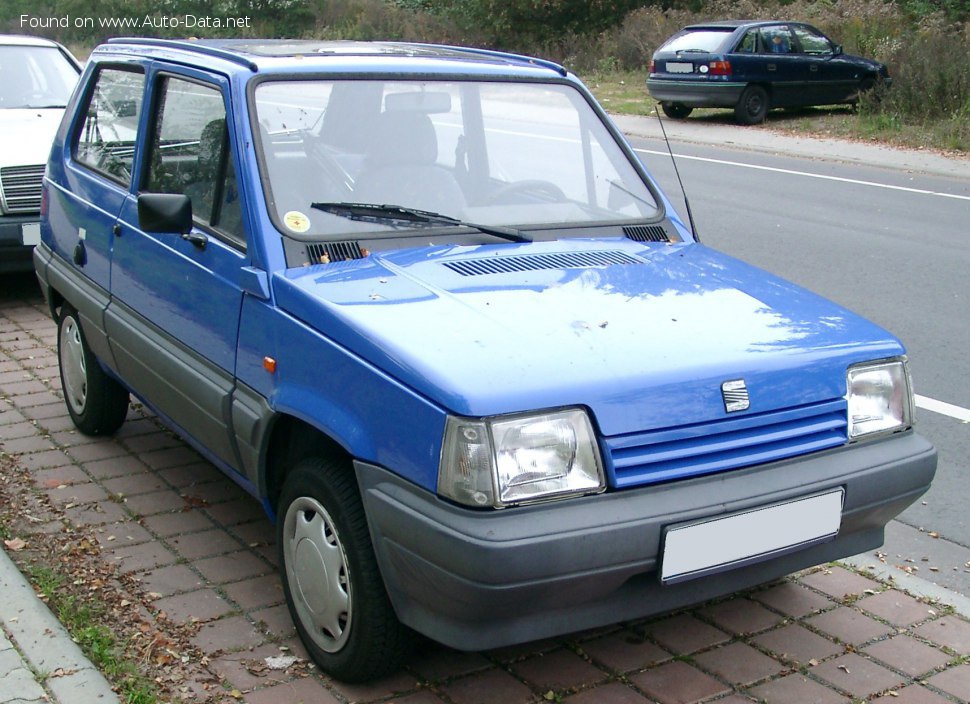
The SEAT Marbella is a city car that was produced by the Spanish automobile manufacturer SEAT from 1986 to 1993. Based on the Fiat Panda, the Marbella was intended to provide affordable transportation for the Spanish market and beyond. It represented a significant step for SEAT, which at the time was undergoing modernization under its new ownership by the Volkswagen Group. While not officially sold in the United States, the Marbella was a popular choice in Europe, particularly in Spain, Portugal, and France, offering a practical and economical solution for urban driving.
SEAT Marbella: A City Car for a Changing Europe
The Marbella emerged during a period of economic growth and increasing motorization in Europe. SEAT, seeking to expand its product range and appeal to a wider customer base, licensed the design of the Fiat Panda and adapted it to create the Marbella. This allowed SEAT to quickly enter the small car segment without significant investment in entirely new development. The Marbella quickly became a mainstay in its target markets, known for its simplicity, reliability, and low running costs.
Engine & Performance
The SEAT Marbella was primarily powered by a small, naturally aspirated 0.8-liter inline-four cylinder engine. This engine, designated 08 NCA, produced 34 horsepower at 5400 rpm and 56 Nm (41.3 lb-ft) of torque at 2800 rpm. While modest by modern standards, this powertrain was sufficient for navigating city streets and achieving reasonable fuel economy. The Marbella’s power-to-weight ratio was approximately 20 kg/Hp, and its power per liter was 40.3 Hp/l. Performance figures reflected the car’s focus on practicality rather than speed; acceleration from 0 to 100 km/h (0-62 mph) took approximately 27.5 seconds, with a top speed of 120 km/h (74.56 mph). The engine utilized a carburetor fuel injection system, common for vehicles of this era, and was mated to a four-speed manual transmission, driving the front wheels.
Design & Features
The SEAT Marbella is a three-door hatchback with a functional and utilitarian design. Its compact dimensions – 3475 mm (136.81 in) in length, 1500 mm (59.06 in) in width, and 1445 mm (56.89 in) in height – made it easy to maneuver and park in crowded urban environments. The car offered seating for five passengers, although rear space was limited. The interior was basic but durable, prioritizing practicality over luxury. The Marbella featured coil spring suspension on both the front and rear axles, providing a comfortable ride on typical city roads. Braking was handled by disc brakes at the front and drum brakes at the rear. Later models were equipped with an Anti-lock Braking System (ABS), enhancing safety. The trunk offered a minimum of 270 liters (9.53 cu. ft.) of storage space, expandable to 1090 liters (38.49 cu. ft.) with the rear seats folded down. The Marbella’s design, while simple, proved to be robust and well-suited to its intended purpose.
Technical Specifications
| Brand | SEAT |
| Model | Marbella |
| Generation | Marbella (28) |
| Type (Engine) | 0.8 (34 Hp) |
| Start of production | 1986 |
| End of production | 1993 |
| Powertrain Architecture | Internal Combustion engine |
| Body type | Hatchback |
| Seats | 5 |
| Doors | 3 |
| Fuel consumption (urban) | 7.7 l/100 km (30.5 US mpg) |
| Fuel consumption (extra urban) | 4.9 l/100 km (48 US mpg) |
| Fuel Type | Petrol (Gasoline) |
| Acceleration 0 – 100 km/h | 27.5 sec |
| Acceleration 0 – 60 mph | 26.1 sec |
| Maximum speed | 120 km/h (74.56 mph) |
| Weight-to-power ratio | 20 kg/Hp |
| Engine Model/Code | 08 NCA |
| Engine displacement | 843 cm3 (51.44 cu. in.) |
| Number of cylinders | 4 |
| Engine configuration | Inline |
| Cylinder Bore | 65 mm (2.56 in.) |
| Piston Stroke | 63.5 mm (2.5 in.) |
| Compression ratio | 8.5:1 |
| Number of valves per cylinder | 2 |
| Fuel injection system | Carburettor |
| Engine oil capacity | 4 l (4.23 US qt | 3.52 UK qt) |
| Coolant capacity | 5.2 l (5.49 US qt | 4.58 UK qt) |
| Kerb Weight | 680 kg (1499.14 lbs.) |
| Max. weight | 1150 kg (2535.32 lbs.) |
| Max load | 470 kg (1036.17 lbs.) |
| Trunk (boot) space – minimum | 270 l (9.53 cu. ft.) |
| Trunk (boot) space – maximum | 1090 l (38.49 cu. ft.) |
| Fuel tank capacity | 35 l (9.25 US gal | 7.7 UK gal) |
| Length | 3475 mm (136.81 in.) |
| Width | 1500 mm (59.06 in.) |
| Height | 1445 mm (56.89 in.) |
| Wheelbase | 2160 mm (85.04 in.) |
| Front track | 1255 mm (49.41 in.) |
| Rear track | 1250 mm (49.21 in.) |
| Minimum turning circle | 9.6 m (31.5 ft.) |
| Drivetrain Architecture | Front wheel drive |
| Number of gears | 4 gears, manual transmission |
| Front suspension | Coil spring |
| Rear suspension | Coil spring |
| Front brakes | Disc |
| Rear brakes | Drum |
| Assisting systems | ABS (Anti-lock braking system) |
| Steering type | Steering rack and pinion |
| Tires size | 145/70 SR13 |
The SEAT Marbella, though a relatively simple vehicle, played an important role in providing affordable and reliable transportation to a wide range of European drivers. Its legacy lies in its practicality, efficiency, and its contribution to SEAT’s growth as a major automotive manufacturer. While never sold in the US market, the Marbella remains a fondly remembered example of 1980s and early 1990s European city car design.
