
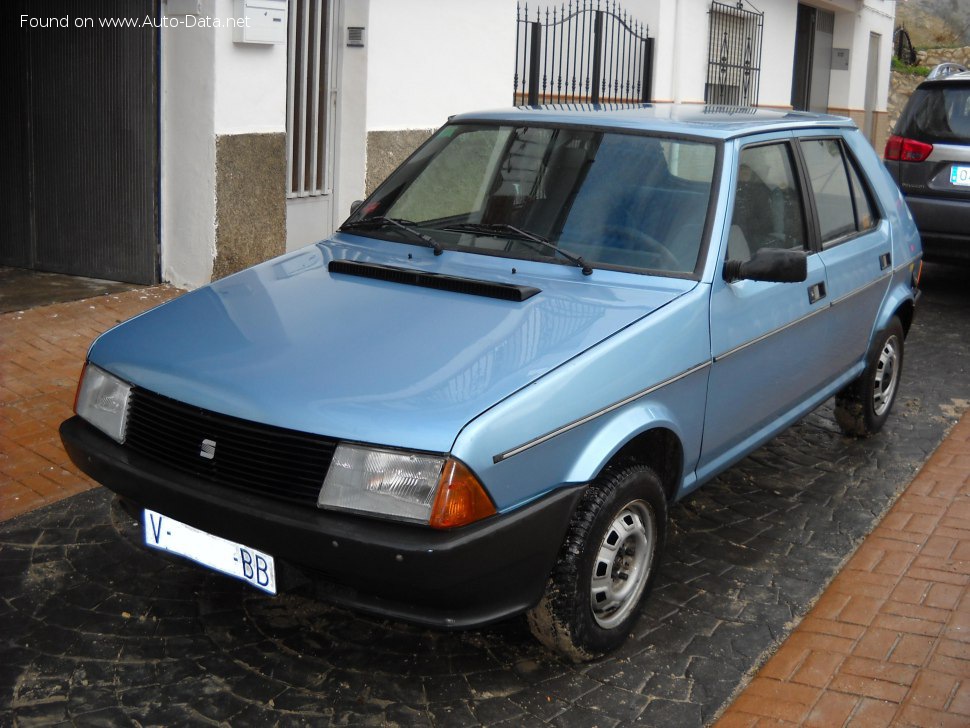
The SEAT Ronda, produced between 1982 and 1986, was a small family car designed and built by the Spanish automobile manufacturer SEAT, which was then part of the Volkswagen Group. Positioned as a competitor to vehicles like the Renault 9 and Peugeot 205, the Ronda was primarily a European market vehicle and was not officially sold in the United States. It represented SEAT’s attempt to modernize its lineup and offer a more contemporary vehicle to its domestic and export customers. The Ronda was based on the Volkswagen Polo Mk2 platform, sharing many mechanical components, but featuring distinct styling and a focus on affordability. This article details the 1.7 Diesel (56 Hp) variant, designated as the 022A, focusing on its technical specifications and place within the broader automotive landscape.
SEAT Ronda (022A) 1.7 Diesel: Overview and Market Position
The Ronda was significant for SEAT as it was one of the first models developed after increased collaboration with Volkswagen. While SEAT maintained its own design language, the underlying engineering benefited from Volkswagen’s expertise. The 1.7 Diesel version, introduced in 1983, was aimed at buyers seeking fuel efficiency and low running costs – a particularly important consideration in Europe during that period. It offered a practical and economical transportation solution, appealing to families and individuals alike. The Ronda, while not a performance car, provided a reliable and functional option in a competitive segment.
Engine & Performance
The heart of the Ronda 1.7 Diesel (022A) is a 1.7-liter inline four-cylinder diesel engine. This naturally aspirated engine produces 56 horsepower at 4500 rpm and 98 Nm (72.28 lb.-ft.) of torque at 3000 rpm. While the power output is modest by modern standards, the diesel engine’s torque characteristics provided reasonable drivability. The engine utilizes a precombustion chamber injection system, a common technology for diesel engines of the era, and features a compression ratio of 20:1. Power per liter is rated at 32.7 Hp/l. The engine is transversely mounted at the front of the vehicle, driving the front wheels. Acceleration from 0 to 100 km/h (0-62 mph) takes 21.5 seconds, and 0 to 60 mph is achieved in approximately 20.4 seconds. The top speed is 144 km/h (89.48 mph). The weight-to-power ratio is 17.3 kg/Hp, and the weight-to-torque ratio is 9.9 kg/Nm. Fuel economy is a strong point, with urban consumption at 8.3 l/100 km (28.3 US mpg), and extra-urban consumption at 5 l/100 km (47 US mpg).
Design & Features
The SEAT Ronda is a five-door hatchback, offering a practical body style for family use. It seats five passengers and provides a usable cargo space. The exterior design, while somewhat boxy by contemporary standards, was considered modern for its time. The Ronda’s interior was functional and focused on practicality rather than luxury. Key features included a five-speed manual transmission, hydraulic steering, and front disc brakes paired with rear drum brakes. The suspension system consists of an independent McPherson strut setup at the front and an independent coil spring arrangement at the rear, providing a reasonable level of ride comfort. Trunk space ranges from a minimum of 370 liters (13.07 cu. ft.) to a maximum of 1250 liters (44.14 cu. ft.) with the rear seats folded down. Safety features were relatively basic for the early 1980s, reflecting the standards of the time. The Ronda’s design prioritized affordability and functionality over advanced features.
Technical Specifications
| Brand | Seat |
| Model | Ronda |
| Generation | Ronda (022A) |
| Type (Engine) | 1.7 Diesel (56 Hp) |
| Start of production | August, 1983 |
| End of production | September, 1985 |
| Powertrain Architecture | Internal Combustion engine |
| Body type | Hatchback |
| Seats | 5 |
| Doors | 5 |
| Fuel consumption (urban) | 8.3 l/100 km (28.3 US mpg) |
| Fuel consumption (extra urban) | 5 l/100 km (47 US mpg) |
| Fuel Type | Diesel |
| Acceleration 0 – 100 km/h | 21.5 sec |
| Acceleration 0 – 62 mph | 21.5 sec |
| Acceleration 0 – 60 mph | 20.4 sec |
| Maximum speed | 144 km/h (89.48 mph) |
| Weight-to-power ratio | 17.3 kg/Hp |
| Weight-to-torque ratio | 9.9 kg/Nm |
| Power | 56 Hp @ 4500 rpm |
| Power per litre | 32.7 Hp/l |
| Torque | 98 Nm @ 3000 rpm (72.28 lb.-ft. @ 3000 rpm) |
| Engine layout | Front, Transverse |
| Engine displacement | 1714 cm3 (104.59 cu. in.) |
| Number of cylinders | 4 |
| Engine configuration | Inline |
| Compression ratio | 20:1 |
| Number of valves per cylinder | 2 |
| Fuel injection system | Precombustion chamber injection |
| Engine aspiration | Naturally aspirated engine |
| Valvetrain | SOHC |
| Kerb Weight | 971 kg (2140.69 lbs.) |
| Max. weight | 1450 kg (3196.7 lbs.) |
| Max load | 479 kg (1056.01 lbs.) |
| Trunk (boot) space – minimum | 370 l (13.07 cu. ft.) |
| Trunk (boot) space – maximum | 1250 l (44.14 cu. ft.) |
| Fuel tank capacity | 46 l (12.15 US gal | 10.12 UK gal) |
| Length | 4011 mm (157.91 in.) |
| Width | 1650 mm (64.96 in.) |
| Height | 1400 mm (55.12 in.) |
| Wheelbase | 2448 mm (96.38 in.) |
| Minimum turning circle | 9.4 m (30.84 ft.) |
| Drivetrain Architecture | Front wheel drive |
| Number of gears and type of gearbox | 5 gears, manual transmission |
| Front suspension | Independent type McPherson |
| Rear suspension | Independent coil spring |
| Front brakes | Disc |
| Rear brakes | Drum |
| Steering type | Steering rack and pinion |
| Power steering | Hydraulic Steering |
The SEAT Ronda, particularly the 1.7 Diesel variant, represents a significant chapter in SEAT’s history, demonstrating the company’s ability to adapt and compete in the European automotive market. While not a groundbreaking vehicle, it provided a practical, affordable, and fuel-efficient option for buyers seeking a reliable family car during the 1980s.
