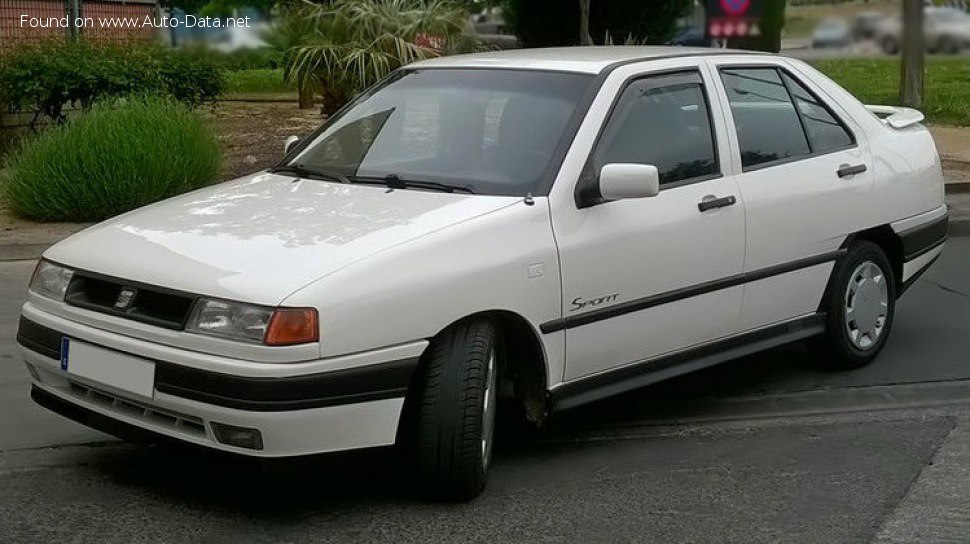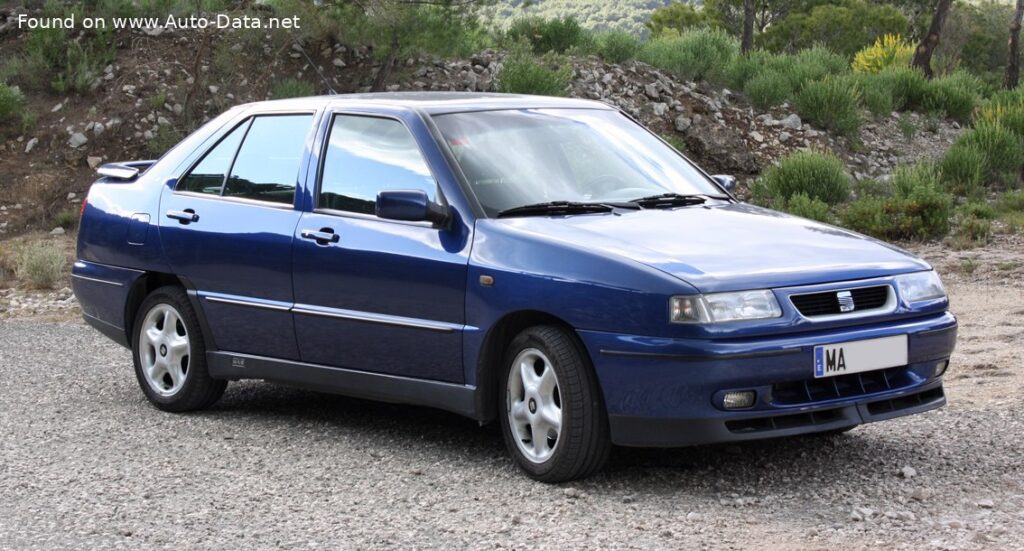
The SEAT Toledo I (1L), particularly the facelifted version introduced in 1995, represents a significant step in the Spanish automaker’s ambition to produce modern, competitive vehicles. Launched in 1991, the Toledo was SEAT’s first entirely self-designed car after decades under the control of Fiat. This initial Toledo, and subsequent iterations like the 1.6i Automatic produced from 1996-1999, aimed to provide a practical and stylish alternative in the compact sedan segment, primarily targeting the European market. While not officially sold in the United States, understanding the Toledo I provides insight into SEAT’s development as a brand and its contribution to the broader automotive landscape.
The SEAT Toledo I (1L) and its Market Position
The Toledo I was conceived as a replacement for the aging SEAT Malaga and Marbella, offering a more contemporary design and improved features. It was based on the platform of the first-generation Volkswagen Golf, benefiting from German engineering while incorporating SEAT’s own styling and design philosophy. The 1995 facelift brought subtle but important changes to the exterior, including revised headlights and bumpers, enhancing its aesthetic appeal. The Toledo I competed with vehicles like the Ford Escort, Opel Astra, and Renault 19, offering a blend of affordability, practicality, and a touch of Spanish flair. Its position in the European market was as a mainstream, family-oriented sedan, appealing to buyers seeking a reliable and reasonably priced vehicle.
Engine & Performance
The 1.6 i variant of the Toledo I (1L) featured a 1.6-liter inline four-cylinder gasoline engine, producing 101 horsepower at 5600 rpm and 145 Nm (106.95 lb-ft) of torque at 3800 rpm. This engine, designated as the AFT model, was a naturally aspirated unit employing multi-port fuel injection. Paired with a four-speed automatic transmission, the Toledo 1.6 i offered a comfortable, albeit not particularly sporty, driving experience. Acceleration from 0 to 100 km/h (0-62 mph) took approximately 13.5 seconds, while reaching 0 to 60 mph required 12.8 seconds. The top speed was recorded at 184 km/h (114.33 mph). The engine’s power-to-weight ratio was 11.4 kg/Hp, and its torque-to-weight ratio was 8 kg/Nm. Fuel economy was rated at 12.5 l/100 km (18.8 US mpg) in urban conditions and 6.7 l/100 km (35.1 US mpg) on the open road.
Design & Features
The SEAT Toledo I (1L) was a four-door, five-seater sedan with a traditional notchback design. The facelifted model featured a more streamlined front end and updated rear styling. The interior was functional and relatively spacious for its class, offering comfortable seating and a decent level of equipment. Standard features typically included power steering, central locking, and electric windows. The inclusion of an Anti-lock Braking System (ABS) was a notable safety feature for the time. The trunk offered a generous 550 liters of space, expandable to 1360 liters with the rear seats folded down, providing ample room for luggage and cargo. The vehicle’s dimensions were 4321 mm (170.12 in) in length, 1662 mm (65.43 in) in width, and 1424 mm (56.06 in) in height. The wheelbase measured 2471 mm (97.28 in).
Technical Specifications
| Brand | Seat |
| Model | Toledo |
| Generation | Toledo I (1L, facelift 1995) |
| Type (Engine) | 1.6 i (101 Hp) Automatic |
| Start of production | September, 1996 |
| End of production | March, 1999 |
| Powertrain Architecture | Internal Combustion engine |
| Body type | Sedan |
| Seats | 5 |
| Doors | 4 |
| Fuel consumption (urban) | 12.5 l/100 km (18.8 US mpg) |
| Fuel consumption (extra urban) | 6.7 l/100 km (35.1 US mpg) |
| Fuel Type | Petrol (Gasoline) |
| Acceleration 0 – 100 km/h | 13.5 sec |
| Acceleration 0 – 62 mph | 13.5 sec |
| Acceleration 0 – 60 mph | 12.8 sec |
| Maximum speed | 184 km/h (114.33 mph) |
| Weight-to-power ratio | 11.4 kg/Hp |
| Weight-to-torque ratio | 8 kg/Nm |
| Power | 101 Hp @ 5600 rpm |
| Torque | 145 Nm @ 3800 rpm (106.95 lb.-ft. @ 3800 rpm) |
| Engine layout | Front, Transverse |
| Engine Model/Code | AFT |
| Engine displacement | 1595 cm3 (97.33 cu. in.) |
| Number of cylinders | 4 |
| Engine configuration | Inline |
| Cylinder Bore | 81 mm (3.19 in.) |
| Piston Stroke | 77.4 mm (3.05 in.) |
| Compression ratio | 10.2:1 |
| Number of valves per cylinder | 2 |
| Fuel injection system | Multi-port manifold injection |
| Engine aspiration | Naturally aspirated engine |
| Valvetrain | OHC |
| Engine oil capacity | 3.5 l (3.7 US qt | 3.08 UK qt) |
| Coolant | 5.5 l (5.81 US qt | 4.84 UK qt) |
| Kerb Weight | 1155 kg (2546.34 lbs.) |
| Max. weight | 1680 kg (3703.77 lbs.) |
| Max load | 525 kg (1157.43 lbs.) |
| Trunk (boot) space – minimum | 550 l (19.42 cu. ft.) |
| Trunk (boot) space – maximum | 1360 l (48.03 cu. ft.) |
| Fuel tank capacity | 55 l (14.53 US gal | 12.1 UK gal) |
| Length | 4321 mm (170.12 in.) |
| Width | 1662 mm (65.43 in.) |
| Height | 1424 mm (56.06 in.) |
| Wheelbase | 2471 mm (97.28 in.) |
| Front track | 1429 mm (56.26 in.) |
| Rear (Back) track | 1422 mm (55.98 in.) |
| Drivetrain Architecture | Front wheel drive |
| Number of gears and type of gearbox | 4 gears, automatic transmission |
| Front suspension | Wishbone |
| Rear suspension | Coil spring |
| Front brakes | Ventilated discs |
| Rear brakes | Disc |
| Assisting systems | ABS (Anti-lock braking system) |
| Steering type | Steering rack and pinion |
| Power steering | Hydraulic Steering |
| Tires size | 195/65 R15 |
| Wheel rims size | 6.5J x 15 |
The SEAT Toledo I (1L) represents a pivotal moment in the company’s history, marking its transition towards independent design and manufacturing. While not a performance icon, the 1.6 i Automatic offered a practical and reliable transportation solution for European families, establishing SEAT as a viable competitor in the mainstream automotive market.