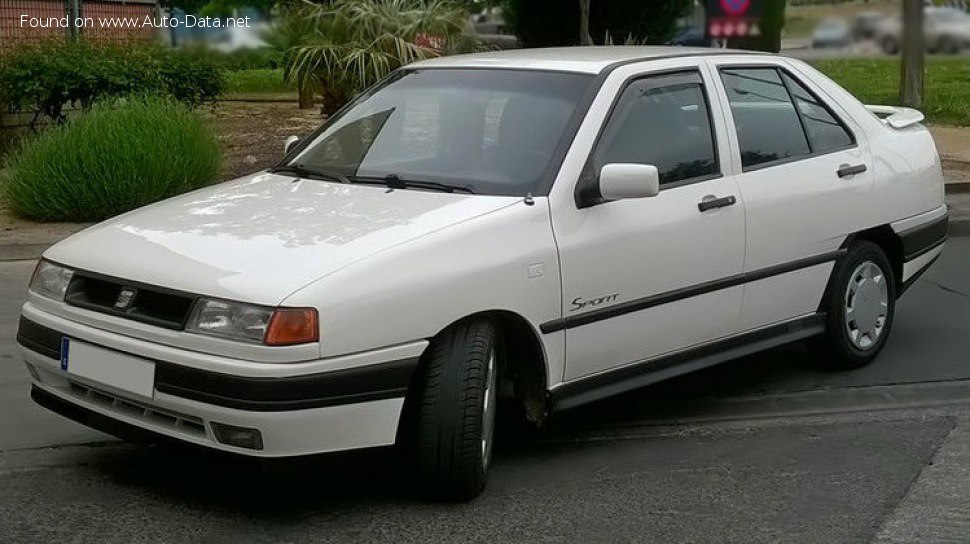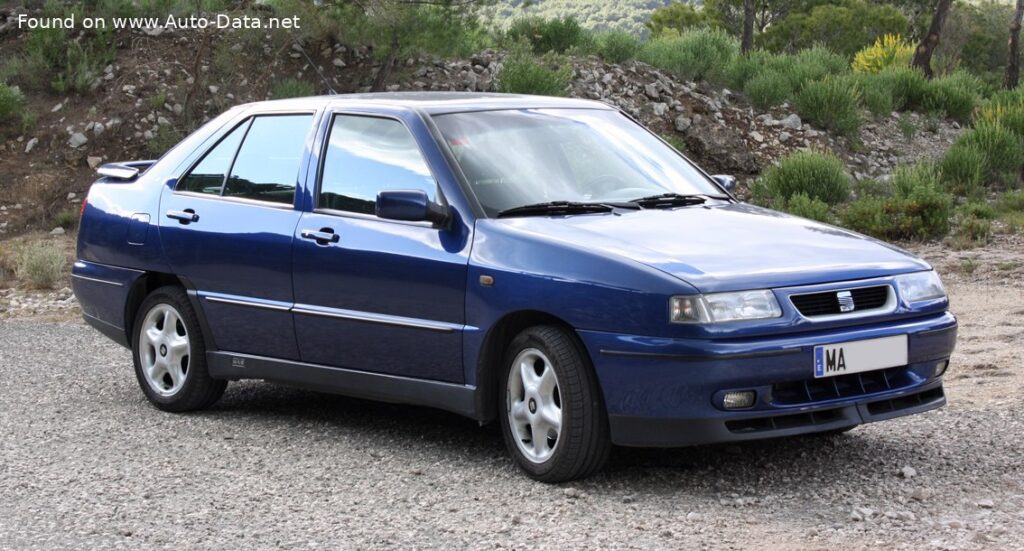
The SEAT Toledo I (1L), particularly the facelifted version introduced in 1995, represents a significant step in the Spanish automaker’s ambition to produce modern, competitive vehicles. Launched in 1991, the Toledo was SEAT’s first entirely self-designed car after decades under the control of Fiat. This initial model, and subsequent iterations like the 1.6 MPi version produced from 1996 to 1999, aimed to provide European buyers with an affordable, practical, and stylish sedan. While not officially sold in the United States, the Toledo was a popular choice in Europe, particularly in markets where compact sedans were favored. It served as a crucial model for SEAT, establishing the brand’s identity and paving the way for future successes.
SEAT Toledo I (1L, Facelift 1995) 1.6 MPi: An Overview
The 1996-1999 SEAT Toledo I (1L) 1.6 MPi is a four-door, five-seater sedan powered by a 1.6-liter inline-four engine. This facelifted version of the original Toledo incorporated styling updates and refinements to enhance its appeal. Positioned within the compact sedan segment, it competed with vehicles like the Volkswagen Jetta, Ford Escort, and Opel Astra. The Toledo distinguished itself with its relatively spacious interior and practical trunk capacity, making it a suitable choice for families and individuals seeking a versatile vehicle. The 1.6 MPi engine, producing 100 horsepower, offered a balance between fuel efficiency and adequate performance for everyday driving.
Engine & Performance
The heart of the 1996-1999 SEAT Toledo 1.6 MPi is a 1.6-liter (1595 cm3 or 97.33 cu. in.) inline-four cylinder gasoline engine, designated the AFT engine code. This naturally aspirated engine utilizes multi-port fuel injection and a double overhead camshaft (DOHC) valvetrain with two valves per cylinder. It generates a maximum power output of 100 horsepower (74.6 kW) at 5700 rpm, and a torque of 148 Nm (109.16 lb.-ft.) at 4500 rpm. This translates to a power-to-liter ratio of 62.7 hp/l. The engine’s front, transverse layout contributes to efficient packaging within the vehicle’s chassis.
Performance figures indicate a 0-100 km/h (0-62 mph) acceleration time of 11.3 seconds, and a 0-60 mph time of approximately 10.7 seconds. The Toledo 1.6 MPi achieves a top speed of 188 km/h (116.82 mph). The weight-to-power ratio is 10.8 kg/Hp, while the weight-to-torque ratio is 7.3 kg/Nm. Fuel consumption is rated at 10.8 l/100 km (21.8 US mpg) in urban driving and 6.1 l/100 km (38.6 US mpg) in extra-urban conditions. The vehicle features a five-speed manual transmission, delivering power to the front wheels.
Design & Features
The SEAT Toledo I (1L) facelift retained the original model’s distinctive sedan body style, characterized by a relatively long wheelbase and a sloping rear roofline. The 1995 facelift brought subtle revisions to the front and rear fascias, including updated headlights and taillights, and a revised grille. The interior offered seating for five passengers and a practical trunk space ranging from 550 liters (19.42 cu. ft.) with the rear seats up to 1360 liters (48.03 cu. ft.) with the rear seats folded down.
In terms of features, the Toledo 1.6 MPi included hydraulic power steering and an Anti-lock Braking System (ABS) as standard equipment, enhancing both driver comfort and safety. The suspension system comprised a wishbone setup at the front and a coil spring arrangement at the rear, providing a balance between ride comfort and handling. The vehicle rode on 185/60 R14 tires. While not boasting the advanced technological features of modern vehicles, the Toledo offered a solid level of equipment for its time and price point, focusing on practicality and reliability.
Technical Specifications
| Brand | Seat |
| Model | Toledo |
| Generation | Toledo I (1L, facelift 1995) |
| Type (Engine) | 1.6 MPi (100 Hp) |
| Start of production | September, 1996 |
| End of production | March, 1999 |
| Powertrain Architecture | Internal Combustion engine |
| Body type | Sedan |
| Seats | 5 |
| Doors | 4 |
| Fuel consumption (urban) | 10.8 l/100 km (21.8 US mpg) |
| Fuel consumption (extra urban) | 6.1 l/100 km (38.6 US mpg) |
| Fuel Type | Petrol (Gasoline) |
| Acceleration 0 – 100 km/h | 11.3 sec |
| Acceleration 0 – 62 mph | 11.3 sec |
| Acceleration 0 – 60 mph | 10.7 sec |
| Maximum speed | 188 km/h (116.82 mph) |
| Weight-to-power ratio | 10.8 kg/Hp |
| Weight-to-torque ratio | 7.3 kg/Nm |
| Power | 100 Hp @ 5700 rpm |
| Torque | 148 Nm @ 4500 rpm (109.16 lb.-ft. @ 4500 rpm) |
| Engine layout | Front, Transverse |
| Engine Model/Code | AFT |
| Engine displacement | 1595 cm3 (97.33 cu. in.) |
| Number of cylinders | 4 |
| Engine configuration | Inline |
| Cylinder Bore | 76.5 mm (3.01 in.) |
| Piston Stroke | 86.9 mm (3.42 in.) |
| Compression ratio | 11.5:1 |
| Number of valves per cylinder | 2 |
| Fuel injection system | Multi-port manifold injection |
| Engine aspiration | Naturally aspirated |
| Engine oil capacity | 3.5 l (3.7 US qt | 3.08 UK qt) |
| Coolant capacity | 5.5 l (5.81 US qt | 4.84 UK qt) |
| Kerb Weight | 1080 kg (2380.99 lbs.) |
| Max. weight | 1580 kg (3483.3 lbs.) |
| Max load | 500 kg (1102.31 lbs.) |
| Trunk (boot) space – minimum | 550 l (19.42 cu. ft.) |
| Trunk (boot) space – maximum | 1360 l (48.03 cu. ft.) |
| Fuel tank capacity | 55 l (14.53 US gal | 12.1 UK gal) |
| Length | 4321 mm (170.12 in.) |
| Width | 1662 mm (65.43 in.) |
| Height | 1424 mm (56.06 in.) |
| Wheelbase | 2471 mm (97.28 in.) |
| Front track | 1429 mm (56.26 in.) |
| Rear track | 1422 mm (55.98 in.) |
| Drivetrain | Front wheel drive |
| Number of gears | 5 gears, manual transmission |
| Front suspension | Wishbone |
| Rear suspension | Coil spring |
| Front brakes | Disc |
| Rear brakes | Disc |
| Assisting systems | ABS (Anti-lock braking system) |
| Steering type | Steering rack and pinion |
| Power steering | Hydraulic |
| Tires size | 185/60 R14 |